Posts

Not-so-polar vortex will make disruptive return next week

Wait! Don’t go digging into your closet to find your winter jacket in that bin of winter clothes just yet. The Polar Vortex may “technically” be returning next week — but it isn’t so “polar” in air quality, and it may not be by other definitions as well. So is it really a Polar Vortex at all? The meteorological community is up in arms today over the usage of the term — and the end result is, of course, leading to varying opinions and arguments. The cause of the argument itself is the modeled approach of a massive upper level troughing system, which will feature much below normal temperatures both aloft and at the surface. The track, size and orientation of the system bear many resemblances to the Polar Vortex which tracked through the Great Lakes this past January.

Still, the time of year makes the sensible weather results quite different. Temperatures which are 10-20 degrees below normal (or more in some locations) won’t quite drop the thermometer near the freezing mark. But, still, things could get quite cool over the Great Lakes and Ohio Valley. Some meteorologists prefer to call the incoming system a Polar Vortex, others don’t. But the bottom line has to do more with meteorology than terminology — and the sensible weather effects are becoming more clear as we move closer. Figure 1 shows temperature anomalies at 850mb as forecast by the GFS next week. Notice the broad area of well below normal temperatures as a result of the large upper level troughing system with cold air moving south from Canada.
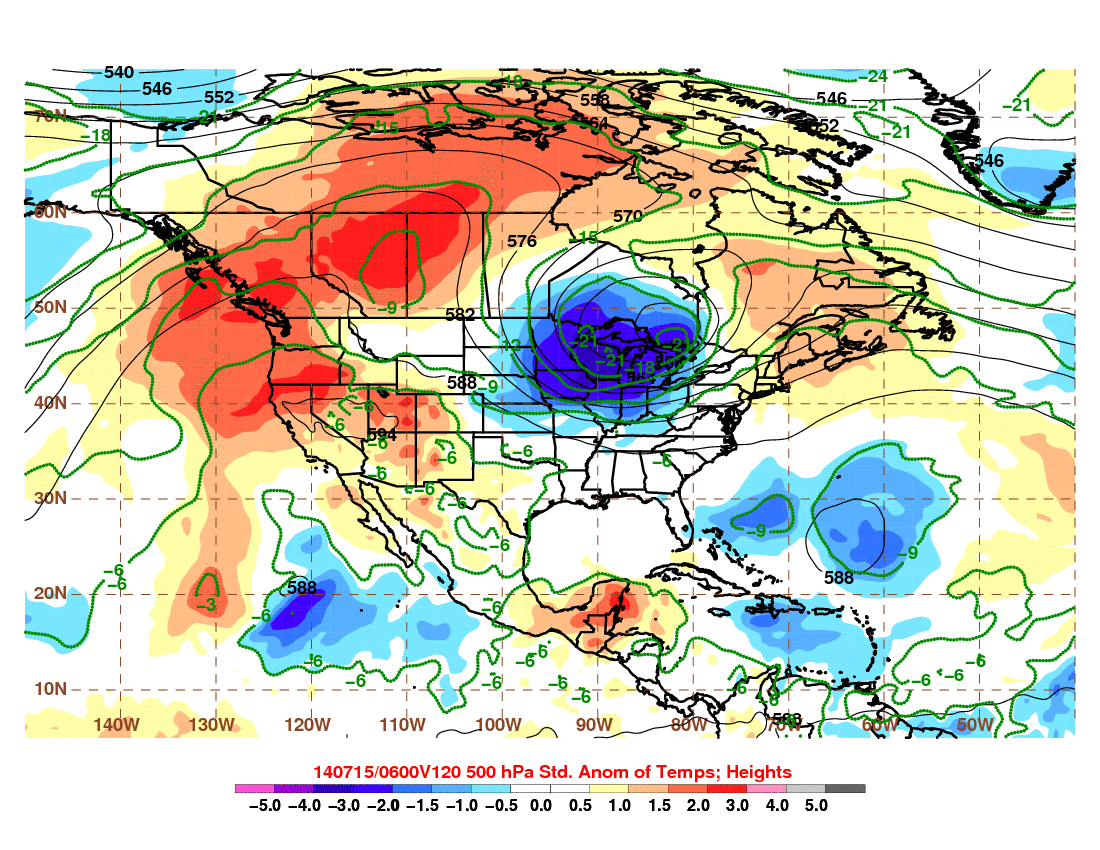
Fig 1. (Atmos Albany)
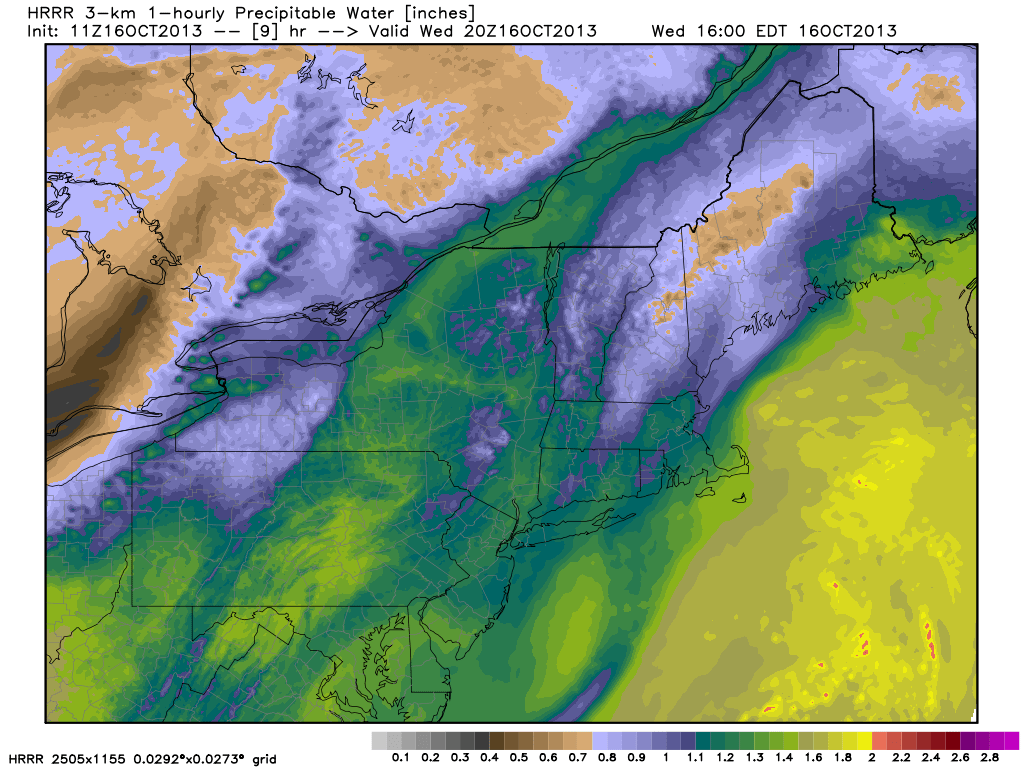
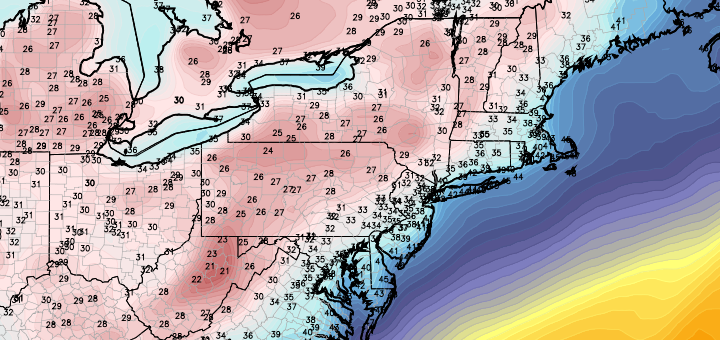
Fig 1. (Atmos Albany)

Read more

Cloudy, drizzly and unsettled through weeks end

The combination of a weak coastal system, meandering off the Mid Atlantic coast, and multiple mid level disturbances moving through the Northeast US will result in generally unpleasant weather from Wednesday through the end of the week. The coastal system is weak but brings moisture and an onshore flow, as the decaying mid level vorticity slowly retrogrades towards the coast on Wednesday. Low clouds and drizzle are possible, despite the lack of any steady rain, especially near the coasts.

Mid level disturbances shifting northeast from the Mississippi and Ohio Valleys through the Great Lakes and Northeast will bring more unsettled weather through the end of the week — signaling the beginnings of a more active pattern. The weekend is expected to feature improving conditions once the frontal system eventually moves off the coast.

High resolution models showing increasing Precipitable Water values by later Wednesday evening.

High resolution models showing increasing Precipitable Water values by later Wednesday evening.

Read more

Forecast: Pleasant work week ahead

Although it may still technically be summer on the calendar, meteorological seasons seem to be the better indicator of sensible weather so far this week — especially this morning as low temperatures fell into the 40’s and 50’s with some upper 30’s in the northwest suburbs. The cool temperatures are occurring as a result of a cold front, which passed through last night and ushered in a cool (but progressive) airmass from Canada. These airmasses typically become increasingly common as the autumn goes on, but don’t stick around for too long early in the season. This year will be no different, as the week will feature pleasant weather but moderating temperatures.
Read more

Potential for Late Season Freeze

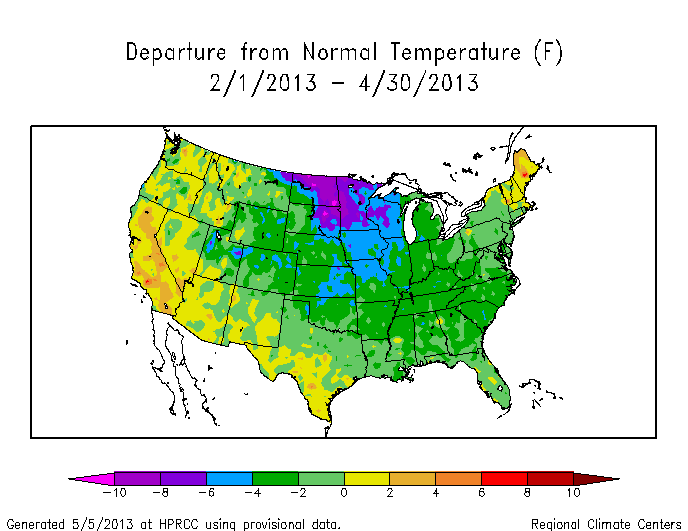
One of the coldest springs in recent history nationwide continues to roll forward with the potential for one more shot of winter across the Mid-west and Northeast. Since February 1st, we have seen a dramatic reversal in temperature anomalies from the blowtorch Dec-Jan period to the very cold Feb-Mar-April of 2013. The only mild areas have been northeastern New England and the SW US – all other locations have been feeling the chill. The epicenter of this cold has been the Mid-west and northern Plains, where many stations experienced over a 20 degree decrease in mean temperature from March 2012 to March 2013:

Last3mTDeptUS

[column size=”one-fourth”]

Chicago  IL:    -27.7º

2012: 64.0º

2013: 36.3º

[/column]
[column size=”one-fourth”]

Des Moines IA: -26.0º

2012: 64.4º

2013: 38.4º

[/column]
[column size=”one-fourth”]

Indianapolis IN: -25.3º

2012: 66.5º

2013: 41.2º

[/column]
[column size=”one-fourth” last=”true”]

La Crosse WI: -27.5º

2012: 59.4º

2013: 31.9º

[/column]


[column size=”one-fourth”]

Marquette MI: -24.3º

2012: 50.6º

2013: 26.3º

[/column]
[column size=”one-fourth”]

Milwaukee WI: -26.3º

2012: 59.1º

2013: 32.8º

[/column]
[column size=”one-fourth”]

Minneapolis MN: -25.2º

2012: 56.3º

2013: 31.1º

[/column]
[column size=”one-fourth” last=”true”]

St. Louis MO: -22.1º

2012: 70.4º

2013: 48.3º

[/column]


The month of May began with similar magnitude of cold in the same areas that have been targeted over recent months. Brutal, recording breaking cold encompassed the Plains, with the historic event of snow flakes flying as far south as Arkansas. The coastal Northeast has been near normal with a northeasterly flow off the Atlantic, but surface high pressure made the airmass a beautiful, dry, sunny one for us. The interior Northeast and OH Valley have been much warmer the past week, though that will change for a time next week.

Read more