Posts

In Autumn, all eyes are on the North Pacific

With Autumn officially underway and the leaves starting to turn, many are beginning to wonder about the upcoming winter, and if the Autumn pattern will foreshadow it. Unfortunately, it is not as easy as “cold October yields cold winter” or “warm October yields warm Winter”. If that were the case, we’d have long range forecasting figured out by now, and there would be no need for winter outlooks. The best we have for now are correlations, analogs, physical pattern drivers, and pattern persistence. When added together, the summation of these various factors provide a higher probability of success in medium to long range forecasting, but these methods are far from perfect. The evolution of different atmospheric oscillations during the autumn season can give us a substantial clue as to the ensuing winter’s dominant index modalities.

In this particular case, let’s examine the autumn north pacific pattern of years since 1990, giving us a sample size of 22+ years. The North Pacific pattern is often represented as the East Pacific Oscillation (EPO). Like the North Atlantic Oscillation the EPO has certain, generally predictable outcomes when it oscillates from positive to negative phases. The positive phase of the EPO is usually associated with lower than normal heights across the northeastern Pacific, much of Alaska, and northwestern Canada. Conversely, the negative phase of the EPO generally produces higher than normal heights over the region just described. The positive (+EPO) tends to flood the United States with maritime pacific air due to the low pressure around Alaska, while the negative (-EPO) acts as a block to maritime pacific air due to high pressure over the NE Pacific/Alaska. The -EPO often sets up a cross polar flow with high pressure centered over Alaska and the flow oriented across the north pole from Siberia into Canada. The -EPO pattern has yielded some of most impressive, severe arctic outbreaks on record.

Read more

Transient warmup expected this weekend

After a frontal passage which brought the return of arctic air earlier this week, temperatures plummeted and winds picked up fairly dramatically leading to unpleasant conditions with much below normal temperatures. Highs in the 20’s and 30’s have been common for the past few days, with wind chill values below that and the air feeling more like it typically would in mid January as opposed to mid March. The warmup which we experienced this past weekend has become a distant memory of sorts.

This weekend, luckily, will feature another warmup however brief it may be. Temperatures on Friday will rebound underneath increasing temperatures aloft and plenty of sun. And while a potential winter storm looms early next week, the moderation will continue into Saturday as high temperatures will move into the 50’s. The changing sun angle will make it feel refreshingly warm — but the warmup will be short lived.

NAM model showing highs in the 50's on Saturday just behind a cold front. Notice the winds picking up out of the west, ushering in a colder airmass for late this weekend.

NAM model showing highs in the 50’s on Saturday just behind a cold front. Notice the winds picking up out of the west, ushering in a colder airmass for late this weekend.

Read more

Ending the developing misconceptions regarding the Polar Vortex

It has been a media frenzy. Since January, when a piece of the Polar Vortex made its dramatic trip through the Central and Eastern United States, the misconceptions regarding its origins and actual definition have continued. Whether made in a joking manner or not, some of the ideas regarding the Polar Vortex’s actual characteristics have created a bit of an issue for meteorologists. When using it to describe the pattern, we now have to keep in mind the potential media impacts. To be frank: That is not the way it should be.

The Polar Vortex, in our hemisphere, is a persistent cyclone which is located near the North Pole. It features a counter-clockwise rotating pool of cold, dense air — some of the coldest on the globe, in fact. The vortex moves around to a certain extent, but generally remains in the vicinity of the poles. What separates and moves southward (sometimes towards our area) in anomalous patterns, are pieces of the Polar Vortex which feature characteristics of the vortex itself and similar air masses.

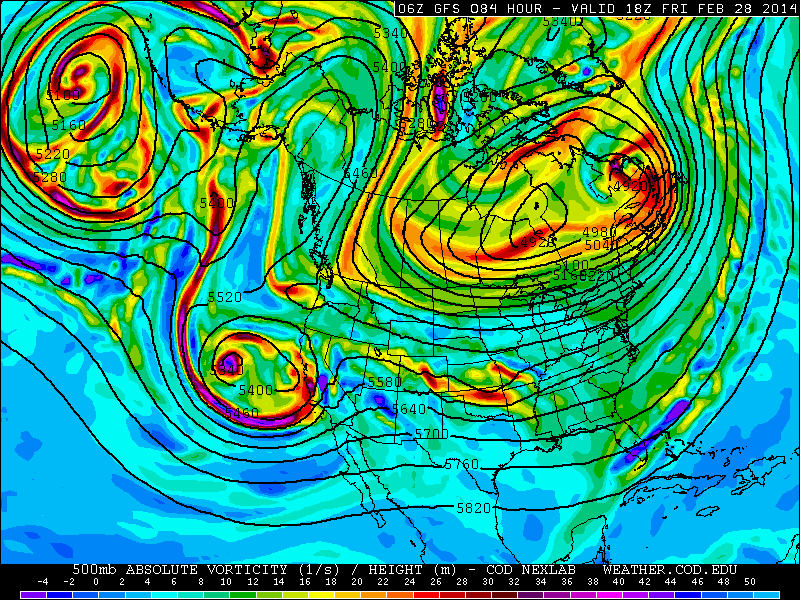
A significant piece of the Polar Vortex is forecast to drop into Southeast Canada later this week. Here, the GFS model forecasts its position at 500mb at 84 hours.

A significant piece of the Polar Vortex is forecast to drop into Southeast Canada later this week. Here, the GFS model forecasts its position at 500mb at 84 hours.

Read more

Colder, more wintry weather set to return

It was a wonderful Saturday. High temperatures in the 50’s, plenty of sun and no precipitation to speak of. The first “winner” of a day in several weeks, in fact. The unfortunate news is that it won’t last long, and in fact the weather from Saturday will become a distant memory by the middle of the upcoming work week. The winter pattern, which dominated for the last month or two, will return — and remain relatively relentless.

Colder temperatures will begin filtering into the area by Sunday, as a frontal boundary nears the area. All won’t be lost, still, as high temperatures will reach back into the 40’s and 50’s just ahead of the front. But as the front nears, temperatures will begin to drop — and winds turn to a much cooler direction. By late Sunday Night into Monday, forecast models are in agreement that light precipitation will begin to develop just behind the cold front, beginning as rain and likely ending as snow in some locations away from the coast.

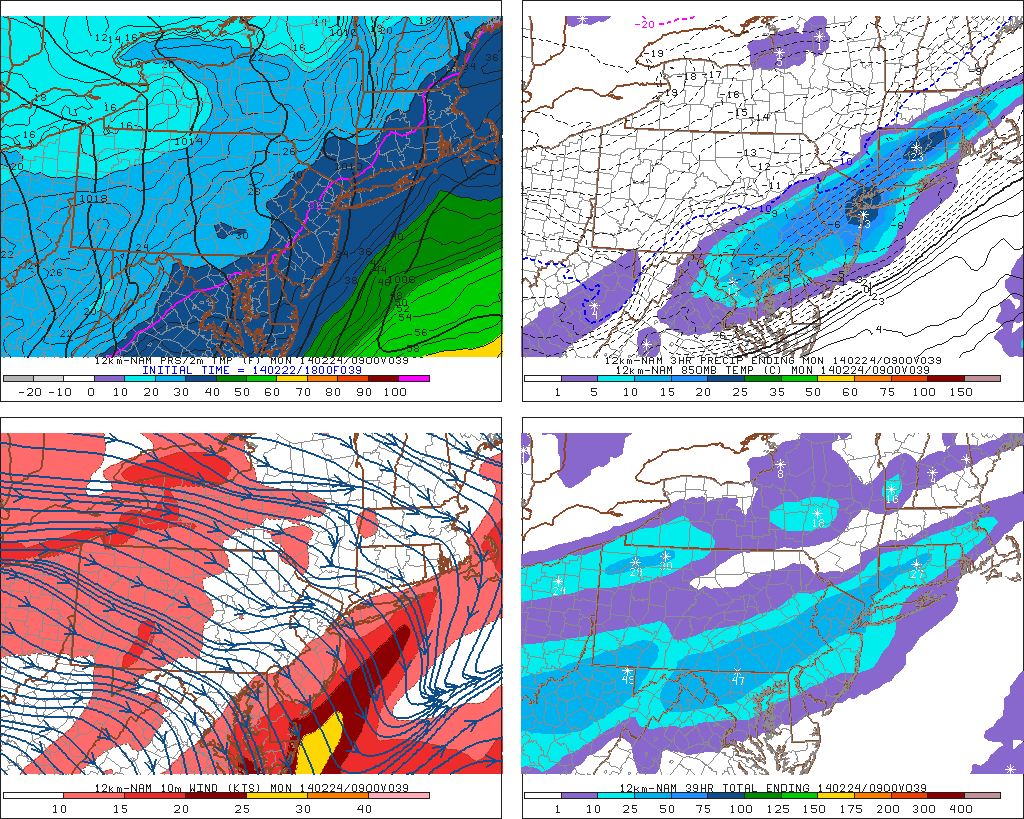
NAM model forecasting precipitation along a frontal boundary on Monday morning.

NAM model forecasting precipitation along a frontal boundary on Monday morning.

Read more