Posts

Prolonged period of wintry weather to start the week

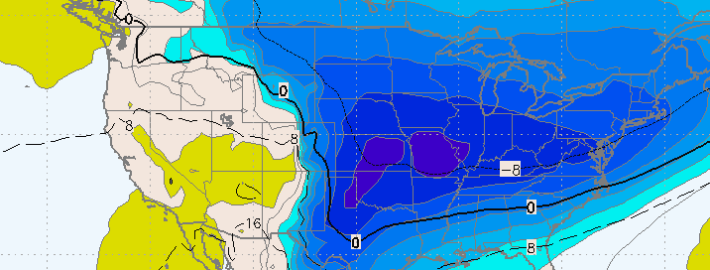
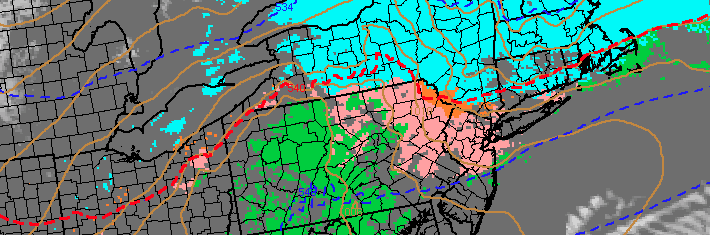
A winter storm affecting the Northeast United States will begin as early as Sunday throughout the area, as lift for precipitation develops along a baroclinic zone and thermal gradient near the area. The forecast in terms of precipitation type and amounts, however, is not as cut and dry as it may seem. The thermal gradient both at the surface and aloft will differ in location, creating widespread differences in precipitation type and a very sharp gradient in potential snowfall and winter weather impacts.

In the mid levels, warming will occur between 850-900mb (above our heads, but not very far up in the atmosphere). This warm layer will push northward to a position near New York City on Monday. What this means, is that any snowflake which forms farther up in the atmosphere will fall through a layer of air that is above freezing. Essentially, it will melt. But our problems don’t stop there — the surface layer of the atmosphere (where we are) is very cold. And that means any precipitation which falls as liquid is going to re-freeze on the surface.

Read more

Multiple winter weather threats to begin February

On the heels of two (arguably three) major winter weather events in the Northeast United States, many are wondering just when the pattern will slow down. The answer: Not soon. Medium and long range forecast models are in good agreement that  an active pattern will continue in the foreseeable future as the Pacific Jet continues to send multiple disturbances into the United States. Fluctuating amplitude of both a ridge on the West Coast and high latitude blocking over the Arctic regions will keep things from getting downright snowy and cold for a prolonged period, but the potential for winter weather events for at least the first few weeks of February looks to be heightened.

The first threat will come as early as the tail end of this week — small, but nonetheless noteworthy as it comes on the heels of an arctic front. Short term forecast models are in agreement that a wave of low pressure will develop along this frontal boundary on Thursday, with moisture streaming north/northeastward along it. The best support for heavy precipitation will remain well offshore. But enough moisture looks to stream along the front within a coupled jet structure aloft to allow for steady precipitation to push eastward from Pennsylvania through New England and the Northern Mid Atlantic.

Read more

Changing pattern could lead to multiple storm threats

We warned you that this was coming. Now, the pattern change is finally beginning to appear on medium and long range model guidance from late December into January. Thanks in part to changes in the stratosphere and retrograding mid and upper level atmospheric features, the pattern over the next week or two will become much more favorable for not only colder than normal air, but winter weather in our area as well. Contrary to what it may seem, the pattern currently is quite unfavorable for cold air and winter weather. Warmer than normal air has settled in to Southern and Central Canada over the past week or so, muting any potential shots of cold air with northwesterly winds.

But the notable feature around the Northern Hemisphere will begin retrograding over the next several days. It begins with the troughiness over the Gulf of Alaska and ridging in the Eastern Pacific. Both of this features will progressively retrograde westward over the next 7-10 days. The end result will bring a mean trough to the Aleutian Islands and a ridge to the West Coast of the United States and British Columbia (also known as a +PNA). Further securing the changing pattern will be the development of a +EPO ridge in Western Canada and the potential for ridging to develop over Eastern Canada, Greenland and the Western Atlantic.

Read more

Wintry pattern change coming by late next week

For any readers who want to know more about any potential rain tonight, as well as the weather for Friday and the weekend, check out our latest forecast discussion. There may even be some scattered showers and isolated thunder with a cold pool aloft, as mid-level lapse rates will be near 7C/KM tomorrow afternoon.

While our area sits in low level moisture and clouds, former Super Typhoon Nuri has transitioned into an extratropical storm, but is forecast to fall to pressures below 920mb! This would be one of the strongest extratropical cyclones on record.

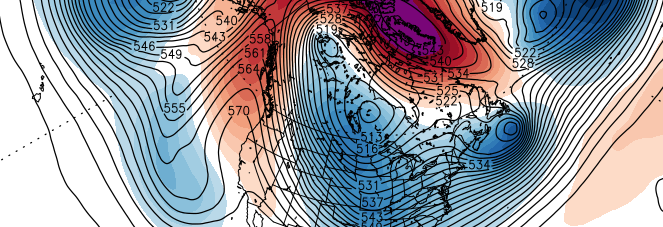
This extremely strong cyclone will help to release plenty of latent heat and energy towards the Poles, which will generate an anomalously strong ridge in Alaska and western Canada. In short, as the extratropical system becomes a behemoth both at the surface and aloft, the strong jet stream and digging trough in the mid and upper levels create an anomalous ridge to their east, pumping a ridge from the West Coast into British Columbia. This ridge will be so strong that it will also flow into the Arctic, tanking the Arctic Oscillation. This allows the Polar Vortex to be weakened and sent to the south on the downstream side of the ridge.

Accordingly, forecast models are in good agreement that the Polar Vortex will split into two, with a piece sagging southward toward Southern Canada during the middle to latter part of next week.

Read more