
Why next week’s storm will not affect our region

As Autumn has arrived, the jet stream tends to get a bit stronger and sag to the south, helping make nor’easters more likely. Some computer model guidance had been hinting at a strong coastal storm approaching the area early next week, which would bring strong winds, heavy rain, and coastal flooding. However, the pattern does not support such an occurrence.

Looking at last night’s European model ensembles at the 500mb level, there do appear to be some features that support the potential for a strong nor’easter to head towards our area. Initially, there is a kink in the heights at 500mb just offshore of the Eastern Seaboard, which indicates our storm system. With strong storms like Sandy, we had a blocking ridge near and to the north of the storm, forcing it to stay to offshore of the southeast coast, instead of shooting out to sea. We also had a trough diving into the Central Plains, heading eastward, eventually capturing the storm and bringing it to the west. At the basic level, those two features certainly exist, which raise an eyebrow.
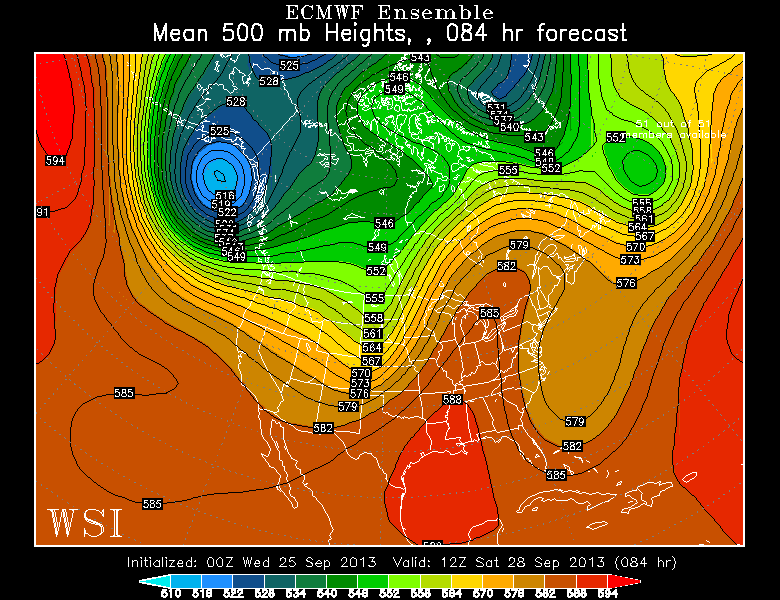
Last night's European model ensembles, valid for 8 a.m. Saturday morning. Image is courtesy of the WSI model lab.

Last night’s European model ensembles, valid for 8 a.m. Saturday morning. Image is courtesy of the WSI model lab.

However, taking a deeper look at things, it is not prudent to say that a storm will trek towards us. For one thing, although there is a strong ridge in the east, extending up through SE Canada and New Foundland, it is merely a function of being downstream of the trough, and is not a block. Blocking typically occurs in higher latitudes — such as Greenland — and the height contours are typically closed. The true blocks are very slow to move and act to buckle the weather pattern, rather than being within the “flow” of the pattern. Since the ridge is merely downstream of the trough — it is within the “flow” of the pattern, and there is nothing to keep this ridge in place. It is thus a transient feature, and will eventually scoot out to sea and weaken. In fact, looking the higher latitudes, the heights are actually very low up there; more evidence that there is no true blocking.

Read more

October blocking could hint at winter pattern

Autumn began just a few days ago, but the weather pattern has already adjusted to the fall-like pattern with temperatures falling into the 30’s and 40’s at night. The first cold nights of the year typically come in mid to late September, as the warm and humid days of summer fade. The cooler, more crisp air gives us the first small taste of the cold winter which is only a handful of weeks away. The pattern has begun its seasonal change, and we are beginning to feel the effects of it. Yet, the best hints of what the winter pattern may have in store for us may be hundreds and thousands of miles to our north — over the high latitude/arctic region.

Seasonal forecasting can be a tedious and intricate task for meteorologists. Many times, meteorologists and forecasters alike find themselves drawing upon past events, analogs, and other research for help with predicting the months ahead. This is especially true in the Autumn season, as winter forecasting begins. Meteorologists are about to enter a flurry of forecasting over the next few months (yes, we are somehow enjoying this benign and calm weather right now). So as we look forward to the winter, we can often use the preceding months as indicators of the pattern to come. The pattern itself can often tip its hand, giving us a clue as to what we may be dealing with a few months down the road.

The words “high latitude blocking” likely will instantly bring back memories of some of our stronger storms and more volatile weather patterns in recent memory. The Blizzard of 2010, Hurricane Sandy, the Nor’Easter just a few weeks afterward. They all occurred during episodes of high latitude blocking, with a negative NAO cor North Atlantic Oscillation (for a background and more information on the NAO, click here). Still, high latitude blocking episodes which occur months before these events can often serve as accurate predictors, foreshadowing in a sense, of the upcoming pattern a few months after. A few months ago, we published some research on the blocking pattern during the month of May helping to predict the pattern during the summer months.

For a bit of reference, high latitude blocking refers to blocking ridges which occur in the higher latitudes over Canada and the North Atlantic (background on atmospheric blocking can be found here). These ridges slow down the jet stream/weather pattern. The high latitude blocking over Greenland, the North Atlantic, or Canada during the winter months often leads to the displacement of very cold arctic air over the United States, very often the Northeast US. The more amplified/slower pattern also leads to the potential for large coastal storm systems and has historically featured snowier and colder periods in the Northeast US.

Read more

Forecast: Another stretch of awesome weather

There hasn’t been much to complain about lately, at least when it comes to the weather. In the last week, we have been fortunate enough to settle into a very pleasant pattern. Last week itself featured 5 straight pleasant days featuring low humidity and plenty of sun. After a brief return to humidity and a cold front with showers on Saturday into Sunday, the comfortable weather has returned again. In fact, this airmass is a bit more chilly — if you haven’t already noticed this morning. Temperatures fell into the 30’s in the interior this morning, and the upper 40’s even in the urban areas. The low of 47 was the coldest so far this season in New York City.

Read more

Pleasant weather, wet weekend, foliage update

The weather over the past several days has been astonishingly pleasant – with highs in the low to mid 70’s, abundant sunshine and low humidity. A Canadian high pressure, which settled into the area earlier this week, has modified a bit — but continues to provide benign weather and comfortable air. The low humidity and near-average highs for this time of the year are comfortable by nature. The deep blue skies will continue for another day on Thursday, with highs expected to reach into the middle to upper 70’s. A few clouds could sneak in on Friday, but the idea of calm weather and comfortable air will continue. Thursday Night will still be a bit brisk, with lows falling into the 50’s.


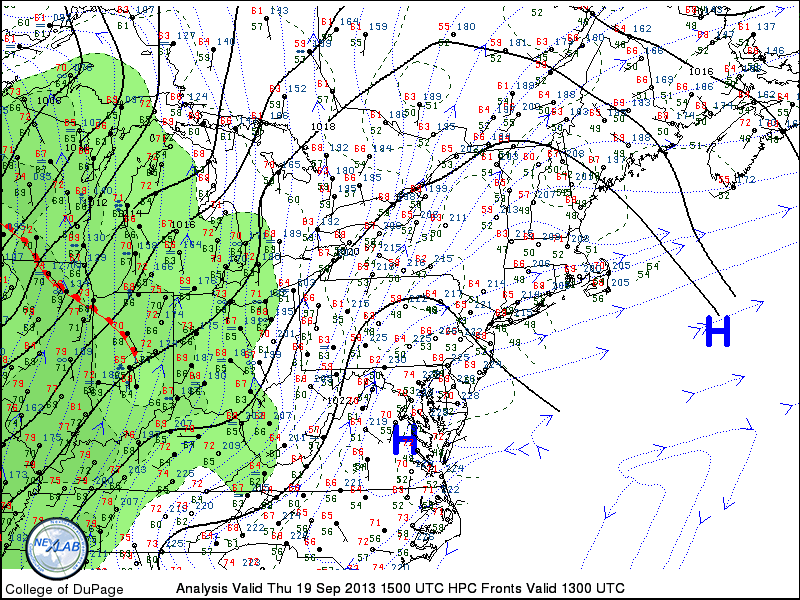
Surface analysis and observations from the morning of September 19th, 2013 in the Northeast US, showing a high pressure in control but beginning to weaken.

Surface analysis and observations from the morning of September 19th, 2013 in the Northeast US, showing a high pressure in control but beginning to weaken.

Read more