
Live Blog: Comet ISON’s biggest hour

Comet ISON reaches perihelion today around 1:40pm Eastern time, and the tension is building as it heads towards the sun. ISON is currently experiencing the most hostile conditions it will in its lifetime, with intense solar wind, incredible temperatures, and ridiculous speed as it rounds the sun. The comet brightened dramatically yesterday, and the brightness was saturating NASA’s SOHO LASCO satellite imagery. But today, the comet has faded as it approaches the sun. In fact, the newest reported attempts of photometric of the center of ISON suggest “there may be no active nucleus at all anymore”.

ISON will reach perihelion today, and we will know the fate of the comet shortly thereafter. If it survives its trip around the sun, it may put on quite a show as it comes around the other side of the sun..and may be visible from earth during the first and second weeks of December. If not, the comet may not emerge and will not be seen again. Our live blog will follow along with new images and information over the next hour. So stay right here!
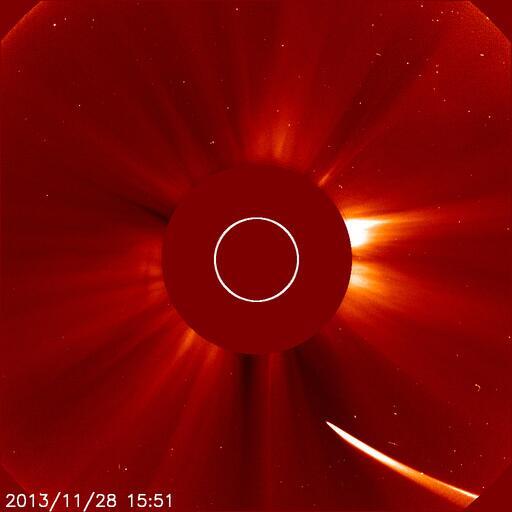
Comet ISON rounding towards the sun on November 28th, 2013.
Comet ISON rounding towards the sun on November 28th, 2013.
Read more

Complex storm system wraps up later today

A dynamic and complex storm system (not a nor’easter by definition despite the efforts of some to call it such) continued to menace the East Coast early on Wednesday, during one of the biggest travel days of the year. Significant delays were reported this morning at several area airports, owing to the strong winds and heavy rain. Through this afternoon, periods of heavy rain are expected to continue. The center of low pressure has moved north and east of the area into Southern New England, but lower pressures extending southward and a noticeable thermal boundary will serve as a “highway” for continuing rainfall.

With time, however, this boundary will shift eastward and the low pressure center will shift north/northeast. The most noticeable effect of this will be the temperature and wind shift. Warm temperatures from earlier this morning (60’s observed throughout much of New Jersey and even into New York City) will become a distant memory as westerly winds behind the aforementioned thermal boundary will usher in colder air. Temperatures are forecast to fall back into the 40’s by later today, and 20’s and 30’s overnight tonight. Snow showers cannot be ruled out by later this evening throughout the area in the wake of the strengthening low pressure center. The heaviest rain is expected to wrap up by mid-afternoon, but will linger into the evening across areas North and East of NYC.

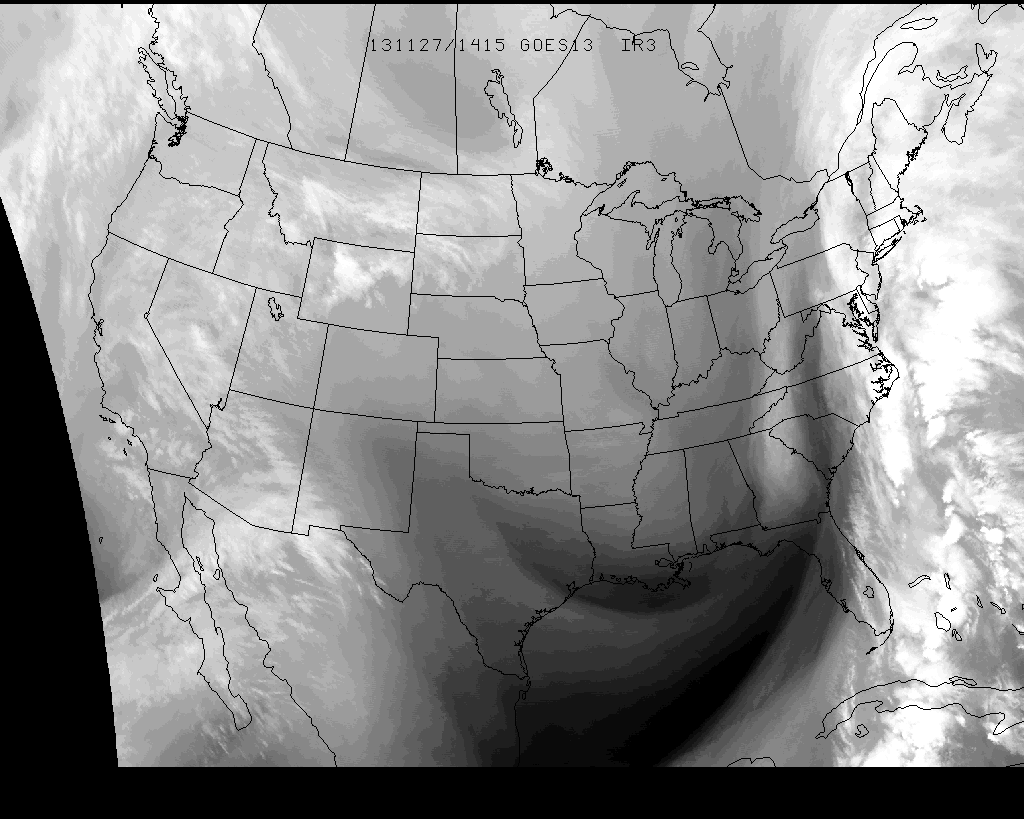
Water vapor satellite imagery from Wednesday 11/27/13, showing a tropical moisture fetch with a storm system in the Eastern US.

Water vapor satellite imagery from Wednesday 11/27/13, showing a tropical moisture fetch with a storm system in the Eastern US.

Read more

Crunch time for ISON, 10 days from perihelion

The clock is ticking on Comet ISON, which is now less than 10 days from its perihelion date with the sun on November 28th. The comet began its long (very, very long) journey through the solar system when it was kicked out of the Oort cloud, a mass of ice and rock in the far reaches of the solar system. ISON is taking a not-so-well-traveled path through the inner solar system, not along the typical belt or path which comets have taken. This means a few things. First of all, ISON is unpredictable. We’ve never seen a sungrazing comet quite like it before. But second and more importantly, ISON is a great tool of study for scientists. How ISON behaves exactly will be very important to scientists and astronomers. So it is safe to say that all eyes will be on the now famous comet over the next 10 days.

What is perihelion exactly? Without getting too technical, it is the point when ISON will come closest to, or “graze” the sun. Comet ISON will feel the intense gravitational pull, incredible temperatures, and full force of solar wind from the sun. In fact, the comet is already experiencing the increasing impacts of all three as it dives towards the sun. The comet recently experienced an “outburst”, with a dramatic increase in brightness by almost 2 magnitudes — and began spewing gas and other volatiles from its surface into space. As it did so, it developed a dramatic tail (which at one point was 16 million kilometers long) and became a naked-eye object in the pre-dawn sky.

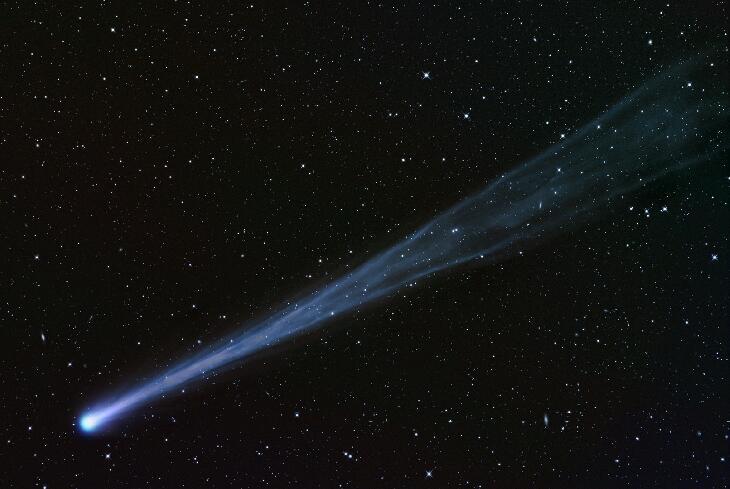
Comet ISON, imaged after its outburst on November 16th 2013.

Comet ISON, imaged after its outburst on November 16th 2013.

Read more

Weekend warmup will feature unsettled weather

Much has been made of the cold and snowy weather this week, and rightfully so. Temperatures fell into the teens and 20’s on Wednesday night after snow on Tuesday, and high temperatures Wednesday afternoon barely scraped into the upper 30’s. Those temperatures are more typical for overnight lows this time of year. But there is another story line in the weather pattern, and it is one that will certainly keep appearing until there is a large scale change: the pattern is progressive. In the mid and upper levels, the pattern shows no signs of slowing down, meaning any airmass that settles into the area (no matter how anomalous) won’t meander around for long.

Not surprisingly, the very cold air which moved through the area early this week is well out of the picture. Temperatures will warm into the upper 50’s on Friday and the warming trend will continue through the weekend. Along with the warmup, unfortunately, will come some unsettled weather. As a mid level ridge builds over the Central and Eastern US, multiple disturbances will ride eastward through the Mid Atlantic states. The result, in terms of sensible weather, will be increased potential for clouds and showers on both Saturday and Sunday — but not a washout.

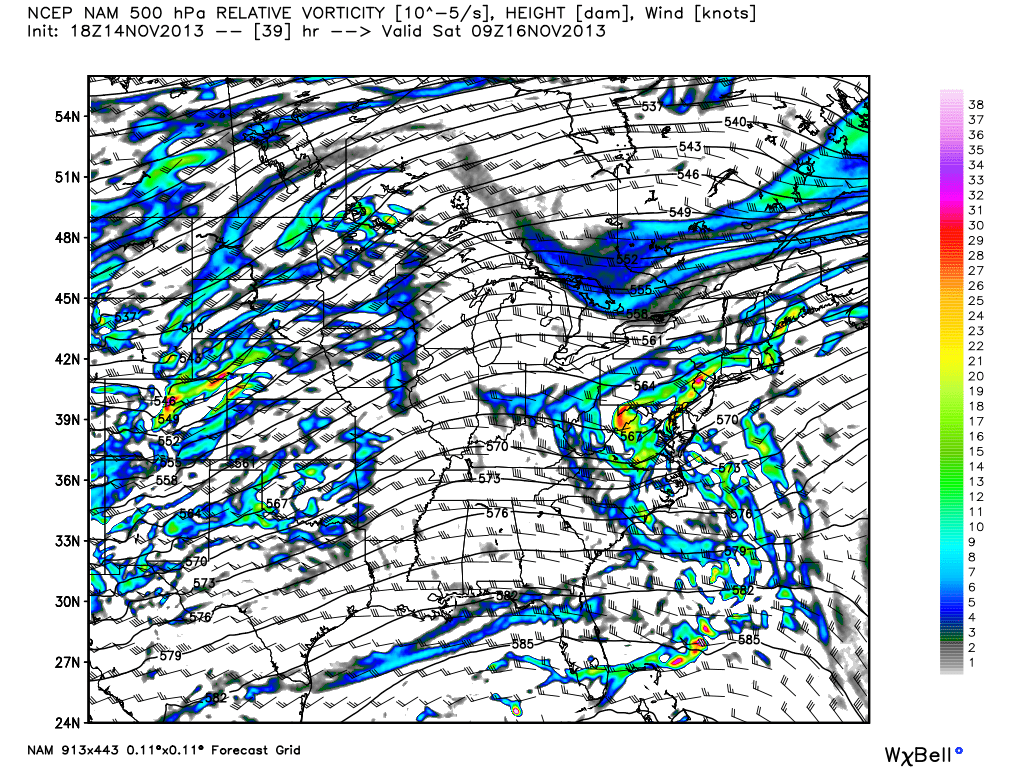
NAM model showing multiple disturbances moving into the Mid Atlantic states this weekend. Image courtesy weatherbell.

NAM model showing multiple disturbances moving into the Mid Atlantic states this weekend. Image courtesy weatherbell.

Read more