Week begins with late season winter storm
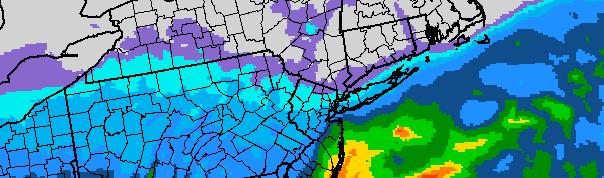
NAM model forecast precipitation totals through Tuesday. Notice the sharp cutoff in precipitation totals from North to South near New York City.

NAM model forecast precipitation totals through Tuesday. Notice the sharp cutoff in precipitation totals from North to South near New York City.

Historically strong blocking, incredibly low Arctic Oscillation values, and a strong negative NAO have been in place for over 7 days. It was only a matter of time. A strong disturbance moving through the Central United States will move eastward towards the Mid Atlantic Coast, and eventually offshore. The surface low, which initially develops towards the Ohio Valley, will be forced to transfer and redevelop off the coast. However, the northward extent of precipitation will be extremely limited with a sharp cutoff likely. This will throw a serious wrench into the forecast — with a large discrepancy in snow possible over small areas.
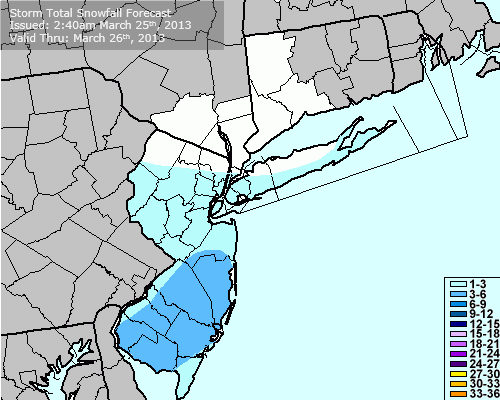
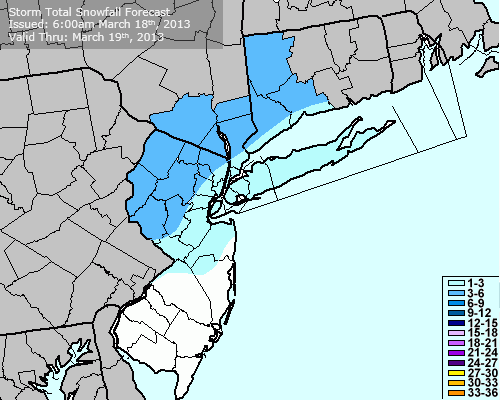
Our Storm Total Snowfall Forecast, valid through Tuesday PM.

Our Storm Total Snowfall Forecast, valid through Tuesday PM.

Forecast models have been inconsistent with the developing gradient. As of Sunday evening, the GFS is the “wetter” of the model guidance — and farthest north with the precipitation shield. The NAM (which had previously shown extreme precipitation totals), Euro and SREF remain farther south. The precipitation amounts and intensity become an increasingly important issue due to the time of year. The warm ground and marginally cold low levels of the atmosphere suggest that light precipitation will not accumulate — and may even fall as rain in some locations on Monday.

Accordingly, the forecast remains highly uncertain as we move forward. We have laid out the expected snowfall totals in our Storm Total Snowfall map, but confidence remains extremely low. It is possible that many locations see light snowfall accumulations but only on grassy surfaces. The best chance for solid light to moderate snowfall totals appears to be over Interior Central and Southern New Jersey, where more persistent heavy precipitation is expected.

A Winter Storm Warning from the NWS remains in effect for Southern New Jersey, while a Winter Weather Advisory remains in effect for the remainder of the area.

The periods of snow, which will begin Monday, could linger into Tuesday throughout much of the area. For up to the minute updates on the upcoming storm system, stay tuned to our Facebook and Twitter accounts.
Cool and dry weekend, snowstorm threat looms

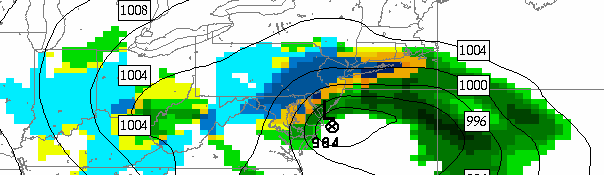
Canadian model (CMC) showing a significant snowstorm impacting the area on Monday. The CMC remains one of the farther north models within the envelope of guidance.

Canadian model (CMC) showing a significant snowstorm impacting the area on Monday. The CMC remains one of the farther north models within the envelope of guidance.

Not only is March madness taking place in the college basketball world, but it’s also taking place in our world of meteorology. Cooler than normal air remains well settled into the region to begin the weekend, as historically strong blocking near Greenland and the North Pole as well as a historically negative Arctic Oscillation (AO) has led to a late-March pattern that feels more like mid-February. High temperatures in the 40’s and cold westerly winds have been a staple in the area weather the past few days. Much of the same is expected through the first half of the weekend, with cooler and dry conditions prevailing. Attention will then turn to a potential snowstorm (yes, snowstorm) on Monday. Forecast models are struggling with the track and intensity of the system as well as the resulting impacts on our area. We’ve detailed the entire threat below.

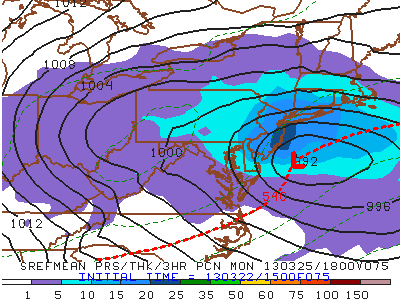
SREF ensemble mean showing a significant snowstorm on Monday.

SREF ensemble mean showing a significant snowstorm on Monday.

It’s Spring. What is causing the threat for the snowstorm? Historically strong blocking over the high latitudes (extending from Greenland to the Pole) is displacing unseasonably cold air into the Northern 1/3 of the US. At the same time, a strong disturbance is ejecting out of the Pacific Northwest into the Central United States. Such a storm track could occasionally cause a rain storm in our area, especially this time of year, with the surface low tracking to our west. However, the presence of the unusually strong blocking is forcing the system farther south, to redevelop off the East Coast. The presence of cold air to the north and throughout our area is increasing the likelihood of snowfall if precipitation makes it to our area.

What are the uncertainties with the system?  One reason why blocking patterns can be so unseasonably cold is the fact that they force powerful Upper Level Low (ULL) pressure systems to meander at latitudes just to our north and northeast, which are a great source of cold air. However, when an ULL is too powerful and too close to our area, it can compress the height field out ahead of our storm and force it drift eastward instead of turning the corner and heading up the coastline. We do know that eventually, the storm will run into a brick wall and be forced to drift eastward. However, will it do this after it gets to only Ocean City Maryland’s latitude, south Central Jersey’s, or somewhere in between? This is the difference between a graze, a moderate rain to snow event, and a major snowstorm.

Read more

Forecast: Clearing, but cold & wintry pattern ahead

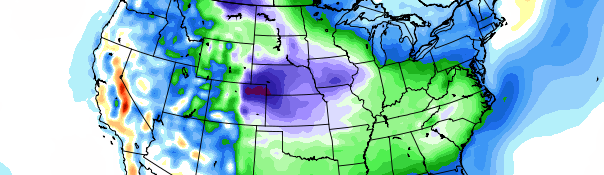
GFS Model showing below normal temperature departures throughout the majority of the United States through the first week of Spring. Image courtesy Ryan Maue and Weatherbell.

GFS Model showing below normal temperature departures throughout the majority of the United States through the first week of Spring. Image courtesy Ryan Maue and Weatherbell.

Rain and snow lingered through the area on Tuesday morning, in the wake of a storm system which dropped a few inches of snow in most locations before a changeover to rain occurred Monday Night into Tuesday morning. Some snow still remained on the ground (and roads) but rain and the presence of some sun later today should help to melt whatever is left, aside from the areas across the interior which accumulated several inches of new snow. The bands of snow and rain are expected to pull away from the area by the afternoon hours on Tuesday, with clearing reaching the area by late afternoon. West winds and some sun could allow temperatures to reach into the middle 40’s on Tuesday afternoon.

The winds will strengthen Tuesday into Wednesday and could become quite breezy at times, with gusts to 30 miles per hour as the new cold airmass enters the area behind the storm system. All eyes will then turn to the potentially wintry pattern towards the end of the week into the weekend. The first system of interest comes as early as Wednesday Night into Thursday, with a weak low pressure system forming offshore. Some light rain or snow is possible along the coast as the storm develops well out to sea  and a weak inverted trough passes over the area. No accumulations are expected.

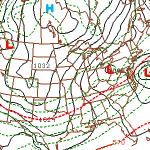
Almost all forecast models show a low pressure system on the East Coast this weekend.

Almost all forecast models show a low pressure system on the East Coast this weekend.

The second, and likely more impactful, potential system won’t impact the area until later this weekend. A strong disturbance will eject out of the Pacific Northwest into the Central United States by Saturday — and then track eastward towards the East Coast by Sunday and Monday. Uncertainty still exists in regards to exact track and strength of the disturbance. Most notably, an upper level low to the north of our area is very important in determining where the system will eventually track. An upper level low farther south over New England will act to suppress the storm, while one farther north will allow the system to come up the coast. In addition, the exact positioning of the strong blocking (discussed in previous posts) will have an impact on the eventual strength of the surface low pressure as it nears the area.

Regardless of exact track, forecast models are in good agreement on an eventual low pressure system passing somewhere to our south off the East Coast late this weekend or early next week. The details should be ironed out over the coming days, and we’ll be sure to keep you updated.

PM Forecast: Period of wintry weather through Tuesday AM

Snow was falling early Monday evening throughout most of the area, and was expected to continue for a few hours. Precipitation will change over to rain with time and continue into Tuesday morning.

Snow was falling early Monday evening throughout most of the area, and was expected to continue for a few hours. Precipitation will change over to rain with time and continue into Tuesday morning.

A storm system tracking to our north and west will redevelop off the New Jersey coast and south of Long Island tonight, bringing steady precipitation to the area overnight into Tuesday morning. Warm air advection (increasing presence of warm

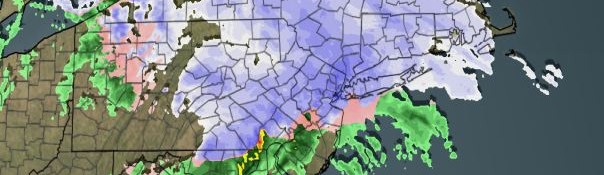
NYMetroweather snowfall forecast through Tuesday at 12pm.

NYMetroweather snowfall forecast through Tuesday at 12pm.

air in the atmosphere) will begin in the evening, changing precipitation from snow to sleet and rain from southwest to northeast with time. However, a period of snow and sleet is likely even near the coast. Across the interior, several hours of snow and sleet are expected to bring moderate accumulations. Travel could become difficult overnight tonight, especially across the elevated interior areas. Eventually, precipitation is expected to change to all rain throughout the area by Tuesday morning before ending. Total snowfall accumulations of 1-3″ on cold surfaces are expected in Northeast NJ, NYC, and Long Island. Mainly wet roads are expected in the city. Across the interior, 3-6″ of snow/sleet is possible before the changeover to rain.

Although we opted not to issue a Storm Alert Brief due to the short-fused nature of the travel difficulties, our storm total snowfall forecast is available…attached to this post. The official 3 day forecast is also included below. After the storm system on Tuesday, attention will turn to a potential winter storm next weekend which has become a feature on almost all medium range forecast model guidance. Stay tuned.

Tonight: Periods of snow and sleet, changing to rain. Low near near 32, colder inland. East winds 10 to 20 miles per hour, gusting near 30 miles per hour.

Tuesday: Rain likely in the morning, then clearing. High near 47. Northeast winds turning west in the afternoon around 15 miles per hour.

Tuesday Night: Partly cloudy, with a low near 30. West winds around 15 miles per hour, gusting to 25 miles per hour.

Wednesday: Sunny and breezy, with west winds around 20 miles per hour. High near 45.