El Nino Update: Not a matter of if, but how strong

As the Spring season moves along, signs begin to become more clear regarding the development of an El Nino. Although there has been relatively high confidence in the development of an El Nino for quite some time, there was still a small bit of doubt, as some expressed skepticism. However, over the last month or so, the atmosphere has undergone changes which should remove any seeds of doubt regarding whether an El Nino will be developing this Spring and Summer. The only doubts that exist now is the final strength of the event (El Nino events usually peak in the Autumn): high-end moderate/low-end strong, a strong event, or a super strong event. For more information regarding the formation of El Ninos and what they mean for our weather pattern, check out the article we published last month. 

What has happened that makes us so confident? The easterly trade winds which usually keep warm water well to the west towards Indonesia have shifted to westerlies. 
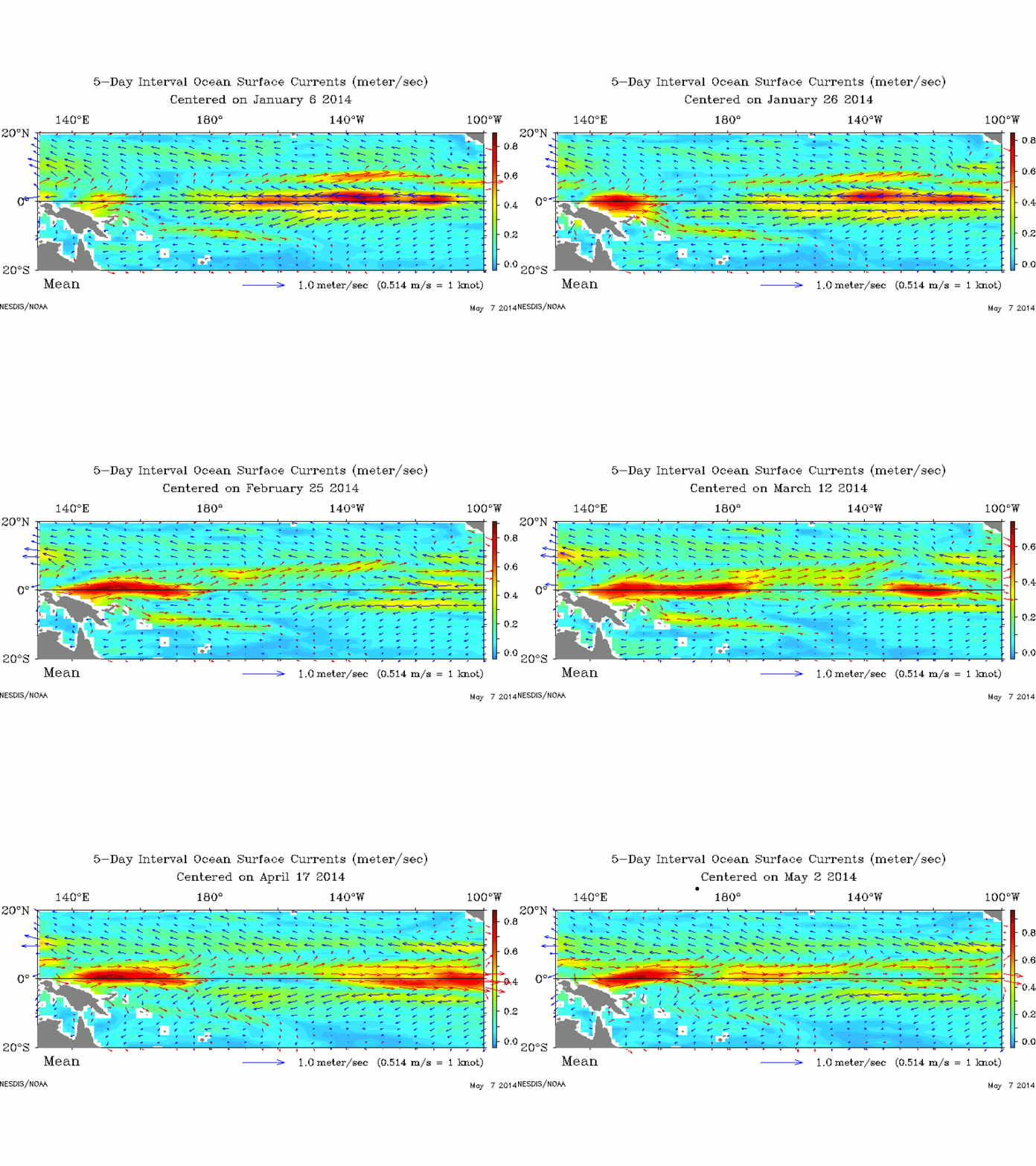
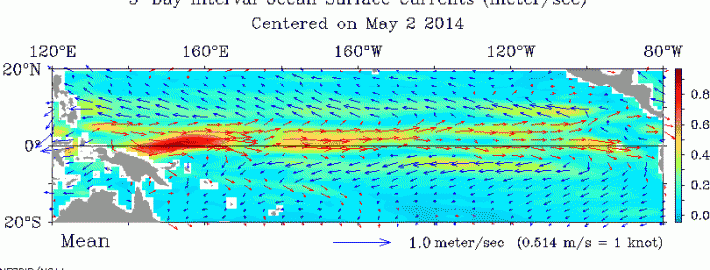
This animation shows the progression of the strength and direction of wind currents. Note how they started off blowing from east to west, but have dramatically shifted in the opposite direction. This is a strong indicator that an El Nino is coming. Click to animate.

This animation shows the progression of the strength and direction of wind currents. Note how they started off blowing from east to west (easterlies, blue arrows), but have dramatically shifted in the opposite direction (westerlies, red arrows). This is a strong indicator that an El Nino is coming. Click to animate.

This means that the base state of the atmosphere which prevents El Nino events has completely changed to one that favors El Nino events. The typical climate pattern has easterly trade winds along the Equator, which blow warm water along the Equatorial Pacific to the west, towards Indonesia and Australia, leaving the rest of the Equatorial Pacific relatively chillier. Now that the surface currents have shifted to blowing from west to east, it becomes much easier for that same warm water from the west to move eastward throughout the rest of the Equatorial Pacific, leading to an El Nino.
Read more

Moderate to strong El Nino becoming increasingly likely

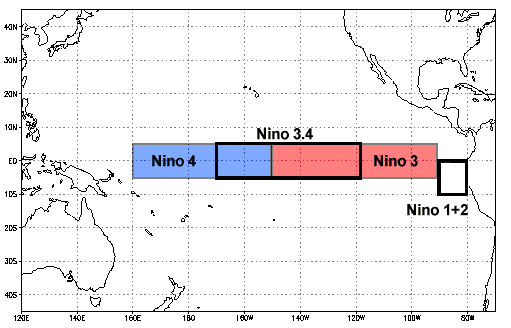
While our area has been enjoying a stretch of pleasant and warmer weather, many meteorologists and weather hobbyists alike have been analyzing interesting data in the Equatorial Pacific: signs of a developing El Nino. An El Nino is generally defined as a trimonthly period where waters in the Equatorial Pacific — from 160 Degrees East to 80 Degrees West Longitude — are warmer than normal. This tends to have effects on the general atmospheric circulation, which will be detailed in this article. The Climate Prediction Center breaks this area into four different Nino regions, since warm anomalies in different regions of the Equatorial Pacific can lead to subtle, yet important changes in how the El Nino behaves.

The four El Nino regions (NCDC).

The four El Nino regions (NCDC).

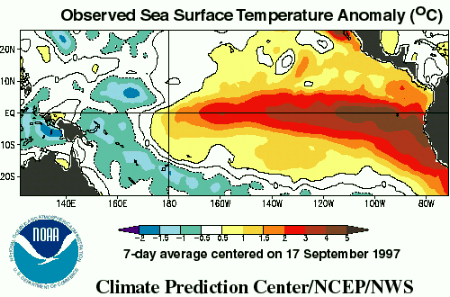
The region used to officially define an El Nino event is Nino 3.4, which spans from about 170 Degrees West to 120 Degrees West. That is not to say that the other regions are not important; they are just not used in the official calculation. Let’s take a look at an example of an El Nino event:

The strong El Nino event of 1997-1998. Notice how warm the waters are in the eastern Equatorial Pacific.

The strong El Nino event of 1997-1998. Notice how warm the waters are in the eastern Equatorial Pacific (CPC).

The El Nino of 1997-1998 was the strongest on record, as it had temperature anomalies between +2C and +5C across the eastern Equatorial Pacific. Also notice how the warmest anomalies were east of Nino region 3.4, which is a classic strong El Nino phenomenon. Let’s see how the forecast from one of our climate models compares to the 1997-1998 event.

The latest CFS model shows an El Nino emerging (CPC).

The latest CFS model run shows an El Nino emerging (CPC).

The values on the left are anomalies in Kelvin, which can also be represented by degrees Celsius, since the incremental increases are the same for Kelvin and degrees Celsius. On the bottom, we see tri-monthly periods. The wavy black line shows what had previously been happening — generally, there was no anomaly at all, indicating no El Nino, nor its counterpart, a La Nina. However, moving forward in time, notice how all of the lines, which represent forecasting members, show a pretty fast increase in the anomaly through the coming months. Another interesting point is how the red lines are the earlier members, and the blue lines are the latest members — and there appear to be more blue members hedging towards the warmer side of the mean than the red lines — which is perhaps an indicator of a further warming trend.

The threshold for a strong El Nino is an anomaly of +1.5C or higher, which certainly seems attainable according to the CFS. While not nearly as strong as the 1997-1998 El Nino, it would certainly still be pretty strong, and the fact that the latest members look warmer than the mean indicates that the El Nino could verify warmer than the forecast mean.

Now that we know what an El Nino is, as well as how strong it is forecast to become, let’s examine what causes an El Nino, and what effects it has on our weather pattern. Read more

Confidence in a significant snowstorm is increasing for Thursday night and Friday

As colder air begins to filter in over the next few days, the weather pattern will become more favorable to support a snowstorm for later this week. While details still remain a bit uncertain, the trends in all of the latest model guidance support the threat for a potentially high-impact snow event.

Although December was a pretty active month as far as winter storms were concerned, there were no major, widespread snowstorms for the entire area. The main reason for this was the lack of any North Atlantic blocking, which helped to keep the flow in the pattern too fast for any major, organized amplification. However, this time around, some North Atlantic blocking has developed. Although it is not tremendously strong, it is located in a perfect position to slow down the pattern and support a major storm. Let’s go over all the pieces in the latest model guidance.

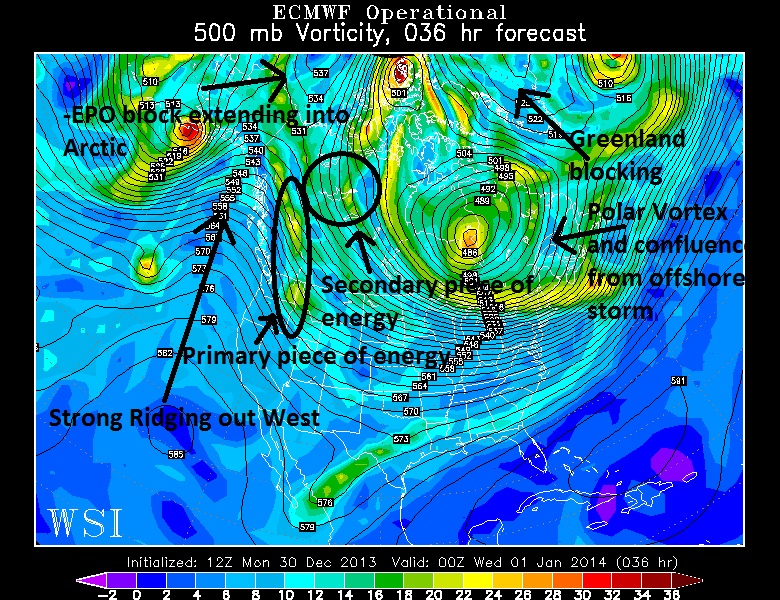
Today's 12z European Model at the 500mb level valid for Tuesday evening shows several key pieces which could help produce a big snowstorm. Image credit goes to the WSI Model Lab.

Today’s 12z European Model at the 500mb level valid for Tuesday evening shows several key pieces which could help produce a big snowstorm. Image credit goes to the WSI Model Lab.

The image above shows today’s 12z European Model at the 500mb level, valid for Tuesday evening. There are several key pieces labeled which indicate the potential for a big storm. Although the storm itself is still a few days away, the fact that this setup is in place within 36 hours gives us a bit higher confidence in a snowstorm of some kind.

Read more

A technical look at Tuesday’s snow

[s2Member-PayPal-Button sp=”1″ ids=”3795″ exp=”72″ desc=”Purchase this post for $.99″ ps=”paypal” lc=”” cc=”USD” dg=”0″ ns=”1″ custom=”www.nymetroweather.com” ra=”0.99″ image=”default” output=”button” /]

Read more