Colder weekend could lead to a wintry mess on Sunday night

As temperatures have moderated along the east coast, an abnormally strong cold airmass has entered the Western half of the United States. This cold airmass is thanks to a strong -EPO ridge over Alaska, which helps to dislodge Arctic cold into the United States. However, because of the +NAO, +AO, and -PNA, this cold is forced into the West, and will initially have a lot of resistance as it tries to head eastward. This pattern is illustrated very well by today’s 12z European model, valid for Thursday night, shown below.
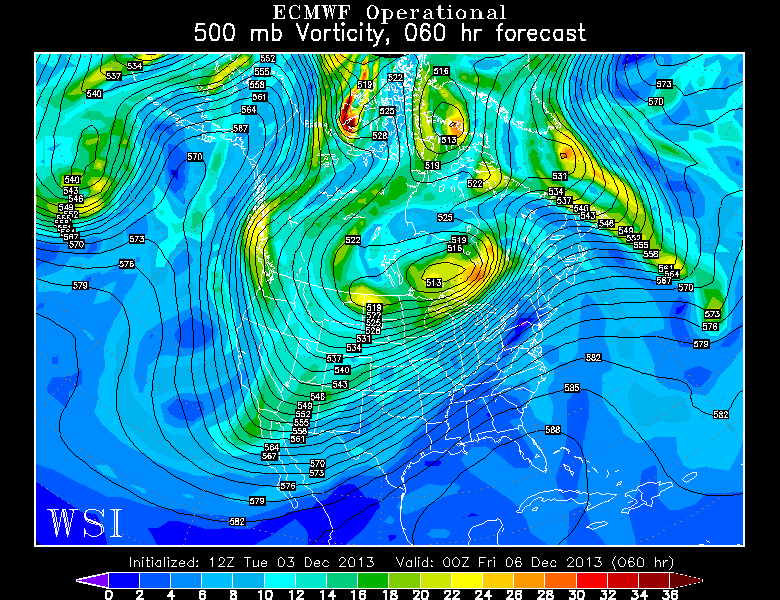
Today's 12z European model valid for Thursday night shows what we call a "gradient" pattern with very cold air to the north and warm air to the south and east. This battle zone between the two airmasses will create the chances for precipitation. Image credit goes to the WSI Model Lab.

Today’s 12z European model valid for Thursday night shows what we call a “gradient” pattern with very cold air to the north and warm air to the south and east. This battle zone between the two airmasses will create the chances for precipitation. Image credit goes to the WSI Model Lab.

The strong -EPO ridge is evident as there are high 500mb heights into Alaska, which is forcing an Arctic airmass into the Northern Plains. This airmass has the chance to break records, and will try to spill eastward with time; however, it has a lot of resistance thanks to the strong ridge in the Southeast. This very warm air in the Southeast and Arctic air in the Northern Plains will create an impressive temperature gradient in the northern Mississippi Valley and Ohio Valley region, and this gradient is where some storms will form. As these storms form, the ridge in the Southeast will force them to track to our west, leading to warm air and rain for Thursday night and Friday. However, the passage of each low pressure will try to gradually shift this gradient eastward due to counterclockwise flow behind them — it is a step-down process. The image below illustrates how strong this gradient really is, and it’s pretty mind-boggling.
Read more

First snowflakes of the season tomorrow morning?

Although the big snowstorm that some models had for Wednesday night and Thursday is definitely not going to happen, the NYC Metro area may still see its first snowflakes of the season tomorrow morning during the rush-hour commute. Yes, this does include coastal areas.

The main culprit for this is the Arctic cold front that will move through the area. There is not a whole lot of moisture with this front, as the main story will be the falling temperatures, as temperatures will struggle to get out of the 30s tomorrow and Wednesday. However, there is some moisture; particularly behind the front, where temperatures will be colder. This is called an anafront, as opposed to the more typical katafront, where most of the moisture is out ahead of the front in the warmer, more unstable airmass.

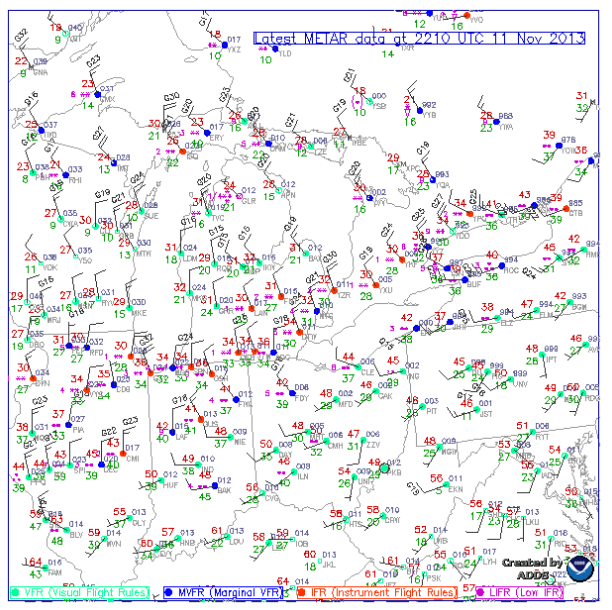
Current surface observations in the Great Lakes show the frontal boundary quite well, with many observations of snow on the cold side of the boundary. This front will cross our area during the overnight hours and should give most of the area its first snowflakes of the season.

Current surface observations in the Great Lakes show the frontal boundary quite well, with many observations of snow on the cold side of the boundary. This front will cross our area during the overnight hours and should give most of the area its first snowflakes of the season.

Normally, it is much easier to generate precipitation ahead of a front rather than behind it, due to the airmass being warmer and having more moisture ahead of the front. But sometimes, due to jet stream dynamics among other things, the best source of lifting actually occurs behind the front. Of course, the colder airmass and lack of a strong storm system will somewhat mitigate the amount of precipitation that does fall; but the temperature gradient, lift, and moisture aloft do support some precipitation.

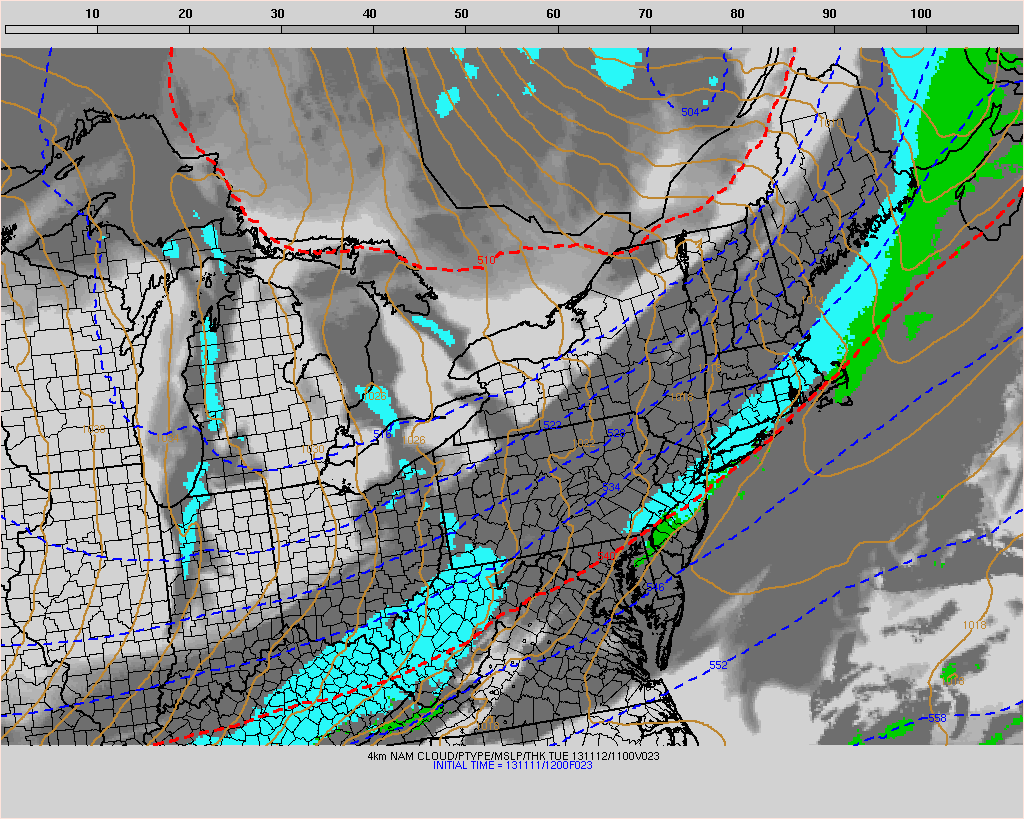
This morning's high-resolution NAM model shows a band of light to moderate snow moving into the area around 6:00 a.m.

This morning’s high-resolution NAM model shows a band of light to moderate snow moving into the area around 6:00 a.m.

Precipitation should start as light rain around 2:00am in further northwest areas, and closer to 4:00am in coastal locations. As temperatures cool, the rain should change to snow about an hour or two after the initial onset of precipitation, fall lightly to at times moderately, and then end between 9:00am and 11:00am from west to east. This means that the immediate NYC Metro area could see a period of steady snow between 6:00am and 7:00am. Accumulations will be very light and limited to only the cold surfaces. Perhaps a dusting to a coating in coastal sections, and a coating to as much as an inch further north and west. The main roads should primarily be just wet, but it may be a good idea to save a bit of extra time tomorrow morning, as some colder roads could be a bit white and slick. It may appear quite wintry at times, due to the strong winds blowing around any snow that does fall.

Read more

Potential scenarios for the storm next week

As some of you may have heard, there is speculation going on about a potential winter storm next Wednesday and Thursday. Snowfall maps from various computer models, such as the European model, have been posted on numerous social media pages. Some of these maps have shown accumulating snow all the way down to the I-95 corridor, leading some to hype the potential for snow. Is this hype justified?

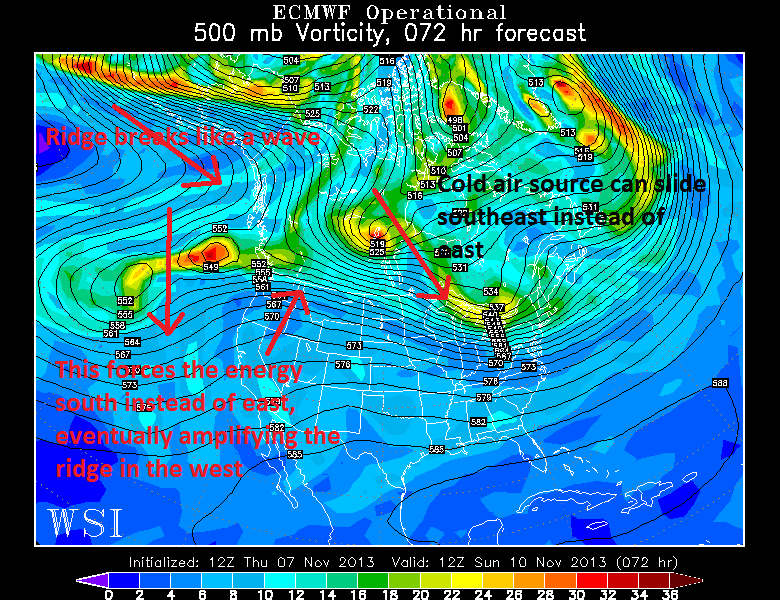
At the end of our previous post, we hinted that there could be a pattern-change coming towards mid-month as a cold air source builds in NW Canada and slides towards the United States via a strong cold front. It turns out this cold blast of air may be more significant than originally anticipated, as this source of cold air has little room to modify as it traverses through the Canadian snowpack. With this cold air push along with warm air still existing to the south, the temperature gradient is ripe for a potential storm system to form. Whether it forms out to sea, takes a track too far west and brings warm air and rain to our area, or takes a track off the coast and brings a snowstorm is yet to be determined.

What is causing this storm to be possible and where is the cold coming from?

It all begins with the Pacific and a unique blocking event near the Aleutian Islands. A very strong ridge is forming there, and what happens downstream of that ridge may become quite interesting.

Today's 12z European Model run valid for Sunday morning shows why a storm system with cold air is possible. Image credit goes to the WSI Model Lab.

Today’s (11/7) 12z European Model run valid for Sunday morning shows why a storm system with cold air is possible. Image credit goes to the WSI Model Lab.

Read more

Pattern overview: Some ups and downs, but overall warm

After a chilly few days, temperatures are rebounding, and this should continue to be the case. Thanks to a -PNA pattern, which favors a trough in the western half of the country and downstream ridging in the eastern half of the country, as well as no -NAO nor -AO to keep that ridging at bay, our temperatures have moderated nicely. Temperatures will rise into the mid and even some upper 60s on Wednesday and Thursday out ahead of that trough, before a cold front comes through on Thursday night with a few showers and chilly weather for Friday and Saturday, but nothing too unseasonably cold.

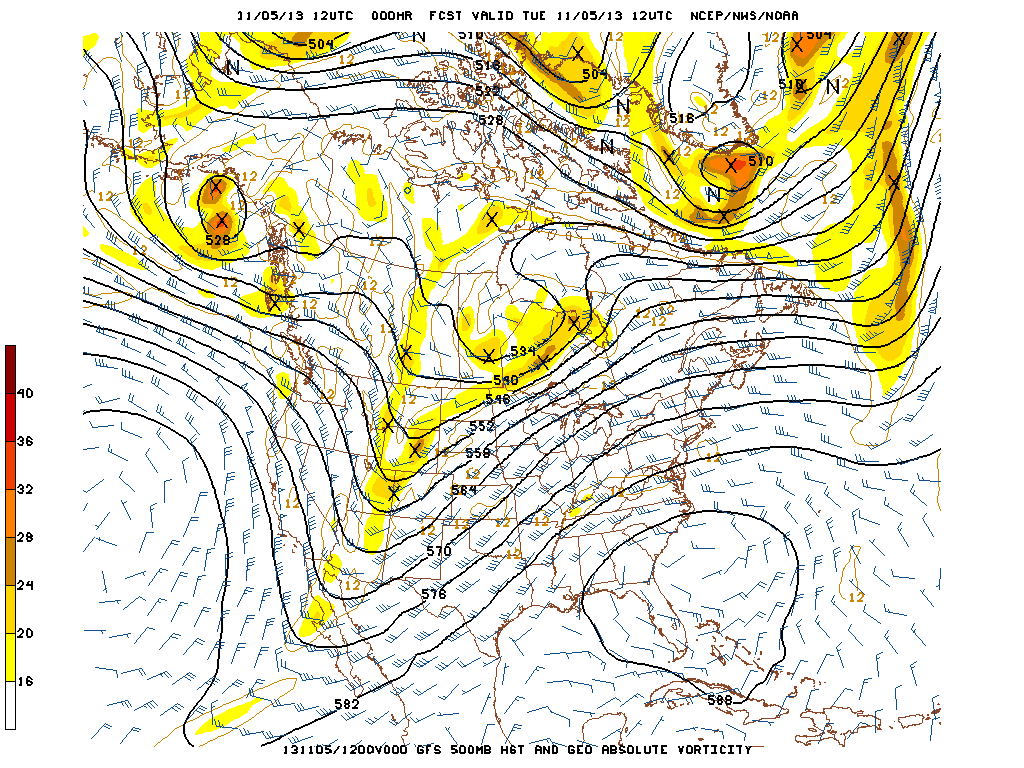
The initialized GFS from this morning shows a positive NAO, positive AO, and negative PNA pattern -- all favoring a ridge in the east.

The initialized GFS from this morning shows a positive NAO, positive AO, and negative PNA pattern — all favoring a ridge in the east.

As one can see, the initialized GFS image from this morning shows very low heights in Greenland, leading to a positive NAO, low heights close to the Arctic, leading to a positive AO, and a trough in the west, leading to a negative PNA. This all favors a ridge in the east, which is clearly shown. And although there is a ridge in the Pacific, its amplitude gets cut-off by low heights in Alaska, which is a +EPO pattern. This means that all the cold air gets bottled up in the Arctic, and cannot get sent down to the United States. Instead, any troughs tend to contain more Pacific-oriented air, so even the trough in the west is not all that impressive. Since there is not a whole lot of cold air associated with the trough, the temperature gradient is weak, and any storm that forms along it will not be all that impressive. Also, the strongest height gradient is currently in the midwest, so any storm would tend to take that track and mostly miss our area.

Read more