Big heat on hold for the foreseeable future

We finally saw a nice break today from the high humidity values, as dewpoints dropped into the low 60s this afternoon, making it feel quite comfortable outside this afternoon. With the lower humidity, this means that temperatures have more room to drop tonight — mid 50s in colder, inland areas to mid 60s in more coastal sections. This is quite the stark contrast from the constant stream of 70s for lows that we have had all month.
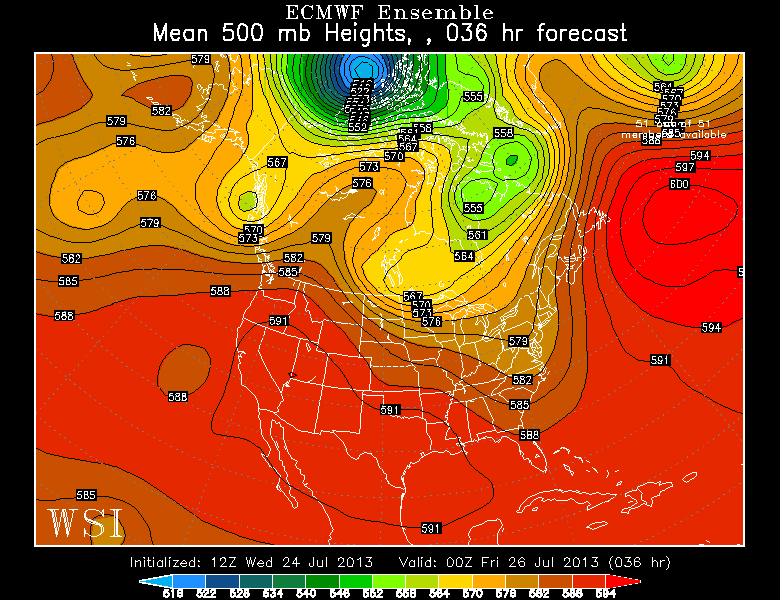
European Ensemble Mean Valid for tomorrow evening shows a frontal boundary being stalled as it runs into the stubborn Western Atlantic Ridge. Image courtesy of the WSI Model Lab.

European Ensemble Mean Valid for tomorrow evening shows a frontal boundary being stalled as it runs into the stubborn Western Atlantic Ridge. Image courtesy of the WSI Model Lab.

As far as what is going on with the synoptic weather pattern, the heat wave has broken as that huge ridge has finally dissipated and split into two ridges — one in the southwest, and one in the NW Atlantic. The NW Atlantic ridge is the same one that has been plaguing us all summer with humidity, showers, thunderstorms — and at times, heat. Although it has fluctuated in position at times, it has generally remained in the western Atlantic.

This 500mb image valid for tomorrow evening gives a good general summary as to what is going on now and what we can expect over the next few days. There is a trough in the northeast, as a cold front made its way through the area yesterday, giving us drier conditions. However, there are still clouds around as the front has stalled just to our east. Because of the tremendously strong western Atlantic ridge of 600 decameters  (!), the front was forced to stall, as it ran into a “wall”, instead of clearing the coast. This leads to a tight 500mb height gradient along the eastern seaboard (which in this case is pretty much a frontal boundary). This leads to the potential for waves of low pressure to develop along this front.

Since the front is just to our east, the biggest rainfall threat would be east of NYC, with NYC itself being on the gradient. For now, we will mention the relatively high chance of showers, with periods of moderate rain at times — especially in eastern sections of the region (such as Long Island) — in an otherwise relatively mostly cloudy regime for tomorrow. With surface winds more northerly, instability should be too low for much in the way of thunderstorm activity, as temperatures may not get out of the 70s tomorrow.  A stark change from last week, considering our lows were often in the mid to upper 70s!
Read more

Severe Weather Threat on Saturday: Run-of-the-Mill or Significant?

NYC sounding saturday

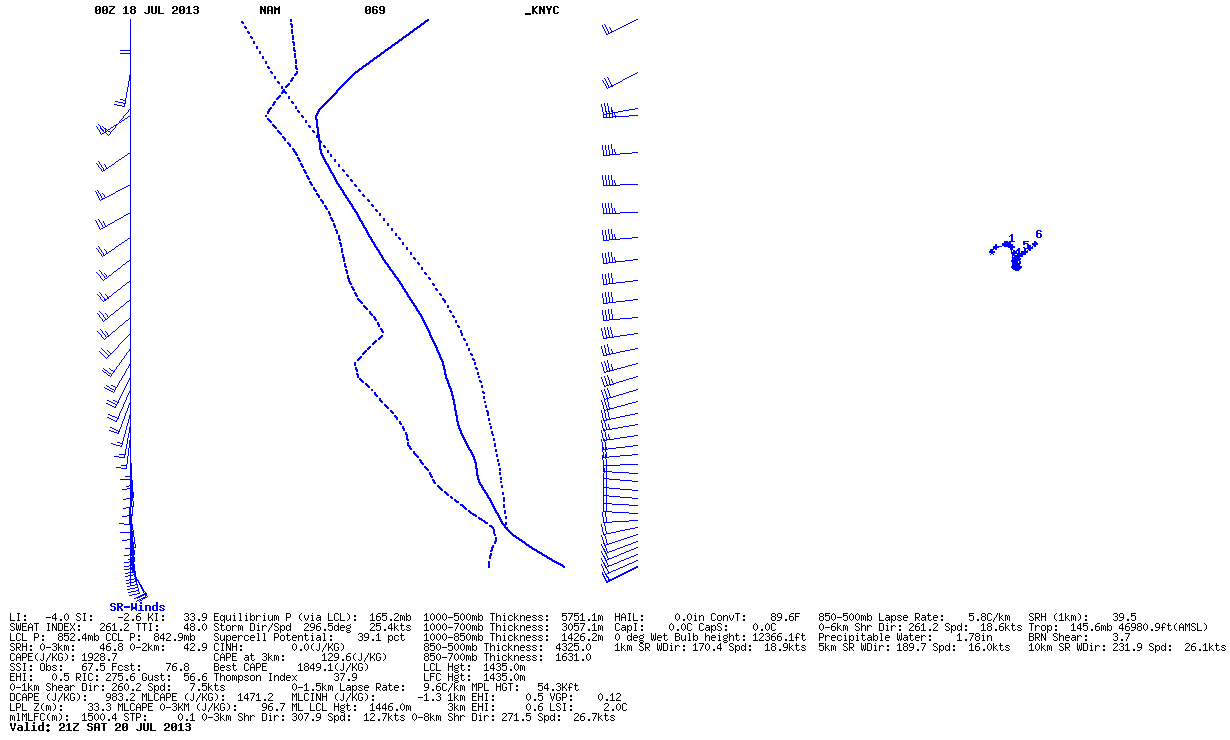
00z NAM Forecast Sounding for NYC, Valid for 5pm on Saturday.


Saturday will be the last day of our heatwave, as a strong cold front approaches the area. With strong cold fronts and very warm, moist air out ahead of them, severe weather threats often ensue, and Saturday will be no different. However, although there are some factors that support severe weather, there are plenty that do not.

A quick technical explanation as to why will be aided in illustration by the sounding above. With a strong storm system traversing southern Canada, the best dynamics — and thus, best forcing — will be located well north of the area. This also means that the strongest mid-level winds and best shear will also be located to the northwest of NYC as well. Taking a look at this sounding, you can see that the wind fields are not that impressive — which does not give very fast forward motion, helping to reduce potential wind speeds. Slower wind fields also support weaker storms, as this prevents the updraft and downdraft from sufficiently separating. The wind speeds are still fast enough for some storm survival, but nothing that is too terribly impressive.

Another thing is that there is essentially no directional shear — the wind field is pretty unidirectional. This will make any tornado threat for our area essentially negligible, and further hinders the amount of updraft and downdraft separation.

Another negative for severe weather is the very tame mid-level lapse rates. The 850mb-500mb lapse rates are only 5.8 C/KM, which is quite unimpressive. We like to see values of around 7 C/KM or greater. Poor mid-level lapse rates tend to lead to squall lines that struggle to maintain themselves, especially as the storms begin to outrun the cold front and thus outrun any dynamic forcing for ascent that there is. Further northwest, poor mid-level lapse rates won’t be as much of a problem, since any squall line can maintain itself via lift from the front; but further east, the lifting from the front is bit further removed from it, and thus weaker.

We do have very steep low-level lapse rates, as from 0-1.5km (about 850mb), they are 9.6 C/KM, which is nearly dry-adibatic. This provides steep low-level instability — and combining this with high heat and humidity — provides good surface-based CAPE of nearly 2000 J/KG. This will help to provide some lift and good, healthy updrafts. Additionally, the steep low-level lapse rates help to provide lots of downward momentum, or negative buoyancy, for any downdrafts. This could help lead to some damaging winds in any strong downdraft, and I suspect that this will be the main severe weather threat. The relatively dry mid-levels could also lead to a threat of hail as well, but this would also be isolated and mainly relegated to the north, west, and northwest as well, since mid-level lift may not be strong enough to generate the very high cloud tops for hail in the NYC area.

Regardless — although the above paragraph does lend some credence to a wind threat, the fact that by evening, the main convective mode may be lines and clusters may mean that the mid-level lapse rates being poor will outweigh the low-level lapse rates being favorable, especially further east and away from the best forcing. So, although some isolated severe wind may be in the cards for Saturday — the best, widespread severe wind threat will definitely be well to the north, west, and northwest of the area, in our opinion. Things could change, and of course, we will keep you posted.


Myriad of threats expected from midweek storm

[alert type=”error”]Storm Prediction Center has placed parts of the area in a Moderate Risk for severe weather on Thursday. Details. [/alert]

A strong storm system traversing the Ohio Valley will strengthen and shift towards the Northeast US on Thursday, bringing the potential for several types of hazardous weather. Forecast models suggest the system may be anomalously strong for this time of year, with pressures dropping to near 990mb as it moves through the Mid Atlantic states. This is absolutely unprecedented for this time of year, as normally the jet stream is too weak this time of year to support such dynamic systems.

A warm front is forecast to lift northward from the Mid Atlantic states to a position near Central New Jersey on Thursday afternoon. The combination of building instability near and south of the warm front, as well as favorable wind fields and forcing for precipitation will lead to the potential for not only heavy rain and strong winds, but severe weather…including the potential for a few tornadoes.

If you have not already, I highly recommend you check out our previous technical discussion, as it will help to explain some concepts that I will talk about in detail for the rest of this post, and give you a pretext as to what is going on.

The exact position and timing of the surface low, cold front, and warm front will be crucial in determining where the tornado risk is, and where the northern boundary of the severe weather can be expected. Latitudes north of the surface low can expect heavy rain of 2-4″ and little in the way of severe weather, areas with the same latitude as the surface low can expect 1-2″ of rain with a chance of being hit by a squall line producing borderline severe winds, and latitudes south of the surface low can expect severe weather and a few tornadoes. The problem is, the exact position of the surface low is still a bit uncertain, but we’ll do our best to warn everyone of the possibilities.

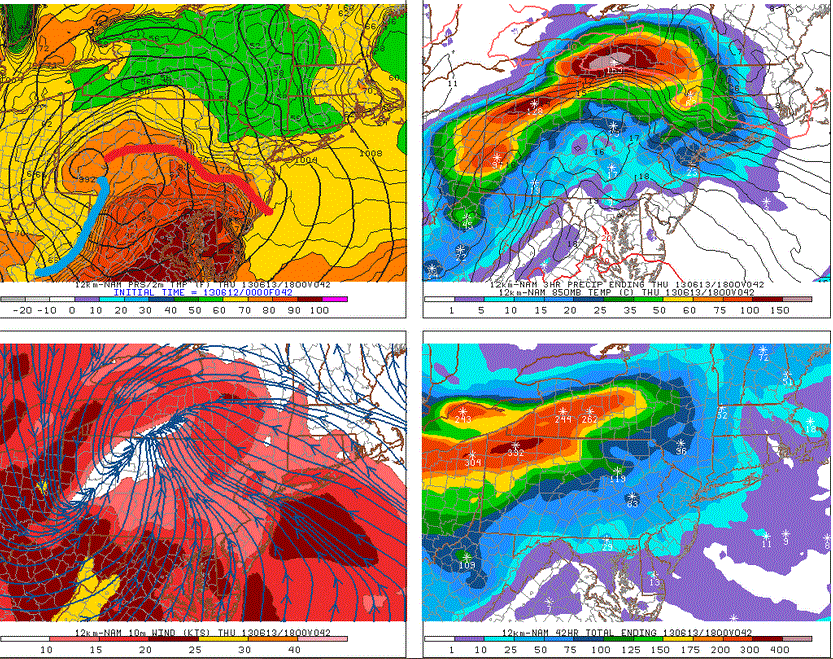
The 00z 6/12 NAM valid for 2 p.m. on Thursday.

The 00z 6/12 NAM valid for 2 p.m. on Thursday.

Our first two images will illustrate the NAM’s boundaries and its movements throughout the day on Thursday. The NAM, at 2 p.m. on Thursday is forecasting a 990mb surface low in SW PA (top left panel). You can see two distinct temperature gradients — one to the south of the low, and one to the east of the low. I quickly highlighted the approximate warm front position in red and the cold front position in blue, at that time.

As I said in yesterday’s discussion, the cold front often triggers a linear convective mode. But look at how far east the warm front extends away from the front! Areas just south of the warm front and away from the cold front can expect a discrete supercellular convective mode. Thus, at 2 p.m., SE PA, SW NJ, DE, and MD could really be under the gun for a tornado threat, and perhaps severe hail as well.

A very key fact that one must understand for this threat: the slower the cold front advances, the longer the warm front will be the main boundary for thunderstorm initiation in the very favorable tornadic environment, thus discrete supercells. A faster moving cold front means that it would eventually be the dominating player in the favorable tornadic environment, potentially “wasting” the environment and turning the convective mode more linear, since it would more quickly intercept that environment. Linear squall lines can still provide embedded tornadoes, so a squall line does not mean there is no tornado threat, but it would be significantly reduced compared to that of more discrete supercells.

Also note the southeast surface winds that even exist to the south of the warm front in SE PA on the bottom left panel — when you combine that with the potent mid level winds from the WSW associated with this powerful storm, you get strong, deep-layer shear supportive for severe weather and even tornadoes. More will be discussed about the wind profiles later in this post.

Read more

Severe Storms Likely for the Mid-Atlantic on Thursday. How Far North Will They Go?

As well evidenced by the recent inclement weather, the northeast is under a very active weather pattern, and after a couple of days of general relaxation, the weather looks to turn unsettled again on Thursday.

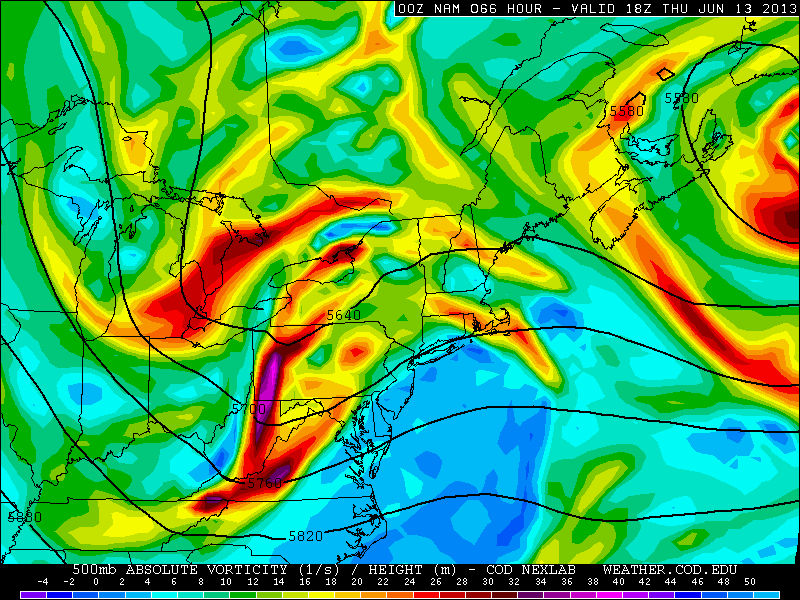
A potent storm system with lots of vorticity will be the culprit for severe weather on Thursday.

A potent storm system with lots of vorticity will be the culprit for severe weather on Thursday.

A powerful storm system will quickly traverse the country, giving the Midwest and Ohio Valley a severe weather event on Wednesday. This will head eastward and approach our area for Thursday. At this point, all eyes will turn towards the northern Mid-Atlantic states: in particular, southeastern Pennsylvania, Maryland, Delaware, northeast Virginia, and perhaps central and southern New Jersey as well. This storm system will provide very strong winds — well in excess of 50 knots — at 500mb, coming out of the WSW; generally a very conducive environment for severe weather. In addition, the potent vorticity, among other factors that will be explained shortly, will also be conducive for lift, in order to generate thunderstorms.

What is often true about these powerful storm systems is that they possess strong boundaries, such as cold fronts and warm fronts. It is along these boundaries, and on the warm sides of them, where we pay particularly close attention, because the warm, moist air in the warm sector is lifted near the boundaries themselves, helping to initiate convection, and thus, thunderstorms. Usually, a cold front in itself is a boundary that is only conducive for squall lines, because they are expansive, they favor lots of lift over the entire front (as opposed to a dry-line, where the lift is more localized), and move quickly — so the best lift continually catches up with any storms that form, causing more and more storms to form in close proximity to them, thus quickly favoring congealing into a line. This is what is typical for northeast thunderstorm setups, and one reason why you tend to see large lines of storms, rather than the discrete supercells that you get in the Plains. However, in addition to this cold front, there will also be a warm front extending from west to east, well out ahead of the cold front.

Read more