Forecast: Cooler weather on the way behind cold front

Behind a cold front which brought significant winds and severe storms to the area on Tuesday (familiar to the front that came through a few weekends ago), cooler air will make its presence felt in the Northeast US beginning on Wednesday.
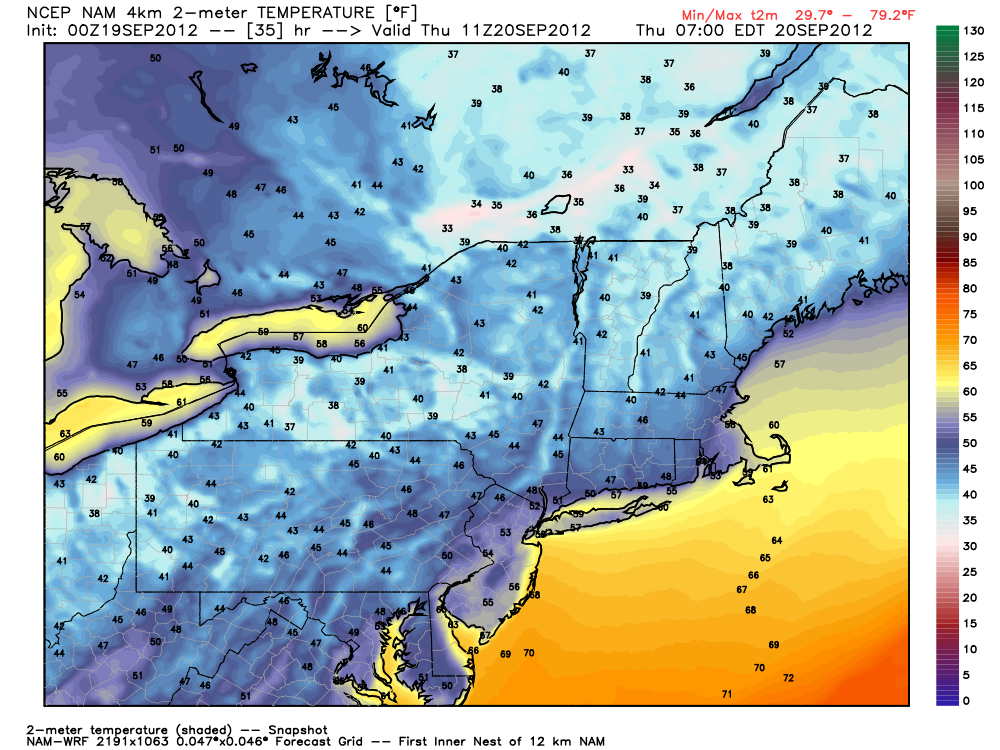
NAM-WRF Model showing low temperatures Thursday morning in the 30’s across New England, and upper 40’s to lower 50’s in parts of New Jersey and NYC.

West-northwest winds will help usher in drier air, which will be the biggest difference you’ll feel upon venturing outside during the mid-week. The humid air and gulf moisture which advected into the area on Tuesday ahead of the cold front has been swept out of the area, and the upper level trough approaching the region will bring the cooldown. Temperatures on Wednesday Night into Thursday morning are forecast to drop into the mid to upper 40’s inland, and lower 50’s in the city and urban areas. Across parts of New England, forecast models are hinting at the potential for temperatures to drop into the 30’s under clear skies and light winds!

The cooler air will moderate with time, as we will observe a warming trend in mid-day temperatures by the end of the week. However, it looks like more upper level troughs will progress towards the region (minus the big warm ups and storms ahead of them), likely keeping the weather on the cooler side of normal through the near future.

Wednesday: Cooler, but bright sun returns. Noticeable drop in humidity and much less wind. Still a bit of a breeze out of the northwest. Highs in the mid 70’s.

Thursday: Highs barely scrape into the lower 70’s with cool northwest winds prevailing. A cool start in the morning, too, with temperatures in the upper 40’s to lower 50’s.

Friday: Warmer than the past few days as the airmass begins to modify a bit. Highs in the middle 70’s, warmer in some spots. Light winds.

Severe Weather Threat With Tornadoes Possible Today

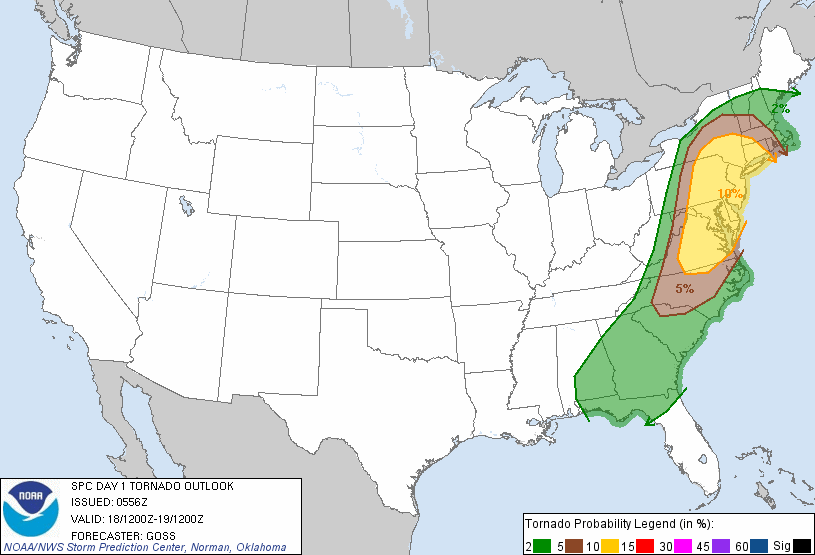
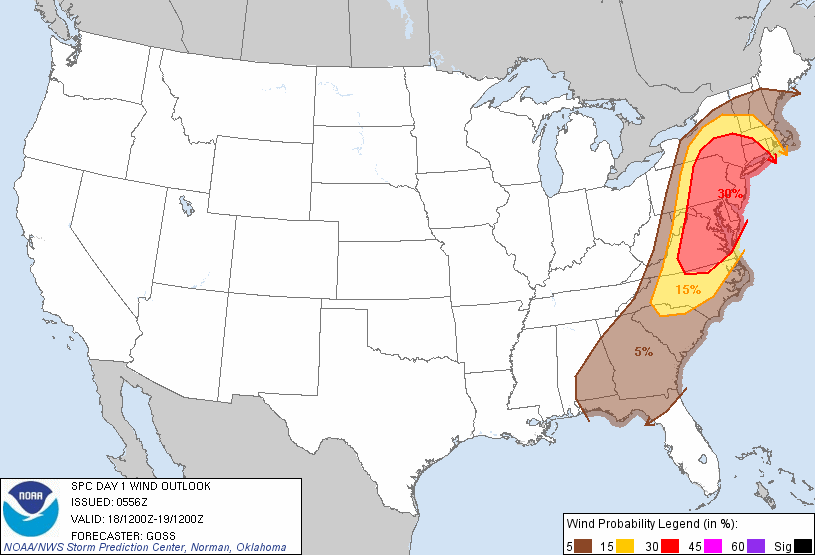
6z SPC Forecast, indicating a 10% tornado probability within 25 miles of a point (top) and a 30% severe wind (58mph gust or higher) probability within 25 miles of a point (bottom).

We have one of the most dynamic storm systems for the month of September in quite some time. The Storm Prediction Center has a “slight” risk of severe thunderstorms for the entire Metro area, but even more impressive is the 10% tornado contour and the 30% severe wind contour. There is also a 5% hail contour, but I would honestly be surprised if there were any hail reports.

We have a potent, amplified longwave trough diving down into the entire eastern half of the country with an associated powerful shortwave moving through the Northern Great Lakes and into Canada. This trough is phasing with ample tropical moisture to the south, helping to create a powerful, dynamic storm system. There will be a warm front moving across the area in the early morning hours, and a powerful cold front moving from west to east, crossing the Metro area in the late evening hours. There are two primary threats with this storm system: discrete low-topped supercells that may form some weak tornadoes, and a squall line entering the region in the late evening hours helping to produce very strong winds. Click “Read More” below to read full-length post. 

Read more

Forecast: Potential for strong storms Tuesday

It has been over a week since the area was last plagued by tumultuous weather. Mid to upper 70’s temperatures during the majority of the daytime hours, clear blue skies and light winds have been a staple in the areas weather for the majority of

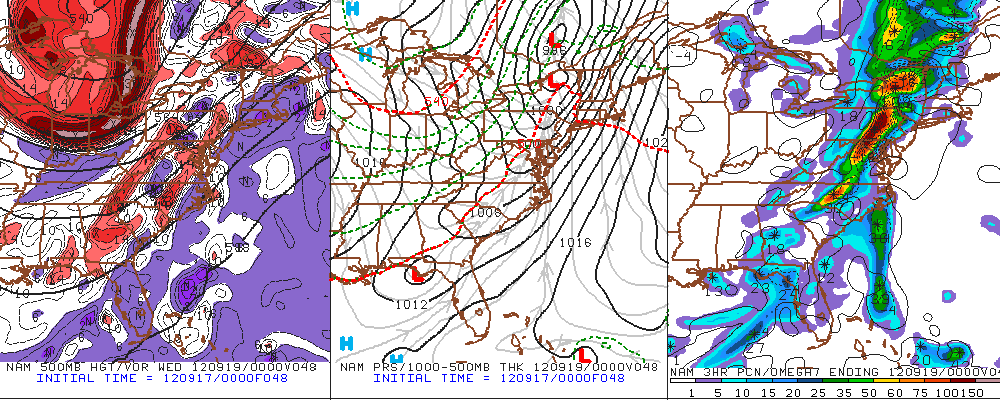
NAM Model showing the storm system forecast to impact the area on Tuesday, with a powerful mid level trough (left), strong surface low and cold front (center) and potential for heavy rain (right).

the aforementioned stretch of pleasant conditions. Even more impressive is the lack of precipitation — not even isolated showers or thunderstorms have been present since the big cold front with severe thunderstorms crossed the area a few weekends ago. However, the atmosphere is reloading and the potential for a more significant storm will once again rear its head early this coming week. Gulf moisture will surge north ahead of a large upper level trough which is expected to drop south/southeast into the Great Lakes before lifting northeast again into Southeast Canada. However, a strong surface low is forecast to develop over Western New York and drag a cold front from Western Pennsylvania and New York through New England and the Mid-Atlantic states. The cold front will serve as the focal point for the development of heavy rain and thunderstorms.

Storm Prediction Center Day 2 Outlook showing a Slight Risk for severe weather in the Northeast. Categorical (left) and probabilistic (right).

Quite possibly the most interesting development on forecast models, even moreso than the potential for heavy rain, is the magnitude of winds which exist just above the surface. Forecast models are indicating a powerful low level jet (a fast moving ribbon of air in the lower levels of the atmosphere) directly along and head of the cold front…with 50 to 60 knot winds at 900-950mb. Whenever these type of winds exist just above the surface, forecasters look for the potential for thunderstorms and convection to mix them down (as they could potentially cause damaging strong winds if that were to occur). In this situation, the forecast remains somewhat uncertain. The missing piece of the puzzle for a more widespread damaging wind event throughout the Northeast US seems to be the development of instability at the surface to help develop the thunderstorms. Without this, the storms will remain elevated and are much less likely to mix the strong winds down to the surface. Regardless, the Storm Prediction Center has placed our area in a “Slight Risk” for the potential of severe thunderstorms capable of producing damaging winds on Tuesday.

With all of this uncertainty, and talk of potential hazardous weather, it’s certainly important to reiterate that the main story with this storm will be the moderate to heavy rain which will be possible beginning around mid-day on Tuesday and continuing into early Wednesday. The change in weather from the last several days will be quite drastic, with gusty winds even ahead of the cold front and unrelated to thunderstorms. And, as we mentioned above, there is the potential for some hazardous weather (including damaging winds and isolated tornadoes) if some meteorological puzzle pieces fall into place. We’ll be sure to keep you updated with more details as the event draws closer. Remember to follow us on Twitter and Facebook for constant updates.

A Reanalysis of the Saturday September 8 Severe Weather Event

In some ways, the Saturday, September 8 Severe Weather Event exceeded expectations regarding the 70mph EF0 tornado in Breezy Point, NY and the 110mph EF1 (one MPH away from being an EF2) tornado in Canarsie, NY. In other ways, though, the severe weather event was underwhelming since the squall line weakened well before reaching the Metro region.

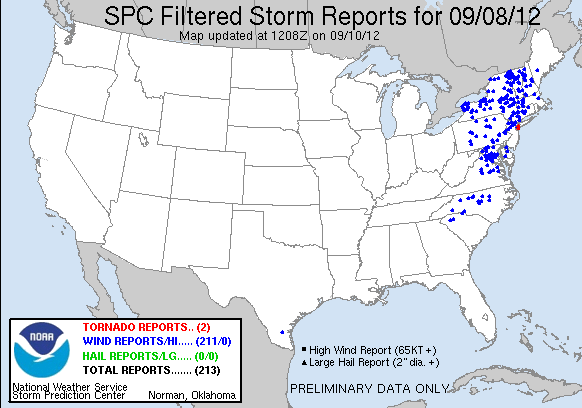
SPC Filtered Severe Storm Reports from Saturday, September 8th

Here are the SPC filtered severe weather reports from the event. There is a decent amount of coverage. However, notice the relative minimums in Pennsylvania, New Jersey, Long Island, and most of central and eastern New England. Additionally, notice that there were no high wind reports (65 knots or greater) and zero hail reports.

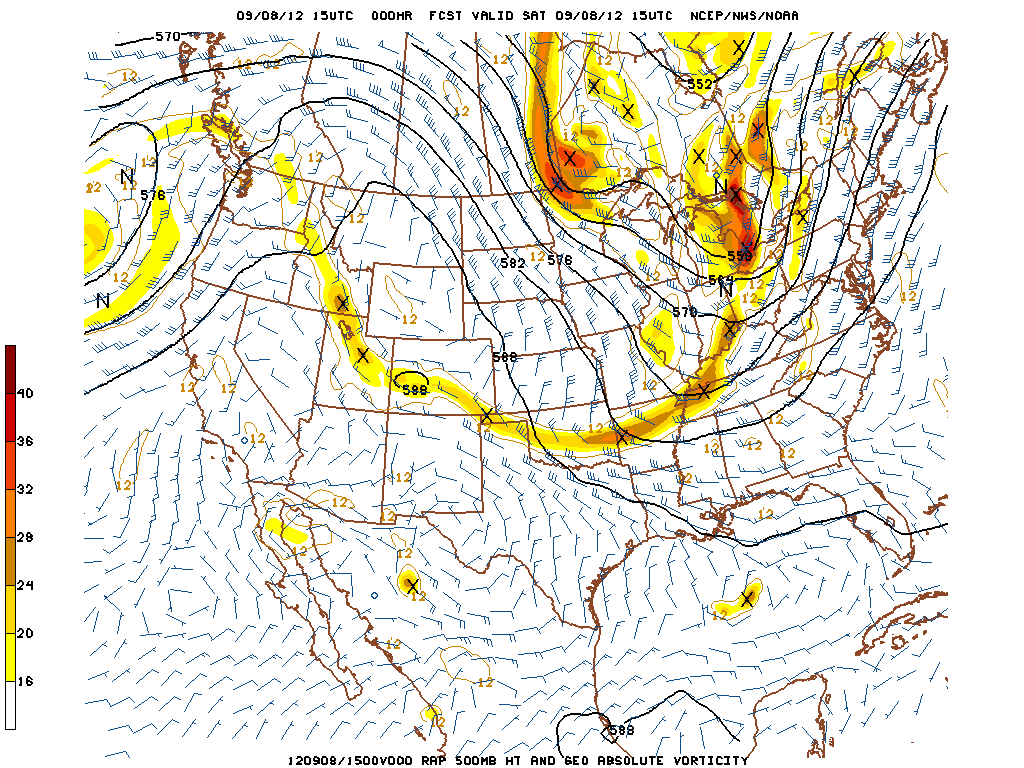
RAP 500mb Analysis from 15z, or 11am Saturday, September 8th

However, let’s start with the two tornadoes in Brooklyn. They occurred around 11am, which is 15z.


RAP analysis at 500mb showed a robust shortwave in the Great Lakes in association with a potent longwave trough. The shortwave was at our latitude at this point, which is important because this helped the synoptic scale forcing for lift stay at our latitude, at the time. Of course, the trough is still well west of the region, so the best forcing was closer to the base of the trough. But considering how potent the trough is, synoptic scale forcing can run out well ahead of the trough base, and combine that with surface-based instability, and lift is generated.


Read more