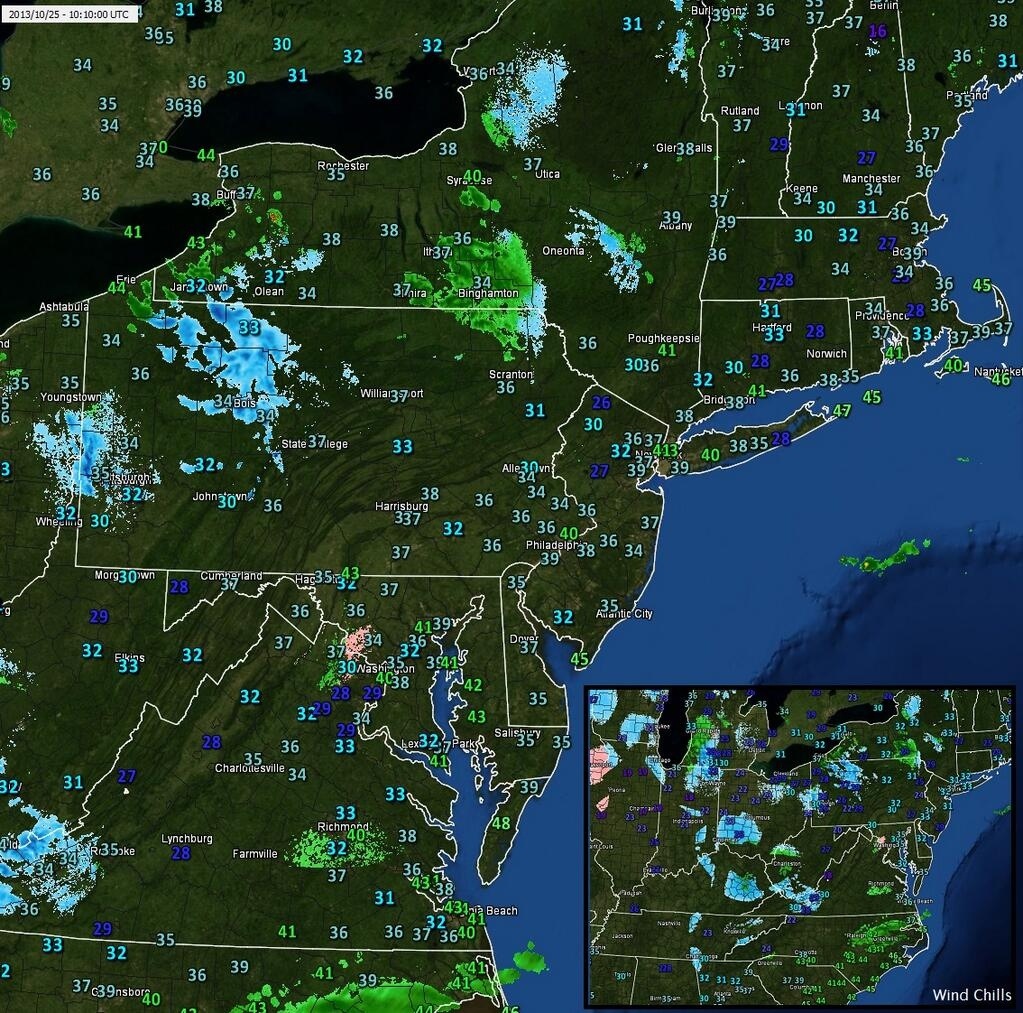
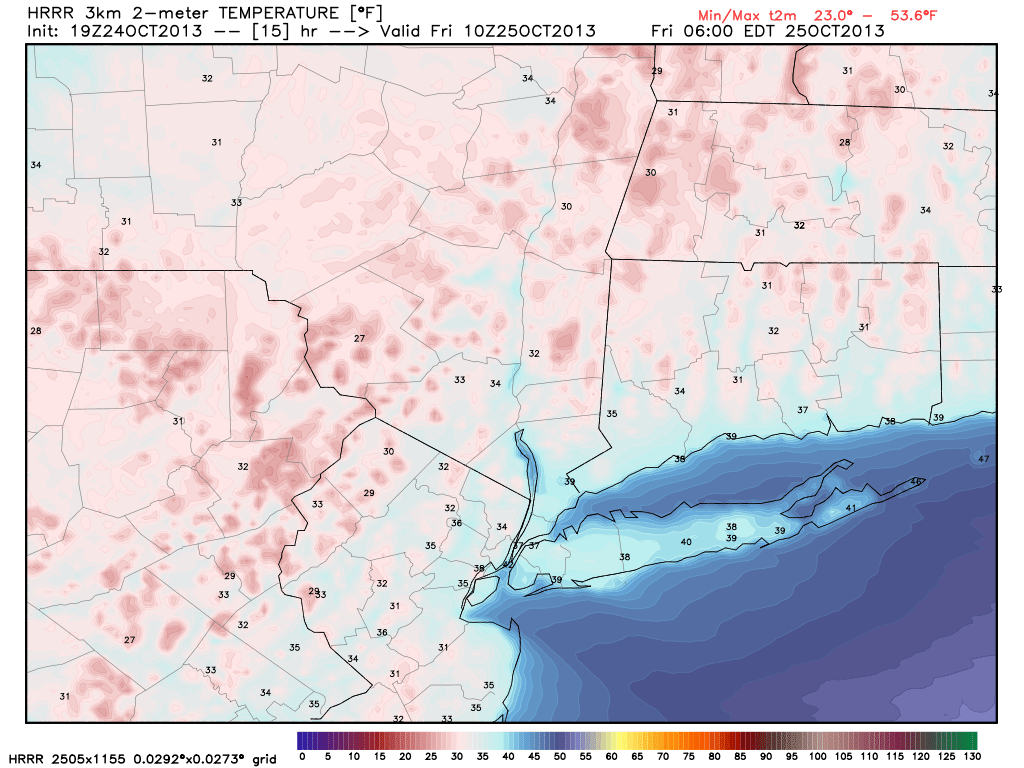
Friday morning was the coldest of the Autumn thus far, with temperatures falling into the 20s and 30s throughout much of the interior. Even urban locations fell into the upper 30s, owing to a very cold airmass aloft and excellent radiational cooling with clear skies and light winds. The growing season officially ended across much of the area suburbs. Friday will remain feeling chillier than much of this Autumn season has, with high temperatures topping out in the middle 50s and an occasional westerly wind gust.
The plus side of the cooler airmass settled into the area will undoubtedly be the presence of abundant sunshine. Dry air remains in place — as has been the case this entire month. In fact, October 2013 is shaping up to make a run for the top 5 driest Octobers on record in New York City. The pattern, not surprisingly, looks dry through the early to middle part of next week at the very earliest. This weekend will be pleasant, albeit a bit chilly, similarly to Thursday and Friday.
Observations and radar in the Northeast early Friday morning (WeatherNut, Twitter).
https://www.nymetroweather.com/wp-content/uploads/2024/02/Empire-2000-x-300-px-2.png00John Homenukhttps://www.nymetroweather.com/wp-content/uploads/2024/02/Empire-2000-x-300-px-2.pngJohn Homenuk2013-10-25 07:55:062013-10-25 09:34:48Brisk, but sunny end to the week
Temperatures plummeted into the upper 20s to low 30s early Thursday morning, and although it remained warmer in the city, many interior areas saw the growing season end. Such was the case for Sussex, Morris, Warren, Somerset and Hunterdon counties in New Jersey. Tonight will offer even colder temperatures, owing to a cold airmass settled in aloft as well as clear skies and light winds.
850mb temperatures have fallen to below -4 throughout much of the area — and temperatures responded today. Highs topped out in the 50’s with blustery west winds, a stark reminder that winter is in fact on the way. The same feel will be in the air tonight. Dew points have fallen dramatically, and the clearing skies and light winds will allow for better radiational cooling. Temperatures are expected to fall into the upper 20s across the interior — and the 30s even in the city.
NAM model, showing temperatures falling into the 20’s and 30’s overnight tonight into Friday morning.
https://www.nymetroweather.com/wp-content/uploads/2024/02/Empire-2000-x-300-px-2.png00John Homenukhttps://www.nymetroweather.com/wp-content/uploads/2024/02/Empire-2000-x-300-px-2.pngJohn Homenuk2013-10-24 17:30:242013-10-24 17:58:10PM Update: Even colder evening on the way
One of the most fascinating aspects of Sandy was how strong she was, despite entering cooler waters. Hurricanes have a strong warm core at the surface, weaken with height, and are barotropic — meaning there are no temperature or density gradients in their environment. This means that they are symmetric — their warm core is entirely surrounded by slightly cooler, but still abundantly warm air. The combination leads to them being vertically stacked (not tilted with height). Thus, hurricanes need warm water and weak upper-level winds in order to strengthen. Strong upper-level winds can choke a hurricane’s outflow channel, and advect new airmasses of different temperatures — providing temperature gradients that hinder their development. In further south latitudes, waters tend to be warmer, and the jet stream tends to be weak. As you head further north, however, the water becomes colder and the jet stream strengthens, leading to stronger upper-level winds. This helps to weaken a hurricane’s warm core at the surface, and tilt its vertically stacked structure, weakening the storm. However, as Sandy headed north, she was able to maintain category one hurricane strength with abnormally low pressures and eventually went on to cause widespread devastation. Why?
Sandy was able to maintain strength and deepen as she became a hybrid of a tropical low and an extratropical low. Strong extratropical lows, such as nor’easters, have cold cores at the surface. Instead of being vertically stacked, they tilted towards cold air with height. This means that they are baroclinic; thermal and density gradients exist in their environment, including frontal systems. More specifically, they are asymmetric — with cold air on the west side of the circulation, and warm air on the east side (by definition, a temperature gradient). Sandy was a hybrid in that she had a warm core of strong winds, but was also asymmetrical, meaning her strength was aided by strong upper-level winds and thermal gradients, instead of being hindered by them.
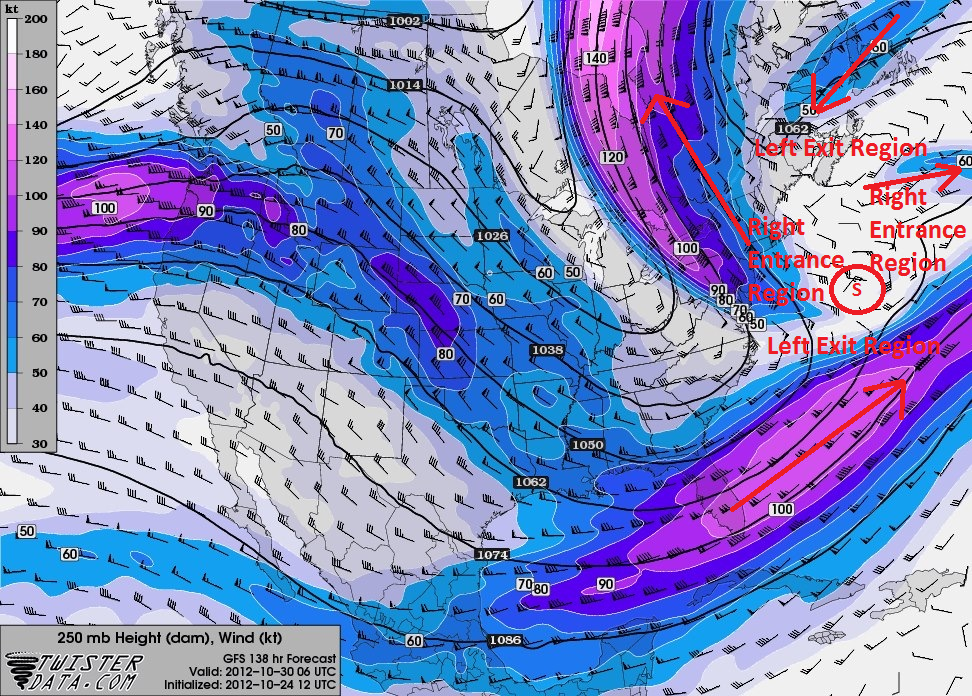
The large trough that phased with and turned Sandy to the west had an abundant source of cold air and strong upper-level winds. There were actually reports of 2-3 feet of snow in West Virginia! That cold air was able to clash with the warmer, tropical air, creating a steep thermal gradient, helping Sandy’s pressures to deepen, despite heading towards colder waters. Additionally, there were several sources of strong upper-level winds that were all co-located in a perfectposition for serious strengthening. When forecasters saw these localized areas of strong upper-level winds (also called jet streaks), it was pretty evident that the model solutions which took Sandy to pressures around 940mb at landfall were not off the wall, and were very much possible.
A GFS forecast showed that Sandy was located in the presence of four different jet steaks — each one favoring a strengthening storm. Sandy is denoted with the circle and the “S” inside. The jet streak regions are drawn and labeled as well.
A chilly new airmass will push into the area this evening behind a coastal storm system, which is currently scooting east and northeast of our area. A few showers moved along the coasts of New Jersey and New York this morning and afternoon, but are expected to move northeastward and stream into Southern New England tonight. As the system shifts northeast, stiff west-northwesterly winds behind it will usher in a cold airmass with 850mb temperatures falling from around 2 C this afternoon to anywhere between -4 and -6 C by Thursday.
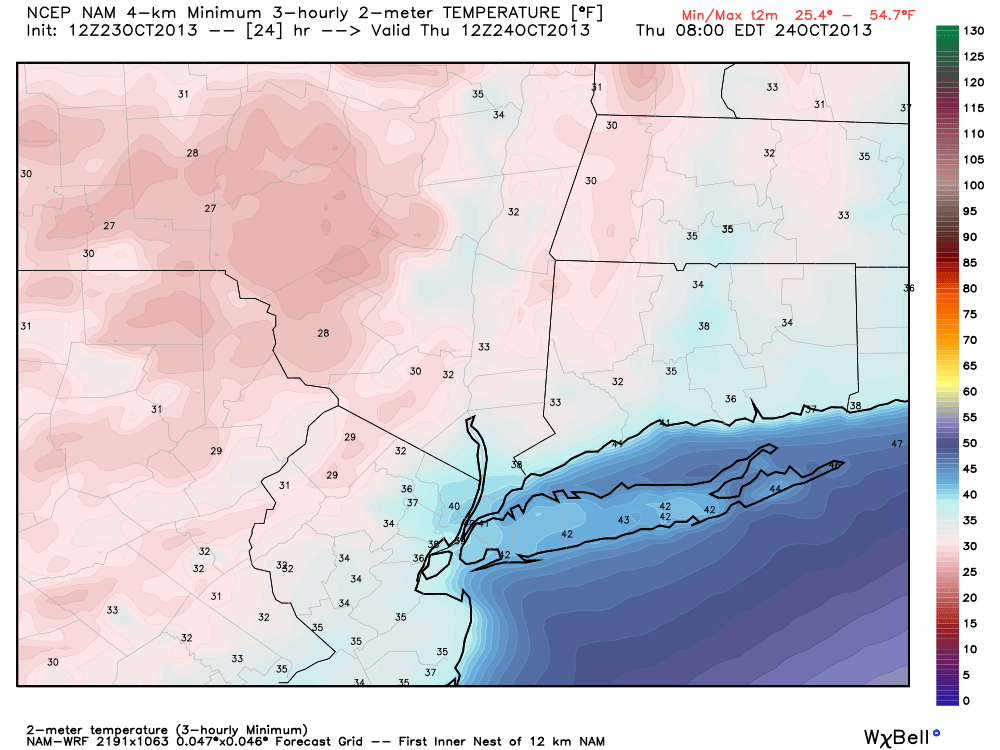
The National Weather Service has issued Freeze Warnings from 2:00-9:00am Thursday in Sussex Co (NJ) and Frost Advisories for Somerset, Morris, Hunterdon, Passaic, Bergen (NJ) Rockland, Putnam (NY) and Fairfield, New Haven (CT). Temperatures are expected to remain a few degrees warmer in the city, falling to the lower 40’s. The growing season may end tonight in many interior areas — and will have another chance to do so Thursday Night into Friday, where low temperatures are expected to be even a few degrees colder.
NAM model forecasting low temperatures in the upper 20’s to lower 30’s in the interior Wednesday Night into Thursday morning.
Hi friends! Our website uses cookies to provide an optimal browsing experience for you. New "Cookie Consent" laws mandate us to inform you of this. As long as you're cool with it, just hit OK. You'll only see this message once.
We may request cookies to be set on your device. We use cookies to let us know when you visit our websites, how you interact with us, to enrich your user experience, and to customize your relationship with our website.
Click on the different category headings to find out more. You can also change some of your preferences. Note that blocking some types of cookies may impact your experience on our websites and the services we are able to offer.
Essential Website Cookies
These cookies are strictly necessary to provide you with services available through our website and to use some of its features.
Because these cookies are strictly necessary to deliver the website, refusing them will have impact how our site functions. You always can block or delete cookies by changing your browser settings and force blocking all cookies on this website. But this will always prompt you to accept/refuse cookies when revisiting our site.
We fully respect if you want to refuse cookies but to avoid asking you again and again kindly allow us to store a cookie for that. You are free to opt out any time or opt in for other cookies to get a better experience. If you refuse cookies we will remove all set cookies in our domain.
We provide you with a list of stored cookies on your computer in our domain so you can check what we stored. Due to security reasons we are not able to show or modify cookies from other domains. You can check these in your browser security settings.
Other external services
We also use different external services like Google Webfonts, Google Maps, and external Video providers. Since these providers may collect personal data like your IP address we allow you to block them here. Please be aware that this might heavily reduce the functionality and appearance of our site. Changes will take effect once you reload the page.