
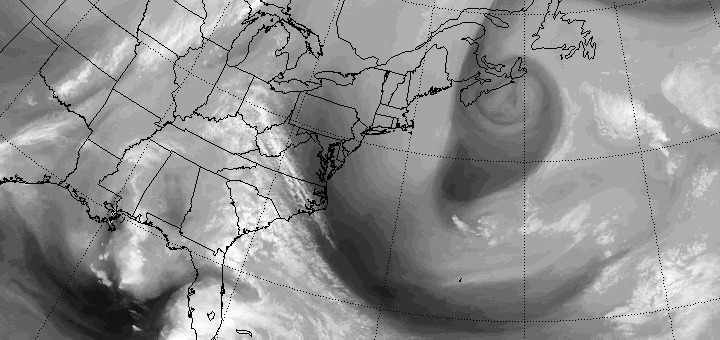
Blocking sends disturbance south from Greenland

High latitude blocking, which we discussed earlier this week as an important predictor in summer temperature patterns around our area, is at it again. A large and anomalous blocking ridge, building north from Canada towards the higher latitudes into Newfoundland and Southeastern Greenland, is forcing a disturbance and upper level low to shift southward. The disturbance will track southward today — and can be seen on water vapor and visible satellite imagery early this afternoon. The feature won’t directly impact our area, nor will it cause any widespread unsettled weather on the east coast, but it could reinforce east/southeasterly winds as it passes later this week.

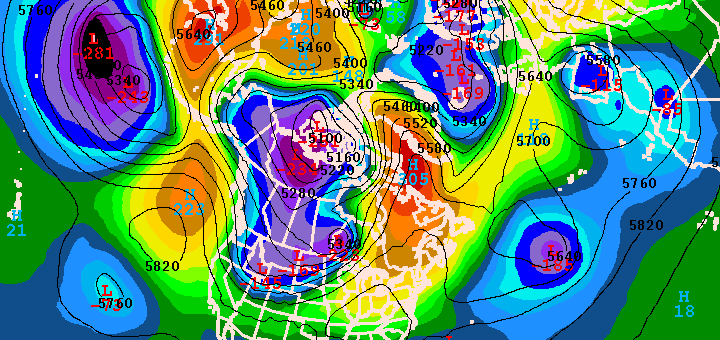
The track of the disturbance is the most unusual. To see an upper level low or disturbance track southward from Greenland all the way to a point just a few hundred miles off of the US East Coast is exceedingly rare. However, one glance at the blocking pattern aloft tells you the story — the disturbance had nowhere else to go, being forced into a small window between the trough over the Atlantic and the blocking ridge to the west over Canada. (Click read more for more imagery).
Read more

NASA imagery captures massive CME

As benign and inactive as the weather pattern has been the last several days in the NYC Area, the sun has been conjuring up some major developments. And it’s acting up again. On Monday a corona mass ejection, otherwise known as a CME, occurred on the edge of the sun. CME’ s are common during the suns more active periods — one of which we are heading into. The more active solar cycle has been underwhelming thus far, but NASA was able to capture Monday’s CME with an incredible high resolution video. Attached below, the video shows the CME erupting off the sun in a rolling wave — shooting billions of tons of particles into space at millions of miles per hour.

Read more

Does blocking in May hint at summer weather?

Seasonal forecasting is one of the more tedious and intricate tasks for meteorologists. Not only is it difficult to predict by nature (no pun intended) — but forecast model accuracy skill is greatly reduced at that range. Often, meteorologists find themselves looking back towards past events, and analogs, for help with predicting the months ahead. In our case, interest was piqued when we noted what seemed to be higher than normal frequency of high latitude blocking this year. Hurricane Sandy, the nor’easter which immediately followed, and many events this winter featured patterns that were driven by blocking patterns over Canada, Greenland, and the higher latitudes towards the pole. The blocking pattern was not overly anomalous at least on a per-year basis, but it certainly seemed to be more frequent than the calendar year which preceded it.

As we look forward to May, forecast models are in agreement on the continuation of higher than normal height anomalies at 500mb over Central and Eastern Canada as well as farther north towards Greenland. The continuation of blocking in the higher latitudes, relative to our location, can offer some interesting insights into the summer temperature forecast as we move forward. Is there a common theme amongst the historically warm and historically cool summers in the NYC Area — and can we relate it to Springtime blocking patterns? The answer, may surprisingly to some, is yes.  For the sake of example, take the summer of 2009 and the summer of 2010. Both of these years featured wildly different patterns, with 2009 remaining very cool throughout the summer while 2010 was warm. In 2009, there was very little blocking observed from March through May. 2010, on the other hand, featured periodic blocking in the high latitudes from February through May. Interested yet?

Read more

Despite deary start, sun returns by midweek

[alert type=”success”]Special: Check out our daily video forecast. If you wish to view a video forecast each day, register with us and head to the “Video” page under the Members tab. Enjoy![/alert]

Dreary conditions, which took control of the areas weather on Monday into early Tuesday, will give way to the return to sun and seasonable temperatures by later on Tuesday. After a cloudy and potentially drizzly start to the day, high pressure to the north and east will begin to strengthen and nudge towards the area as an atmospheric disturbance aloft weakens. As this occurs, clearing is expected to push into the area from the east. Areas that see the sun on Tuesday will be able to warm up into the 60’s despite a light east/southeasterly wind.

Read more