Monday’s snow threat trends north, still a concern

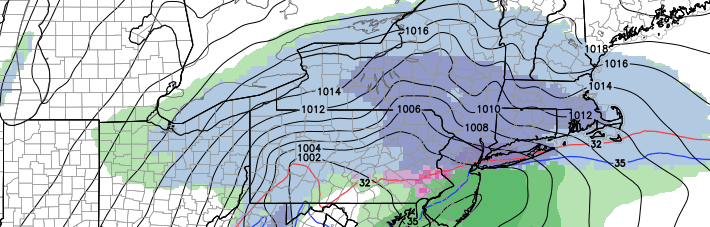
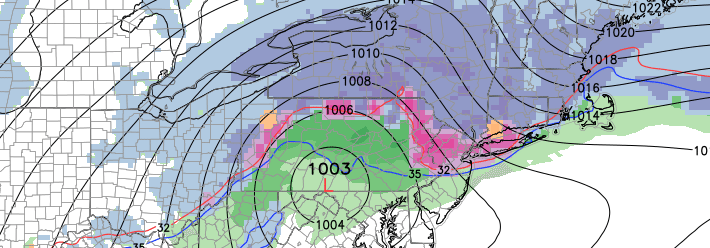
The winter weather potential for late this weekend into early next week has been well advertised. A low pressure system is forecast to develop from the Ohio Valley into the Northeast states late this weekend, along a thermal gradient otherwise known as a baroclinic zone, and force the development of precipitation in the Northeast States. Forecast models, however, had been displaying tremendous uncertainty with the positioning of that thermal gradient — uncertainties which were well documented. The past 48 hours have seen forecast models trend farther north with the thermal gradient, changing the complexion of the storm threat completely.

What this means for our area, is that precipitation type and amounts become less certain. The thermal gradient, essentially, is a boundary where there is a large temperature gradient over a short distance. Along and just north of this zone, enhanced lift for precipitation can occur as the development of a low pressure system is promoted near or just south of it. With this gradient trending north, forecast models have introduced warmer temperatures in the mid levels, and have shifted precipitation northward into New England.

Read more

Multiple winter weather threats to begin February

On the heels of two (arguably three) major winter weather events in the Northeast United States, many are wondering just when the pattern will slow down. The answer: Not soon. Medium and long range forecast models are in good agreement that  an active pattern will continue in the foreseeable future as the Pacific Jet continues to send multiple disturbances into the United States. Fluctuating amplitude of both a ridge on the West Coast and high latitude blocking over the Arctic regions will keep things from getting downright snowy and cold for a prolonged period, but the potential for winter weather events for at least the first few weeks of February looks to be heightened.

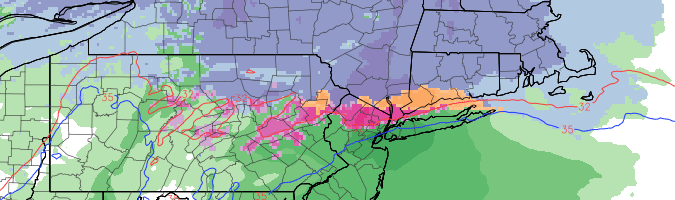
The first threat will come as early as the tail end of this week — small, but nonetheless noteworthy as it comes on the heels of an arctic front. Short term forecast models are in agreement that a wave of low pressure will develop along this frontal boundary on Thursday, with moisture streaming north/northeastward along it. The best support for heavy precipitation will remain well offshore. But enough moisture looks to stream along the front within a coupled jet structure aloft to allow for steady precipitation to push eastward from Pennsylvania through New England and the Northern Mid Atlantic.

Read more

Why Monday’s storm will disappoint NYC snow lovers

Much has been made over the past few days about a potential winter weather event in New York City on Monday morning. Vindication, they’ve called it. After the Blizzard of 2015 barely skirted our area and brought historic snowfall to New England, this Monday’s event was seen by snow lovers as the makeup-call to our blown chance last week. But, we say, not so fast. Despite what forecast models have hinted at over the past few days, there are meteorological elements to this storm system which not only argue against significant snowfall in New York City — but in fact, argue for a few inches of snow followed by sleet and then plain rain. A snow lovers nightmare.

For those who aren’t enamored by snowfall in New York, this article will serve as a bit of detail and an opportunity for understanding some atmospheric processes which are going to be occurring on Sunday Night into Monday Morning. There is a method to the madness of meteorologists, despite what the public opinion may have been on Tuesday morning when most woke up to much less snow than they anticipated.

Read more

What we know about Monday’s potential snowstorm

On the heels of a low pressure system which brought light snowfall to the area on Friday, a shortwave will drive southward through the Plains states on Saturday. Coming over the top of a mid and upper level ridge on the West Coast of the United States, the shortwave is forecast to amplify southward from the Plains states through the Mississippi and Ohio Valleys by Sunday. As a result, a surface low pressure will form and move from the Mid Atlantic States to a position off the Northeast Coast by Monday morning and afternoon.

Forecast models have been struggling to pin down details in regards to the mid and upper level features which will characterize the storm system. Earlier this week, models were in good agreement that the storm system would take a more southerly track. With the surface low moving from the Mississippi Valley to the Southern Mid Atlantic Coast, the main concern for our area would be precipitation staying too far south for meaningful snowfall. But in the past 24 hours, a noticeable trend toward a more amplified solution has emerged. Forecast models now track the system off the coast of New Jersey — raising concerns that precipitation type may change to sleet or rain across portions of the area on Monday.

Read more