An Early Look at the Pattern for Thanksgiving Week

The days before Thanksgiving are some of the busiest travel days of the year, meaning that the weather has an even larger impact than usual. Accordingly, we have already been keeping an eye on model guidance for this period. While it’s still too far out to forecast with confidence, our November outlook did show some cooling to near average later this month, with an overall warm month in the means. Not coincidentally, there does appear to be some kind of pattern change on the model guidance that has piqued our interest.

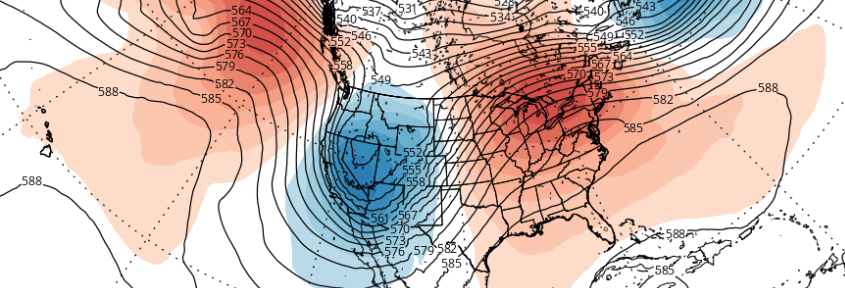
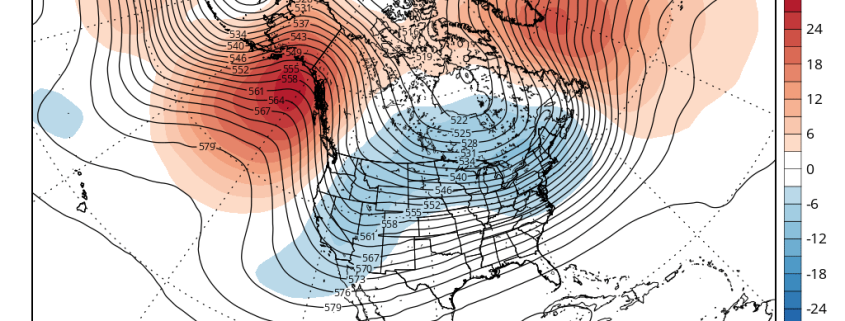
Forecast models and their ensembles have consistently showed above normal 500mb heights developing early next week over the Northeast Pacific. These heights extend up to Alaska, which causes the Eastern Pacific Oscillation (EPO) to go into its negative phase. Another ridge initially over the eastern US this will be forced to build into the Davis Strait and Greenland — temporarily bringing the North Atlantic Oscillation (NAO) down into its negative phase as well. This pattern will bring one or two cold shots into the Western and Central US on Thanksgiving week. The main questions are: a) will this airmass make it into the Eastern US, b) if so, how much (if any) modification will there be, and c) how long will this colder regime last?
Read more

The Importance of High Latitude Blocking in The Upcoming Winter

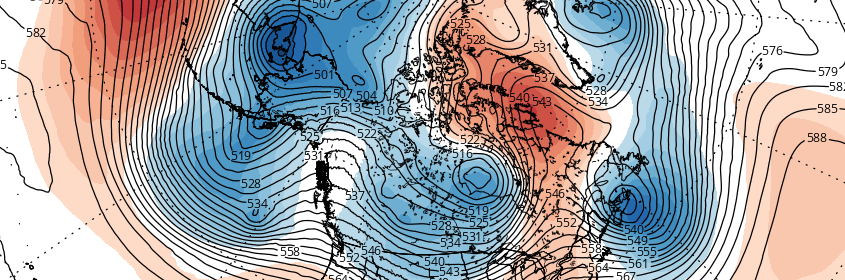
In our winter forecast, we discussed certain signals that supported high-latitude blocking developing for the middle and late periods of this upcoming winter. High-latitude blocking often comes with negative phases of the North Atlantic Oscillation (NAO), the Artic Oscillation (AO), and/or the Eastern Pacific Oscillation (EPO). High-latitude blocking is one most important factors in any winter forecast, as it typically supports colder temperatures and larger snowstorms for the Northeast US. This is an even more important factor in during a strong El Nino winter, as the Pacific or Subtropical jet is generally more active and stronger.

Research from Al Marinaro (@wxmidwest ) brought to light a strong correlation between the sea-level pressures in North Pacific and the NAO modality, during +ENSO (El Nino) winters. North Pacific sea-level pressures less than 1013 mb had a -NAO value on average for the December, January, February, and March period (DJFM). Sea-level pressures above 1013 mb during the month of October had either a positive NAO value or very close to netrual in the following winter. An official pressure for North Pacific reading has not been released for October yet. However, NCEP/NCAR reanalysis tells us that sea-level pressures were on average around 1010 mb over the region 65N-30 & 160E-140W in the North Pacific. That would be well-below the 1013mb threshold for a -NAO DJFM.

Read more

Monitoring the Stratosphere in November

Well, we’d be wrong not to mention that we are all rejuvenating from releasing our winter forecast for 2015-16. We hoped you all enjoyed reading it –whether or not it was what you were hoping to hear. It took a lot of collaboration, research, and efforts between all of us here to put it together.

In the upcoming days, we plan for a series of technical posts for our premium subscribers to explore more on important topics from the winter forecast. For this post,  we discuss more about Stratospheric Warming.

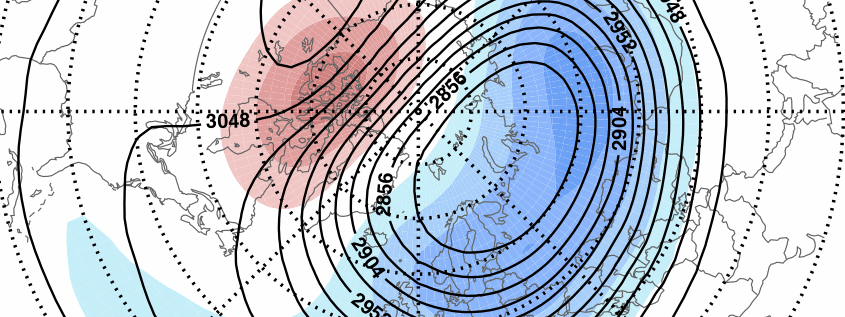
There’s been a high volume of discussion within the weather community regarding snow cover extent over Eurasia, and it’s potential foreshadowing of Sudden Stratospheric Warming (SSW) events, which may be correlated to a negative Artic Oscillation phase (-AO), 2 to 3 weeks thereafter.  According to the automated graph below, snow cover is now expanding and running close to 2009 at this time. As some of you may already know, the winter following that was featured colder than normal temperatures with above normal snowfall for December; and then same again in February. We also had a minor stratospheric warming in event in November, before a major SSW later in January and February.

Read more

November 2015 Outlook: Above Average Temperatures Likely

It’s that time of Autumn again, where weather enthusiasts start looking into the longer range forecasts for  telleconnections, pattern changes, and the first chance of snowfall; while everyone else who dreads winter will start shopping for new coats, boots and shovels. For now, it’s snow haters rejoice: It appears there will be very little wintry weather through most, if not all, of November.

Read more