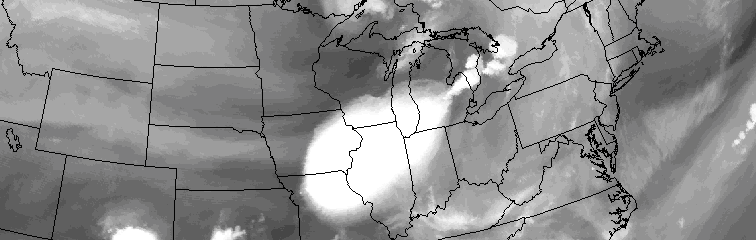
Severe thunderstorms possible this afternoon and evening

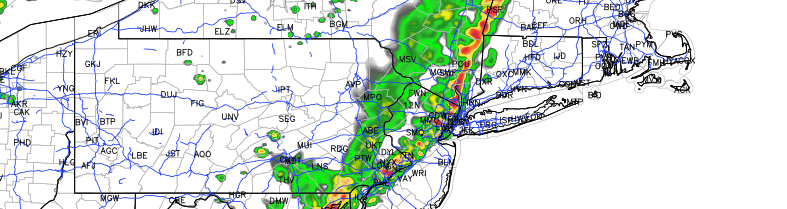
12:30pm: This morning, we initially had a strong area of showers and rumbles of thunder in Pennsylvania that was moving toward our area. if it hit us, the atmosphere would have stabilized and the severe threat for thunderstorms would have significantly gone down.
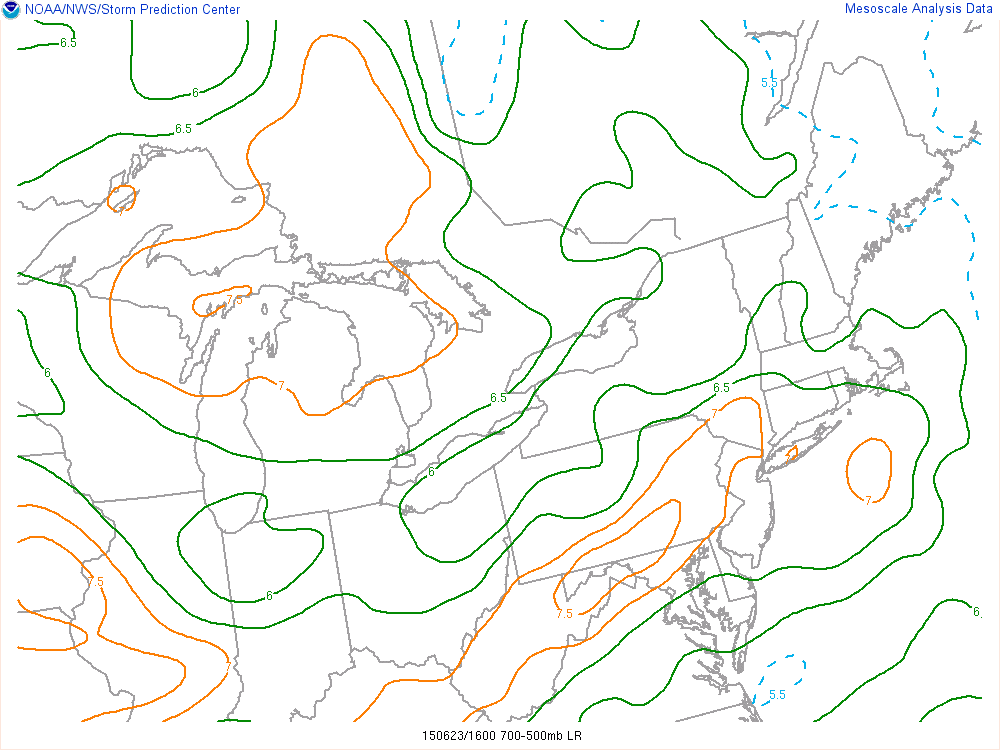
Current SPC Mesoanalysis as of noon shows an area of mid-level lapse rates in excess of 7C/KM in our area. This is very significant, as it leads to plenty of instability in the middle of the atmosphere, as well as providing a capping inversion below it that weakens any weak convection and keeps us sunny and unstable.

Current SPC Mesoanalysis as of noon shows an area of mid-level lapse rates in excess of 7C/KM in our area. This is very significant, as it leads to plenty of instability in the middle of the atmosphere, as well as providing a capping inversion below it that weakens any weak convection and keeps us sunny and unstable.

However, the EML we discussed yesterday was able to work its way into the region and provide a capping area that completely disintegrated this area of showers. This means that clouds will quickly be disintegrating, and we will quickly be able to destabilize the atmosphere, making it very ripe for severe weather.
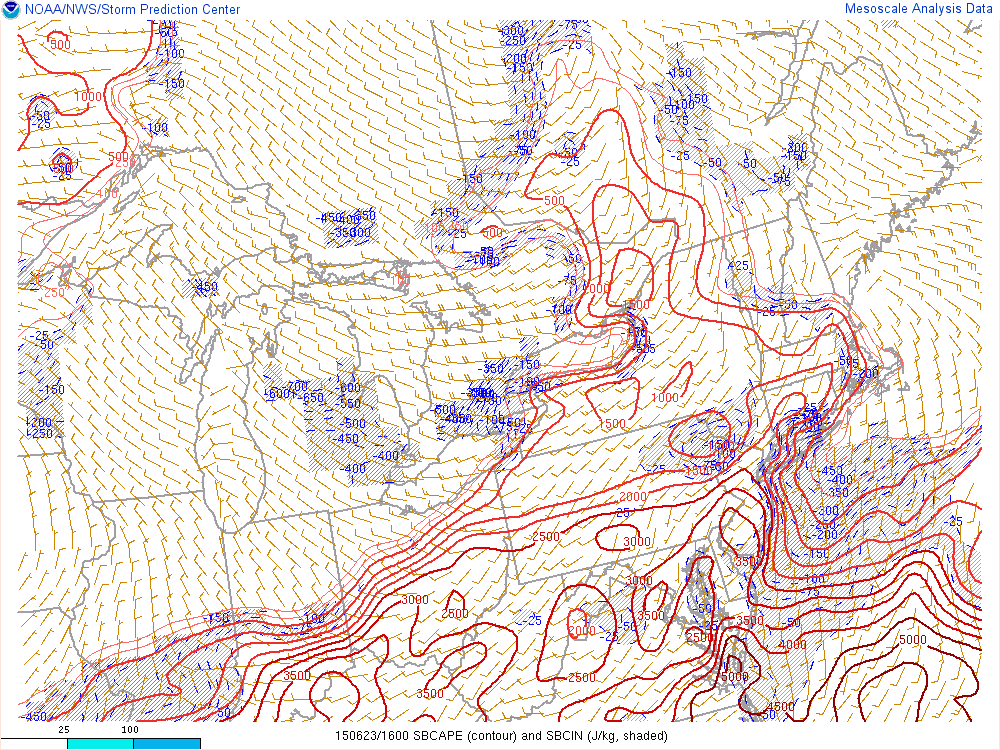
Current Mesoanalysis from the SPC shows already building values of surface-based CAPE.

Current Mesoanalysis from the SPC shows already building values of surface-based CAPE.

In fact, surface-based CAPE values are already in excess of 3,000 J/KG in many areas, which is actually ahead of schedule. When this is combined with the strong mid-level lapse rates and strong wind shear, severe weather is expected to hit a decent chunk of our area later this afternoon. The primary threat will be damaging wind gusts and vivid lightning, but large hail is also a threat, and a tornado threat is non-zero.

—–

An energetic mid level disturbance, impressive wind shear, and moderate to significant atmospheric instability will combine to create an enhanced threat for organized severe thunderstorms in the Northeast US on Tuesday. While some uncertainties still exist in regards to exactly how the event will unfold, confidence is rising in the heightened threat for severe thunderstorms — even in the NJ and NYC Metro Area. While not everyone will experience a severe storm, the threat for organized thunderstorms is much higher than normal today.

Thunderstorms are forecast to develop over Northern Pennsylvania and New York State, and begin progressing southeastward throughout the day. Meanwhile, atmospheric destabilization will occur over much of New England, the NYC Metro, New Jersey, and the Mid Atlantic. Instability parameters are expected to be quite high, especially by Northeast US standards. With more than adequate wind shear for thunderstorm organization, these storms are expected to spread southeast toward the coast during the late afternoon and evening.

This post will serve as a Live Blog throughout the day for updates and information on the latest analysis as well as a relay point for Watches and Warnings from the Storm Prediction Center and Local NWS offices. A de-brief on the threat is below:
Read more

Isolated severe thunderstorms likely today

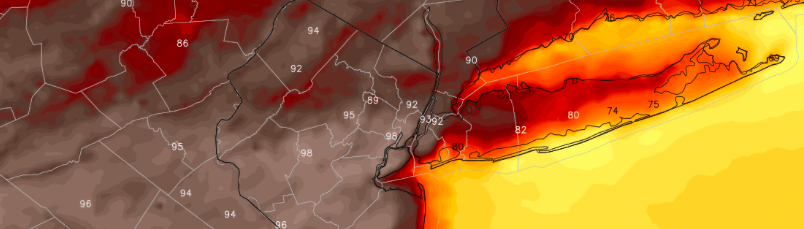
A deep southwesterly flow has developed this morning, allowing for increasingly warm mid level temperatures to advect into the area. Surface temperatures, as a result, are expected to rise much higher today than they did on Wednesday. Temperatures in the low 90’s are anticipated by early afternoon throughout much of New Jersey and New York City. Humidity will be on the rise as well. An Air Quality Alert is in effect for parts of NJ and NYC today, which means you should avoid prolonged exposure to the heat and humidity as air quality will be subpar. 

A wind shift boundary, sitting just to our north over the Lower Hudson Valley, will serve to enhance the development of instability to its south. Models are in good agreement that upward of 2500 joules of Surface Based CAPE will develop from Eastern PA into New Jersey and New York City during this afternoon. These numbers are quite high for our area — especially during this time of year.

Read more

Slight risk for strong storms this evening

The Storm Prediction Center has placed much of the area from New York City westward in a Slight Risk for severe thunderstorms this afternoon and evening. Ahead of an approaching frontal boundary, warm and humid air is advecting northward into the region. Increasing dew points and surface heating will lead to the development of moderate instability throughout the area by the afternoon hours. Accordingly, the approaching front will aid in the development of storms from Eastern Pennsylvania into Western New Jersey.

These storms will move toward a narrow axis of instability over New Jersey reaching toward New York City this afternoon. Narrow, only because east of New York City a stout marine layer will remain in place. This will keep storms elevated and weaker — temperatures there will be cooler as well with less instability. Nevertheless, the storms will march eastward through New Jersey toward NYC right around the PM Commute. The main threats with any storms will be gusty winds, lightning, and heavy rain.

This post will be updated throughout the day with the latest information including watches and warnings.

Read more

Spring Weather: Severe thunderstorms, and the SPC

Each year, as the atmospheric pattern begins to undergo a transition and wavelengths begin to change, the threat for strong to severe thunderstorms becomes a focus of the meteorological community in New Jersey, New York and Connecticut. Spring, in fact, marks the beginning of “Severe Weather” season in our area — which generally has been known to begin on May 1st. There have obviously been severe thunderstorms before May 1st, but in general the most consistent potential for organized severe storms begins in May and ends in August or September.

Interestingly enough, severe thunderstorms feature some terminology and atmospheric interactions which can be very confusing not only to interpret as meteorologists, but to understand on the public level. Knowing the basics of how organized thunderstorm events develop, and how forecasters attempt to predict and quantify their potential, will help to make things a little less confusing when severe weather season comes around this year.

Read more