Severe Weather Possible This Afternoon, Yet Another Unstable Pattern Next Week

Good Afternoon! 

Despite some heavy showers and thunderstorms that moved through the immediate New York metro area this morning, most of the area was able to clear out quite significantly this afternoon. With high humidity in place and full sunshine, we saw the development of numerous cumulus clouds, especially to the north and west of the city. With instability rising gradually through the early afternoon hours, shear kicking in, and forcing from an approaching upper level trough all coming together, we have seen numerous showers and thunderstorms go up over portions of the Mid Atlantic and Northeast regions. Given rather unimpressive lapse rates, unidirectional shear vectors, and a general broad area of forcing, this activity has mainly been limited to multi-cellular and pulse-cell storms. These storms will mainly be capable of damaging winds and possibly a wet micro burst or two, as the weak mid level lapse rates will fail to sustain any significant updrafts over much of the region. As these updrafts collapse over time, they may do so rather quickly, leading to winds up to 60 mph and torrential downpours, which may cause localized flooding.

However, as we head deeper into western Pennsylvania and New York state, the vertical wind shear profile becomes a little more favorable for more organized convection, and we have seen some embedded supercell structures form within larger convective masses. These storms will have a much higher threat of damaging winds, large hail, and even a brief tornado or two. This stronger activity will likely remain exclusive to this region, as the severe parameters quickly become less supportive for anything too strong the further east you head.

Regardless, the rest of the afternoon should remain quite nice for a typical August day, with highs deep into the 80’s-possibly getting to that 90 degree mark in some locations. As we mentioned before, humidity will be increasing ahead of the front located off to our east, so it will feel quite muggy out, and any locations that saw some of the heaviest rains this morning will have the added moisture in the air from evapotranspiration.

As we head into the evening hours, we should see the development of more showers and thunderstorms over the Northeast, as the previous cells begin to collapse and leave convergent boundaries as to which new thunderstorms can form along. Winds from the south will continue to pump moisture/instability into the area, with CAPE values remaining in the 1200-2800j/kg^2 range until sunset. In addition to the instability in place, a very weak warm front will be passing through the region, and this may work to locally improve wind fields, but only to a small extent. At this time, it appears that the best chance for showers and thunderstorms this evening will be over portions of southern New York, eastern Pennsylvania, and possibly far northwest New Jersey. These showers and thunderstorms should mainly be capable of producing gusty winds and small hail, with heavy rain likely as well.
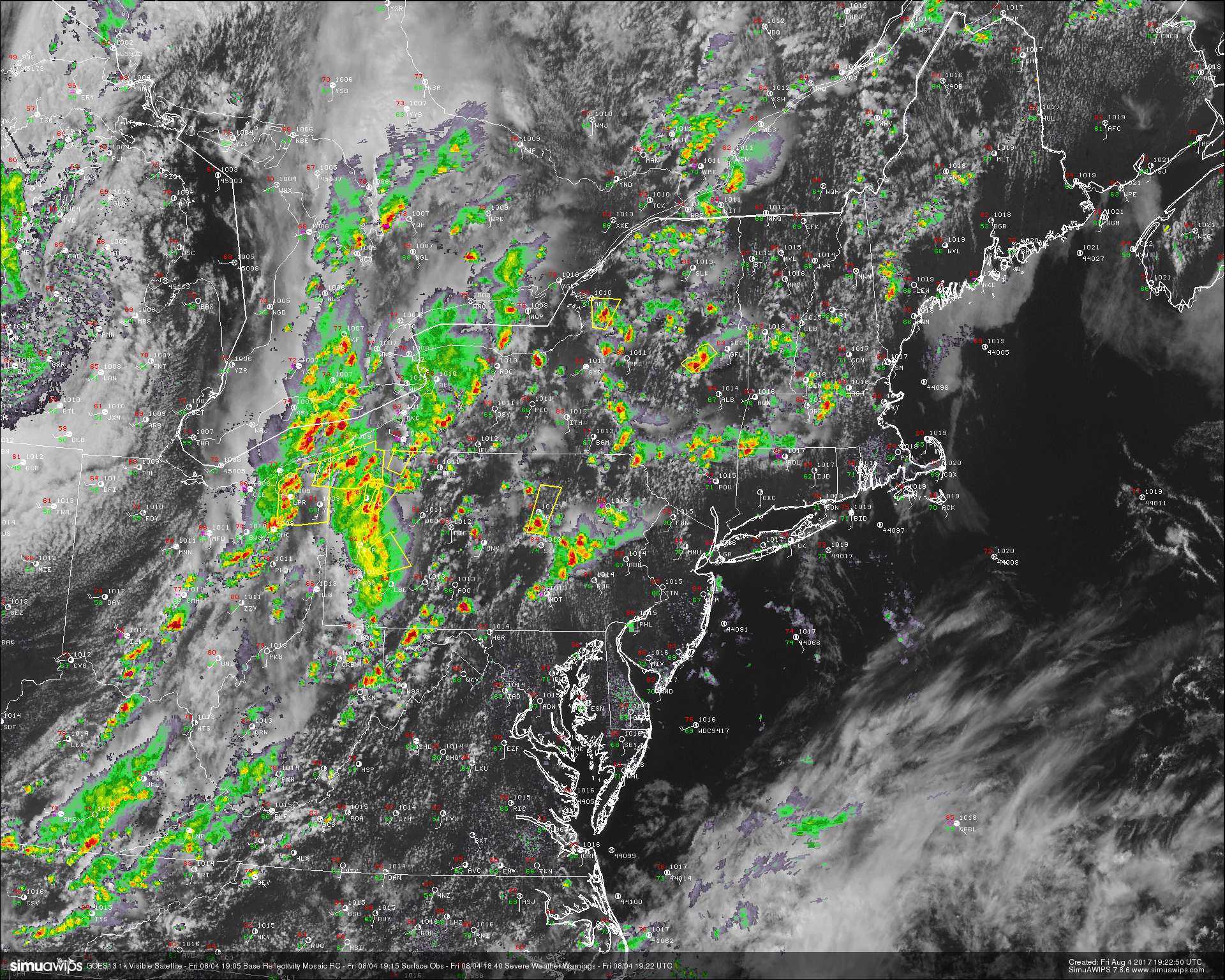
This afternoons latest regional radar mosaic, high resolution visible satellite imagery, surface observations, and severe warnings. Courtesy of Simuawips)

This afternoons latest regional radar mosaic, high resolution visible satellite imagery, surface observations, and severe warnings. Courtesy of Simuawips)

Saturday and Sunday 

Saturday may start off cloudy and with a few showers and an isolated thunderstorm in spots as the large upper level trough to our west finally begins to move through. This shower and thunderstorm activity should move rather quickly through the northern portions of the metro area, but brief heavy rain, gusty winds, and small hail may all be possible with any stronger areas of activity.

Afterwards, a cold front associated with the large upper level trough will finally move through the Northeast during the afternoon hours, and will likely clear any residual showers out. Behind this front will be some refreshing Canadian air that will also be packing much lower humidity with it as well, so there should be a noticeable change in airmasses by lunchtime tomorrow. With clearing skies, low humidity, and light westerly winds behind the front, highs should be able to get into the low to middle 80s tomorrow, which is right around normal for this time of year. Tomorrow evening will be a very pleasant one, as the skies begin to clear out and winds out of the north and west continue to usher in cooler air. Conditions will be in place for radiational cooling to take place over the entire Northeast, which is somewhat uncommon for this time of year. This will allow for lows to fall into the upper 50’s to low 60’s across our area-with some locations to the far north and west possibly seeing low 50’s tomorrow evening!

Sunday looks to be the “gem” in this forecast period as light winds, low humidity, and warm temperatures in the 80’s will dominate the day region-wide. Clouds may begin to increase later in the evening, but overall Sunday should be an excellent day for any outdoor activities!
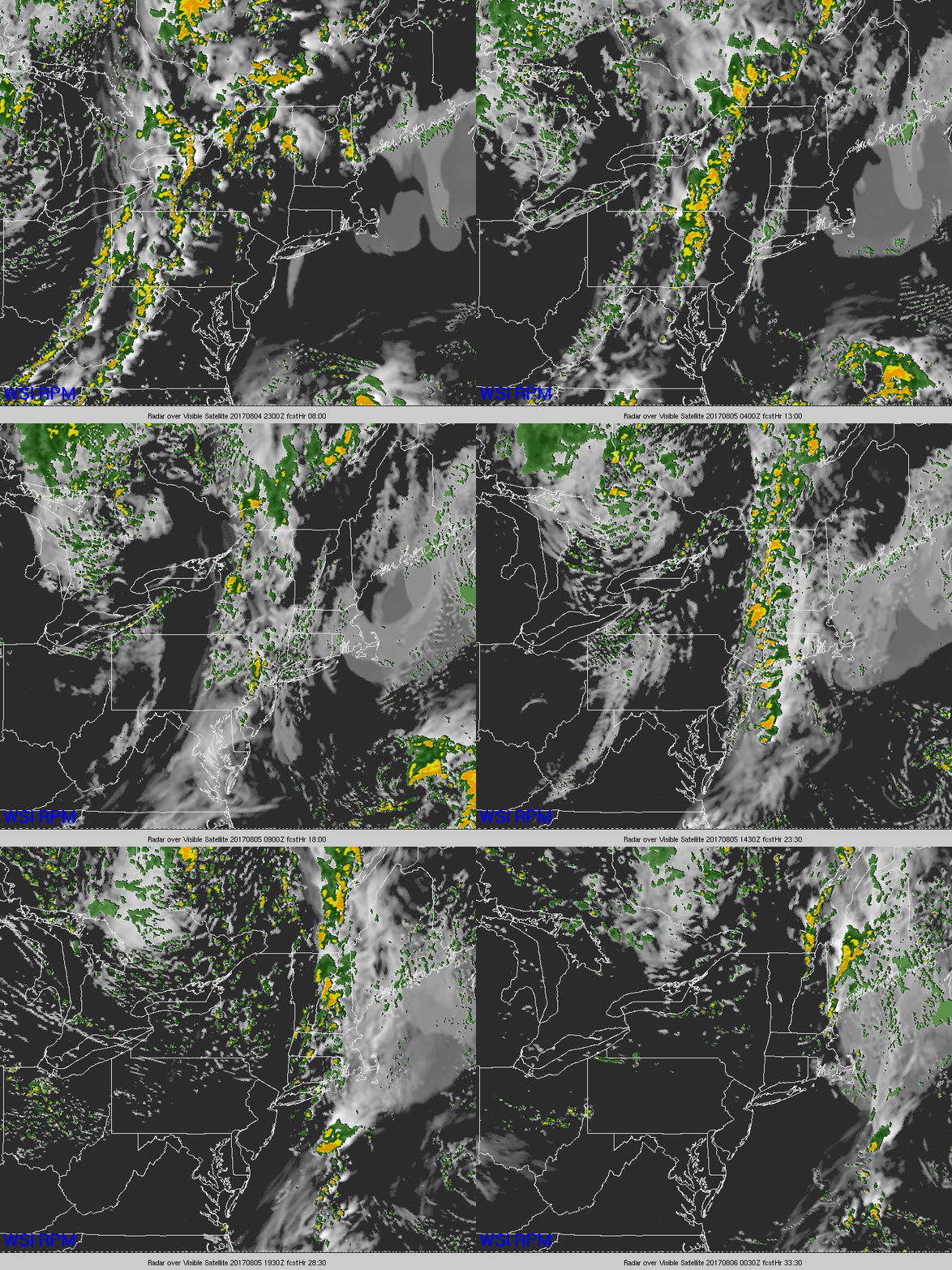
CLICK TO ANIMATE This afternoons RPM model showing the evolution of this evenings storms, as well as the cold front passage tomorrow morning/afternoon (courtesy of WSI)

CLICK TO ANIMATE
This afternoons RPM model showing the evolution of this evenings storms, as well as the cold front passage tomorrow morning/afternoon (courtesy of WSI)

Next Week

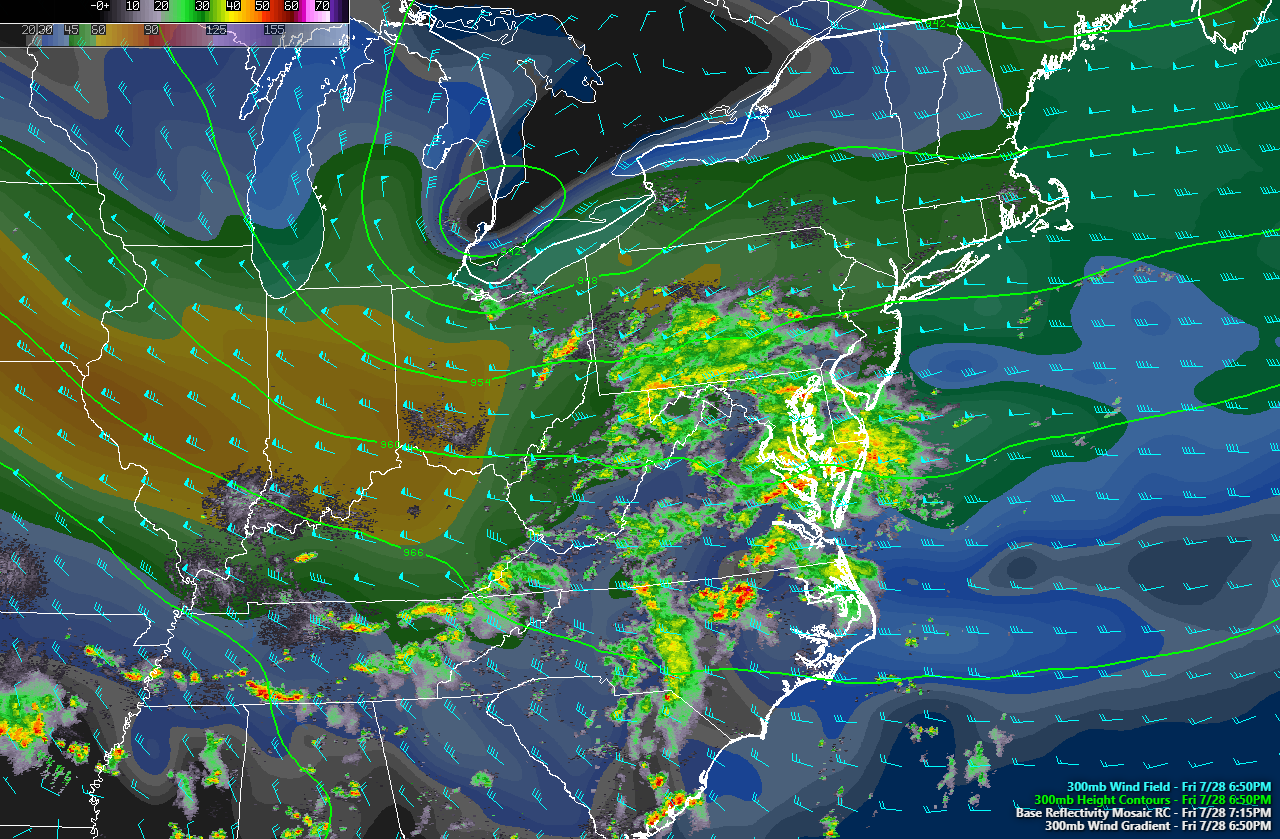
Our eyes will once again shift to the west, as yet another northern stream disturbance begins to approach our area. As this system approaches, it will begin to dig up a serious amount of warm air and moisture from the south and west and direct it towards the Mid Atlantic and Northeastern states. As the mid to upper level system draws closer, a frontal boundary will likely set up. Below this boundary there will be very warm and muggy conditions, while locations to the north experience more seasonable conditions. Above the surface, a large and very impressive upper level jet streak will be nosing in, which is a tell-tale indicator of potential heavy rain for this area. the questions that remain to be answered at this time are where does this frontal boundary set up, how much instability will be in place, and will these ingredients come together at the right time to produce widespread heavy rain? If these conditions do come together on Monday in the correct manner, then we may have to watch for potential flooding rains and much cooler temperatures to start off the week. We will likely have to revisit this system as more data becomes available.

This system should exit the coast late Monday, and an area of high pressure should begin to take over for Tuesday and into Wednesday. However, we may have another rain chance later in the week as the active northern stream regime shows up once more.
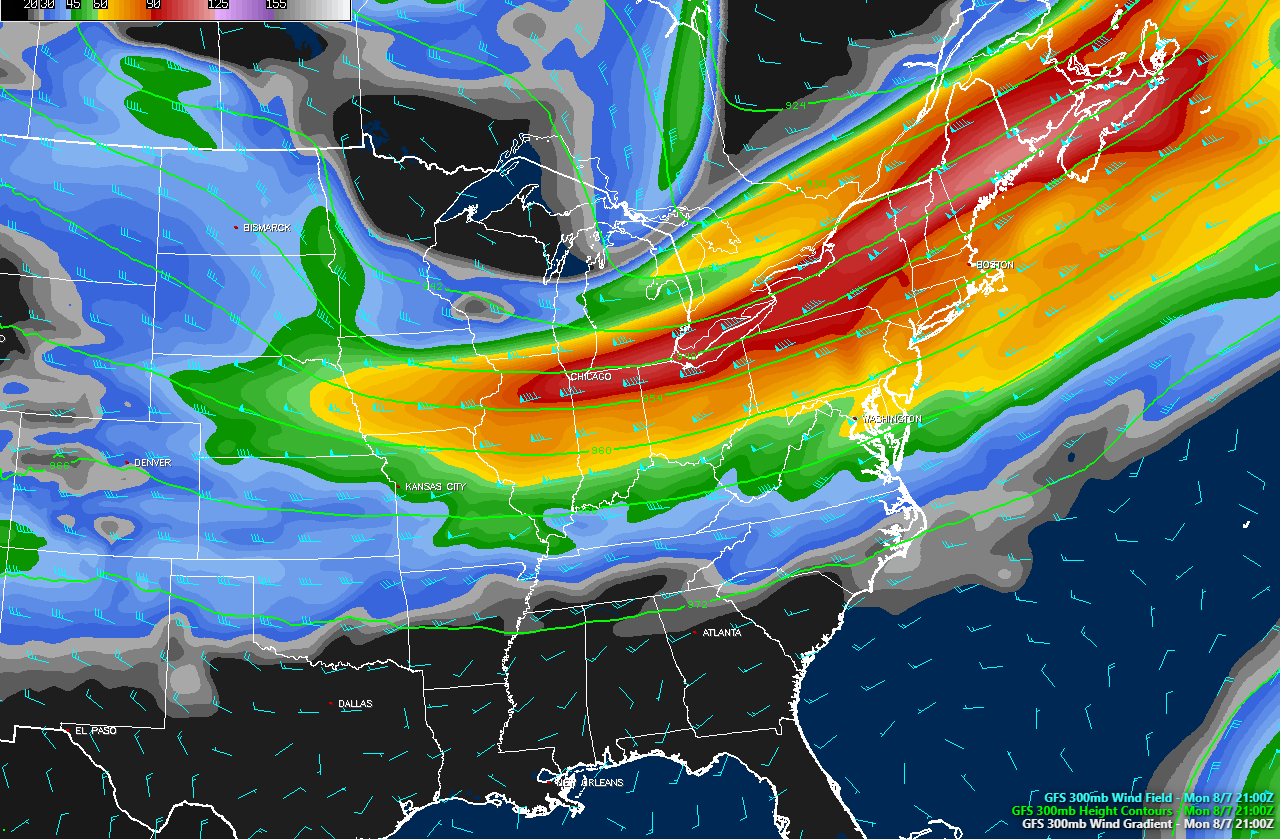
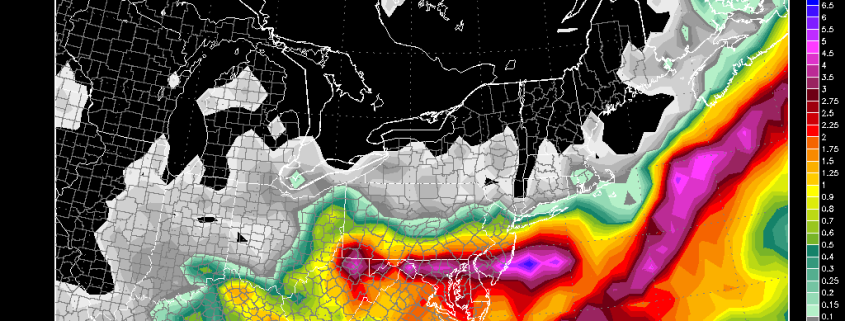
This afternoons GFS model showing the very favorable juxtaposition of an expansive upper level jet streak that could potentially aide in the development of heavy rain on Monday (courtesy of Simuawips)

This afternoons GFS model showing the very favorable juxtaposition of an expansive upper level jet streak that could potentially aide in the development of heavy rain on Monday (courtesy of Simuawips)

For more information and posts like this one, make sure you sign up for Premium Forecasts — where multiple detailed articles, videos, and interactives are posted each day. Also, come interact with our staff and many other weather enthusiasts at 33andrain.com!

Have a great evening!

Steve Copertino
PM Rain Exits, Storms and Cooler Weather Possible This Weekend!

Good Evening!

After a relatively hot and humid day across the entire Northeast and Mid Atlantic regions, we have seen large-scale thunderstorm development courtesy of the mid level shortwave that we discussed back on Monday. This shortwave was located to the west of the area, and with CAPE values of around 2000-3000 j/kg^2, PWATS near 1.5″, and strong low level lapse rates, the weak amount of energy associated with the disturbance was more than enough to set off numerous showers and thunderstorms around 2pm. Due to a significant lack of vertical wind shear, these storms were not able to move all that much from where the initial updrafts formed, and thus most cells rained themselves out over time. However, when these updrafts collapsed and the rain cooled air rapidly sunk to the surface, it created new boundaries which served to provide breeding grounds for renewed storm development. In some locations we saw this happen three to even four times over, which caused serious street flooding.

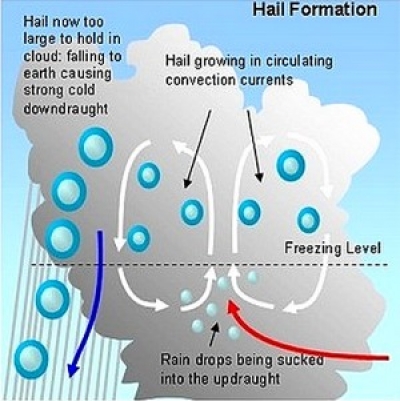
In addition to the street flooding, cool/dry air aloft allowed for some of the more robust thunderstorms to develop marginal to severe hail stones, with some reports of stones reaching the 1.75″ mark! Some folks may have noticed that these storms were also producing a cooler rain than one would expect during August, and this also can be attributed to the cooler air aloft. These drops were whats know as “Big Drops” (I know, very creative) and form when an updraft just isn’t able to keep ice suspended long enough to freeze sufficiently to reach the ground as hail. However, a few thousand feet up in the atmosphere, these drops were frozen, and when they crashed into one another, they create a negatively charged particle in the atmosphere, called an electron. When enough of these electrons build up in an updraft, they connect with positively charged particles (protons) at the surface, the path they take to get to one another creates lightning! With a ton of ice in the atmosphere from numerous updrafts this afternoon, there was a very impressive amount of lightning that went up across the area. Some of this lightning even caused damage to houses and property, with some areas losing power. Otherwise, today’s storms mainly posed a very heavy rain, lightning, and gusty wind threat.

As of six o’clock this evening, most of the showers and thunderstorms that formed early this afternoon were finally beginning to wind down. Lightning activity over the area has greatly weakened over the past hour or so, and this also points towards a gradual dissipation of the rest of the thunderstorm activity. As this time, we think that the heaviest showers and thunderstorms should dissipate by sundown, with only a few lonely cells remaining thereafter. Some residual cloud cover is likely as we head into the overnight hours, and this will help to keep overnight lows rather mild, with temperatures dropping to around the low to middle 60’s.

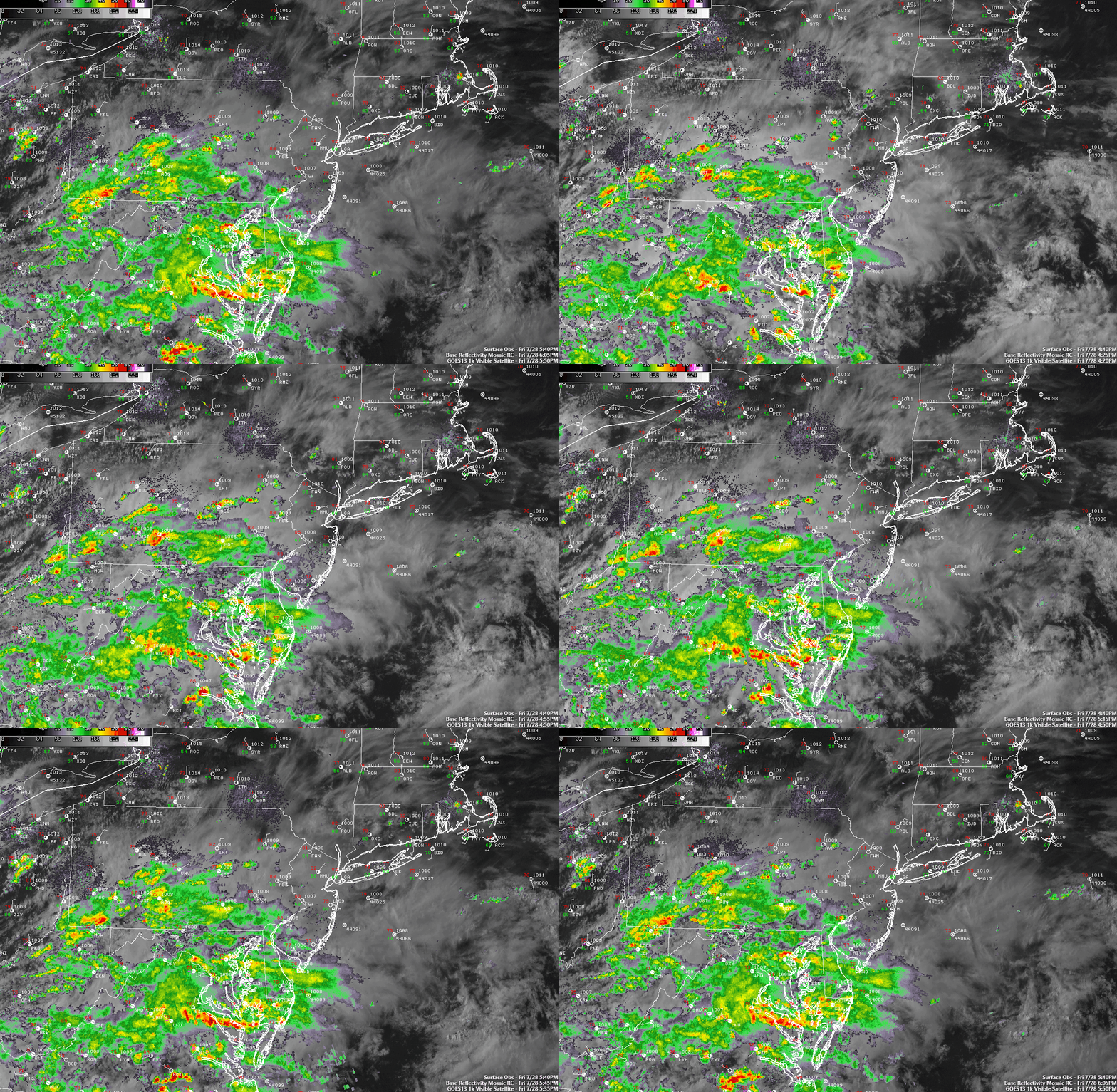
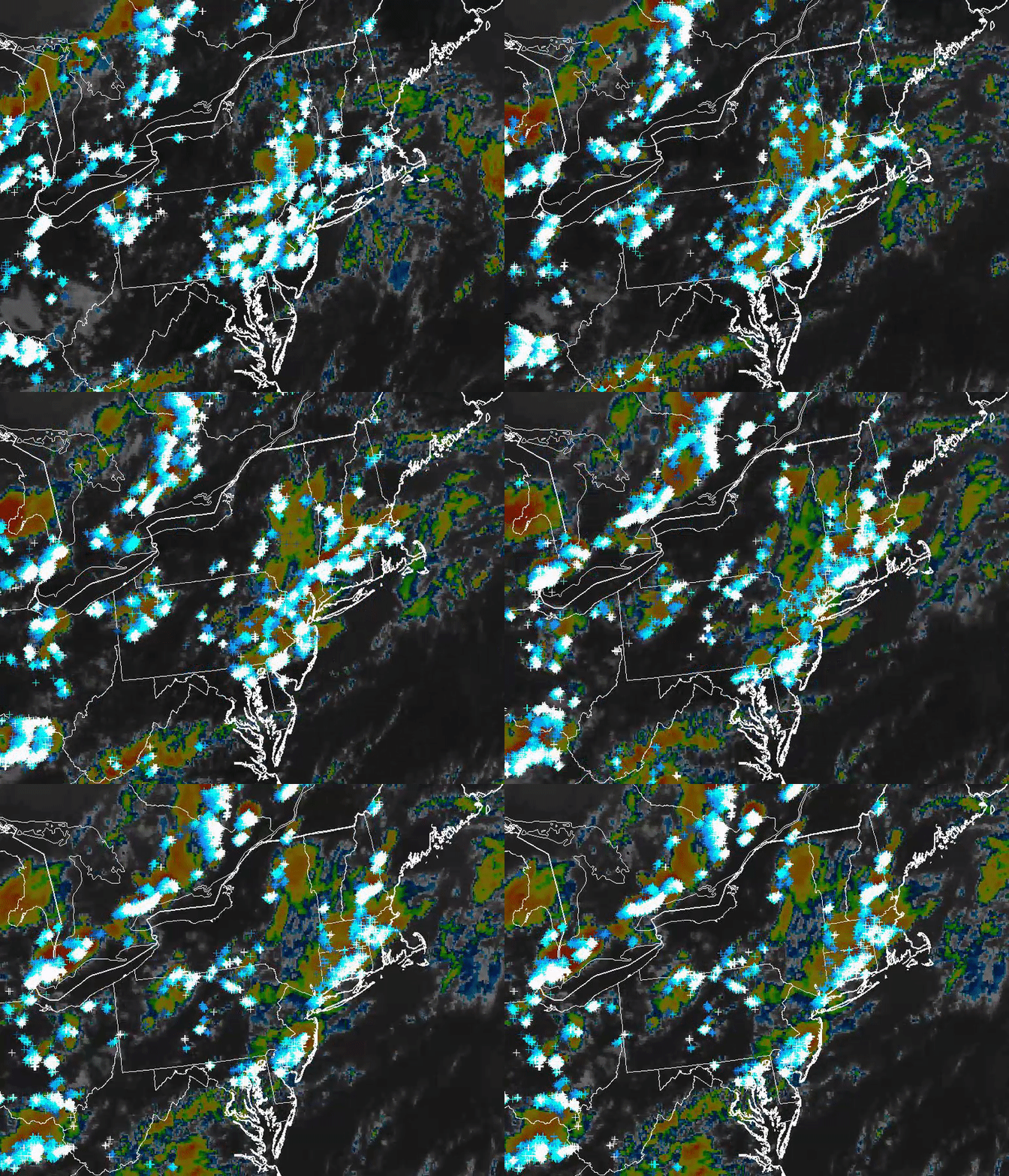
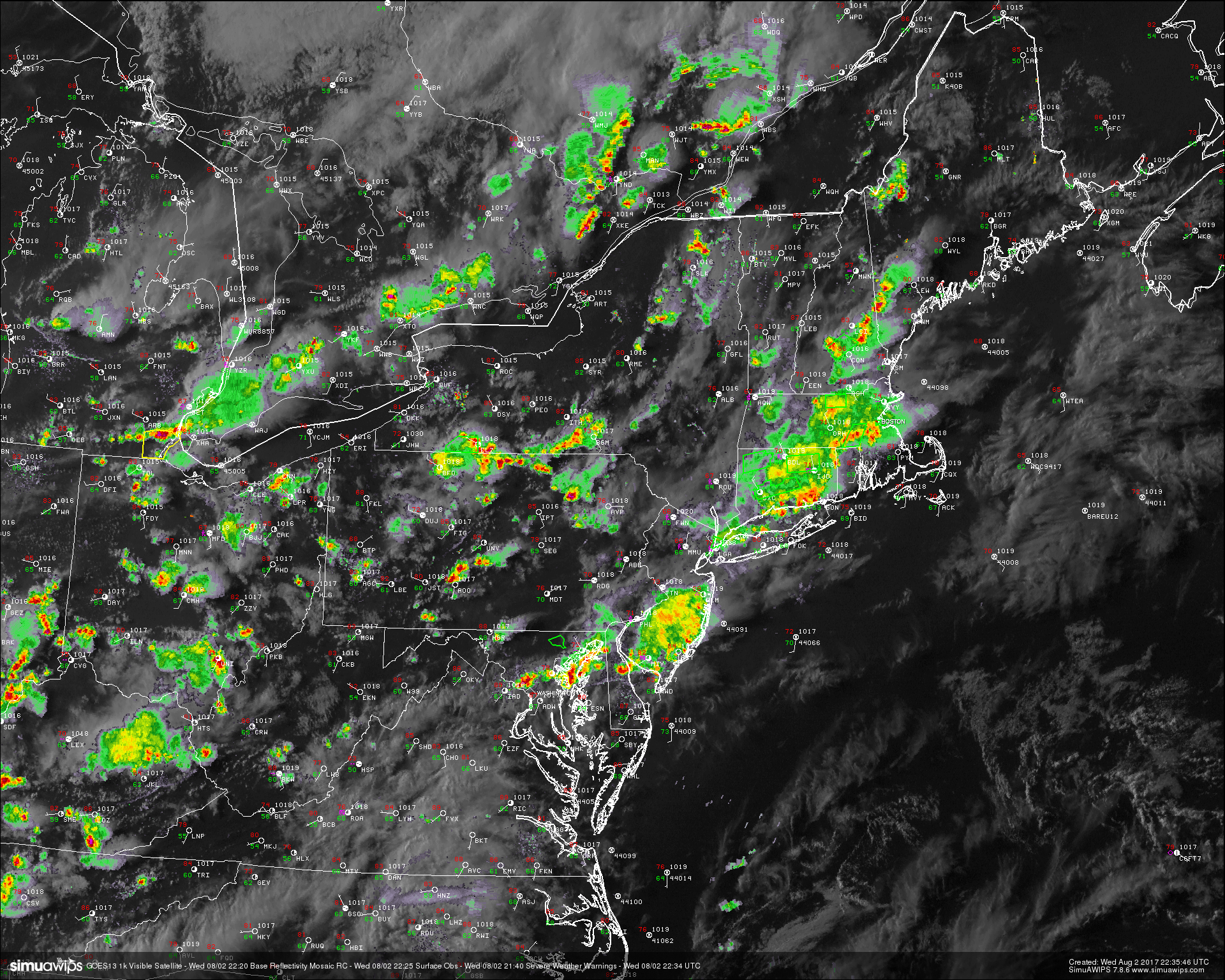
This evenings latest regional radar. high resolution visible satellite, surface observations. and severe warnings, showing the bulk of the heavy rain dying off. This trend should continue as we head deeper into the evening (Courtesy of Simuawips)

This evenings latest regional radar. high resolution visible satellite, surface observations. and severe warnings, showing the bulk of the heavy rain dying off. This trend should continue as we head deeper into the evening (Courtesy of Simuawips)

Thursday and Beyond

Thursday should start off just as the past few days have, with any low clouds quickly burning off by the mid to late afternoon hours. This will allow afternoon temperatures to climb significantly during the afternoon hours, with highs likely reaching the middle 80’s to lower 90’s across the area. With a moist airmass in place tomorrow, we should see the region destabilize once again by the mid to late afternoon hours, similar to as we saw today. The main difference will be that tomorrow does not look to have a coherent area of forcing to initiate thunderstorm development, so any thunderstorms tomorrow afternoon will likely have to rely on convergent boundaries from local sea breezes. This activity will likely be limited to a heavy rain and lightning threat given the lack of favorable parameters for anything outside of heavy thunderstorms. Storms should gradually fade tomorrow evening, leaving generally mild and humid conditions in their wake.

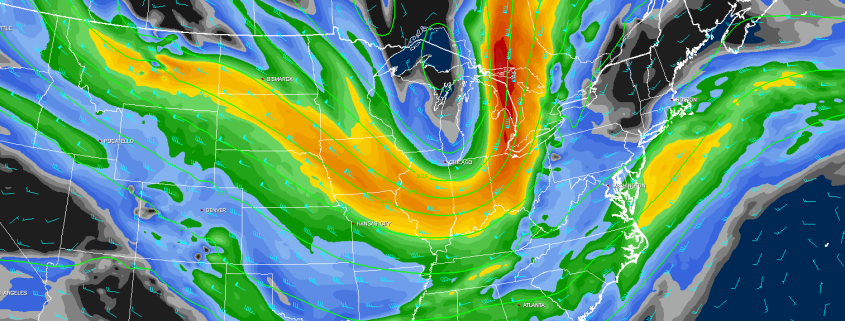
As we head into the first half of the weekend, a large shortwave trough diving out of Canada will provide a threat of heavy rain and possibly some thunderstorms over the area as moisture begins to surge north from the Gulf States. This system will be watched closely, as it does have a very favorable upper level jet streak which could potentially enhance a heavy rainfall threat over our area. A strong cold front looks to push through late Saturday and into Sunday, which should bring not only cooler temperatures to our area, but also much lower humidity compared to what we’ve been seeing-which should make for an enjoyable end to the weekend!

Now here’s a sample of what our Premium clients get with a special video discussion with Doug Simonian!

(Detailed Discussion With Doug Simonian)  

For more information and posts like this one, make sure you sign up for Premium Forecasts — where multiple detailed articles, videos, and interactives are posted each day. Also, come interact with our staff and many other weather enthusiasts at 33andrain.com!

Have a great evening!

Steve Copertino & Doug Simonian 
 

Locally Strong Thunderstorms Possible on Wednesday

Good evening! We hope you enjoyed this summery Tuesday. This article is going to just focus on the potential for thunderstorms on Wednesday afternoon — some of which could briefly pulse to strong to even severe status.

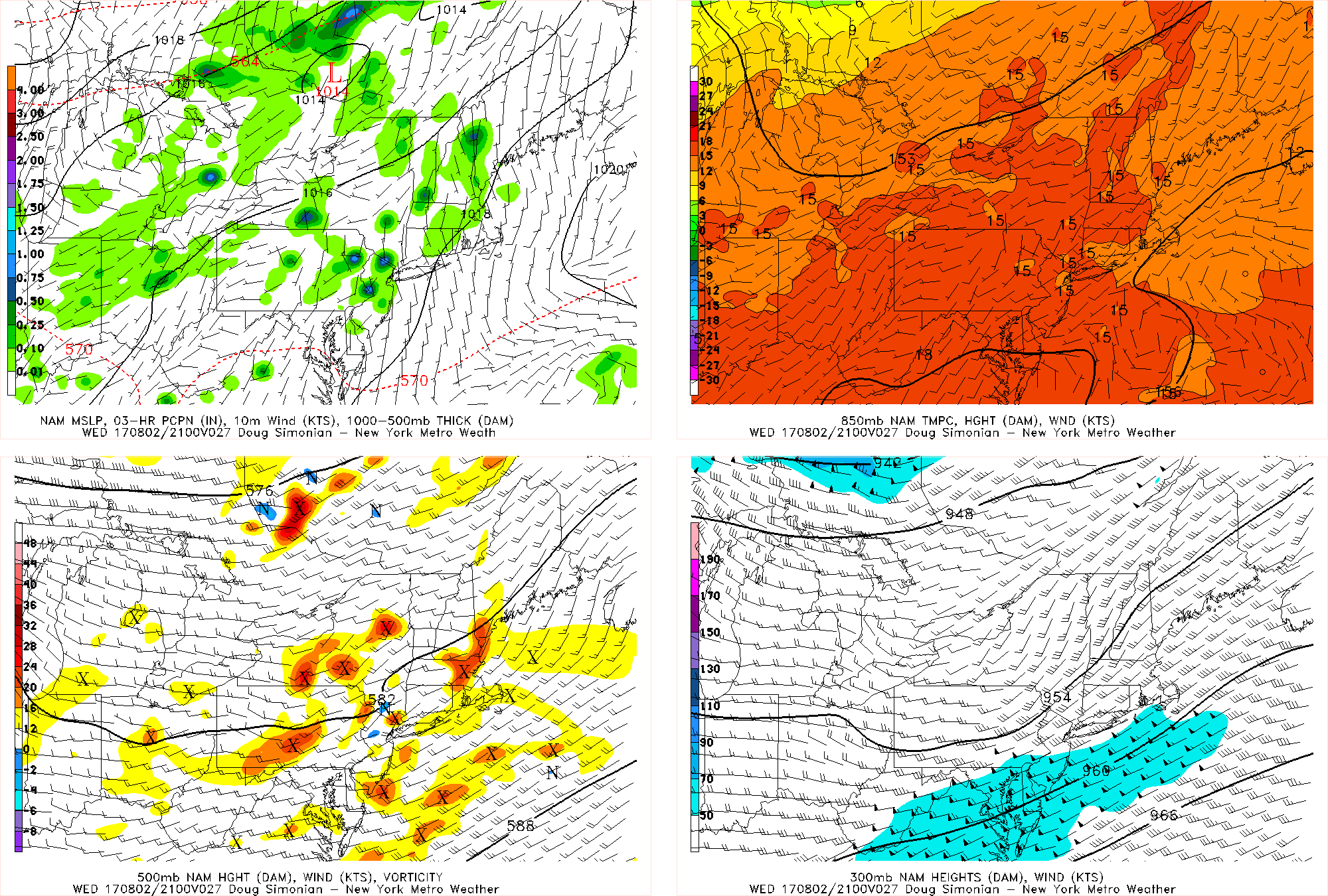
It all starts with a shortwave trough that will be moving into the area on Wednesday, bringing plenty of vorticity with it and thus lift. This is a true lifting mechanism that we have not had over the past couple of days, which should allow coverage of thunderstorms to be higher on Wednesday than on Monday and Tuesday.

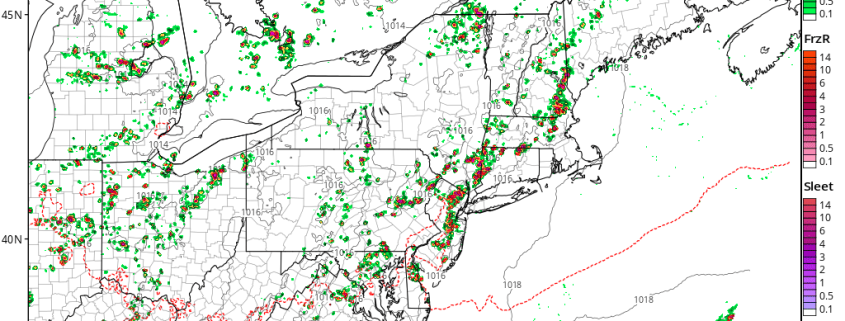
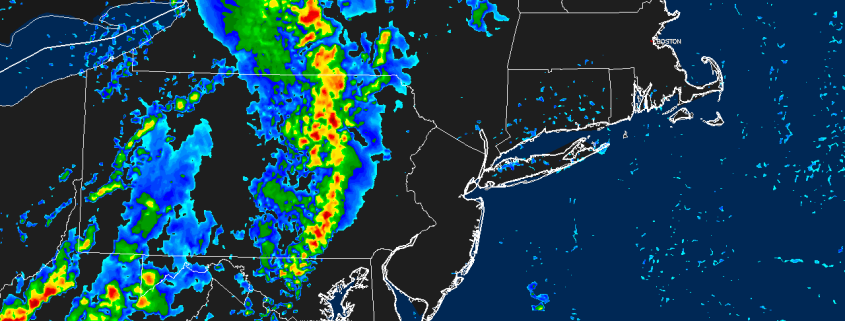
Tuesday afternoon's NAM model valid for Tuesday afternoon shows a shortwave trough with embedded vorticity helping to trigger some showers and thunderstorms in New Jersey.

Tuesday afternoon’s NAM model valid for Tuesday afternoon shows a shortwave trough with embedded vorticity helping to trigger some showers and thunderstorms in New Jersey.

In the midst of this warm and humid airmass, surface-based instability should be pretty high already, but the fact that this shortwave trough will be lowering heights a bit but also not contaminating the airmass with too much moisture will help increase lapse rates somewhat significantly. This allows for updrafts to potentially be more robust and for more of the cumulonimbus cloud to be in dense, cold air aloft — both factors allow for more hail formation, the potential for downburst gusty winds, and somewhat vivid lightning.

Read more

Bulk of Unusual July Storm Stays South, Locally Heavy Rain Still Possible

Good Evening! 

Well the storm that we have been following for the past week or so is in its formative stages as of this afternoon/evening, with heavy rain beginning to break out over portions of the Mid Atlantic states. While the storm should continue to develop and mature through the evening, the overall evolution and impacts that will be accompanying this system have changed quiet a bit. As we outlined on Wednesday in the “What Could Go Wrong” section, we stated that the overall positive nature of the incoming trough was not conducive for phasing of the lead energy ahead of the system, thus making us question the overall likelihood of widespread heavy rainfall over the New York metro area. Since that time, the models have come into line with our previous thinking and have really shifted the upper level features around, which has in turn has had a rather dramatic effect on exactly where the heaviest rainfall will occur tonight and into Saturday morning.

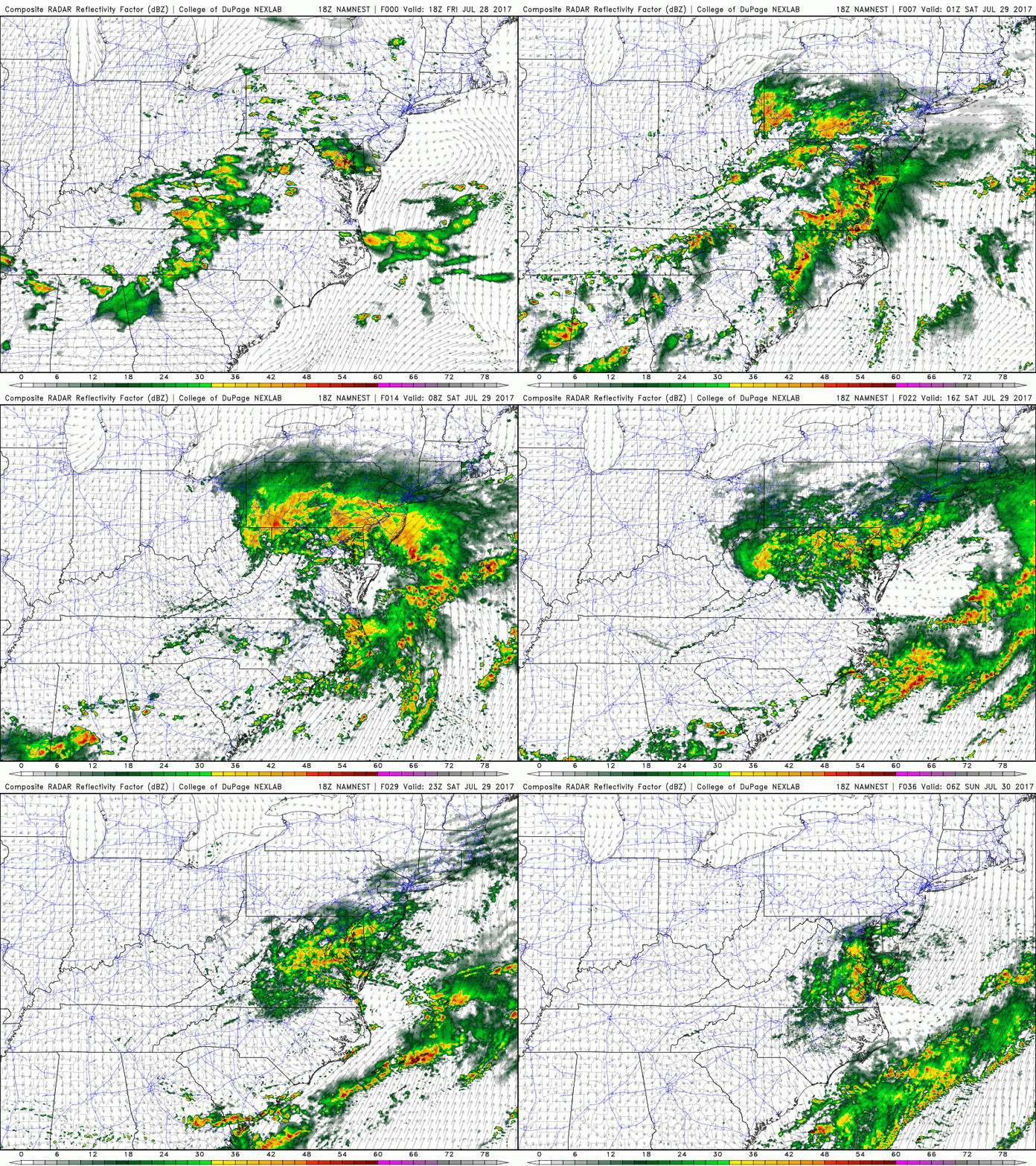
This afternoons and evenings regional radar mosaic, high resolution visible satellite imagery, and surface observations, showing the development of widespread heavy rains over the Mid Atlantic region. This development will continue to ramp up through this evening (Courtesy of Simuawips.com)

This afternoons and evenings regional radar mosaic, high resolution visible satellite imagery, and surface observations, showing the development of widespread heavy rains over the Mid Atlantic region. This development will continue to ramp up through this evening (Courtesy of Simuawips.com)

So what has changed over the past few days? 

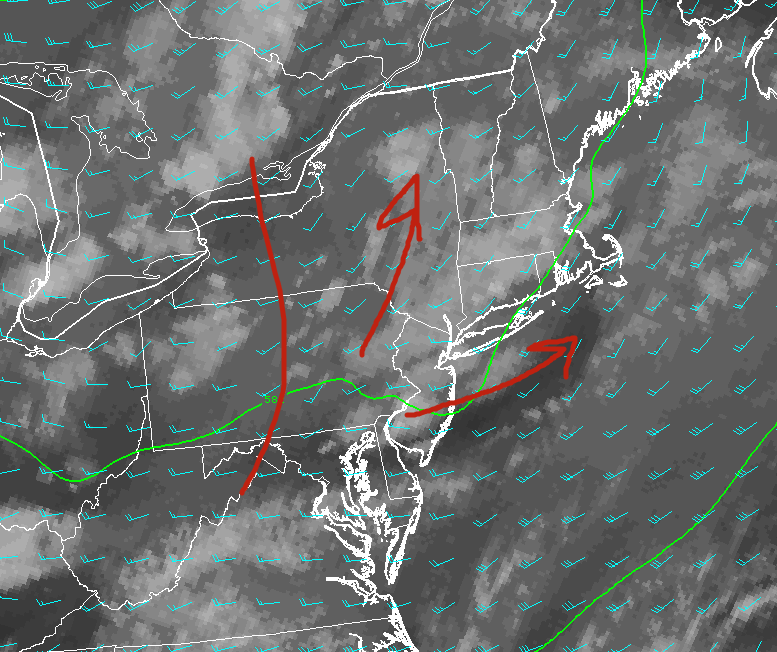
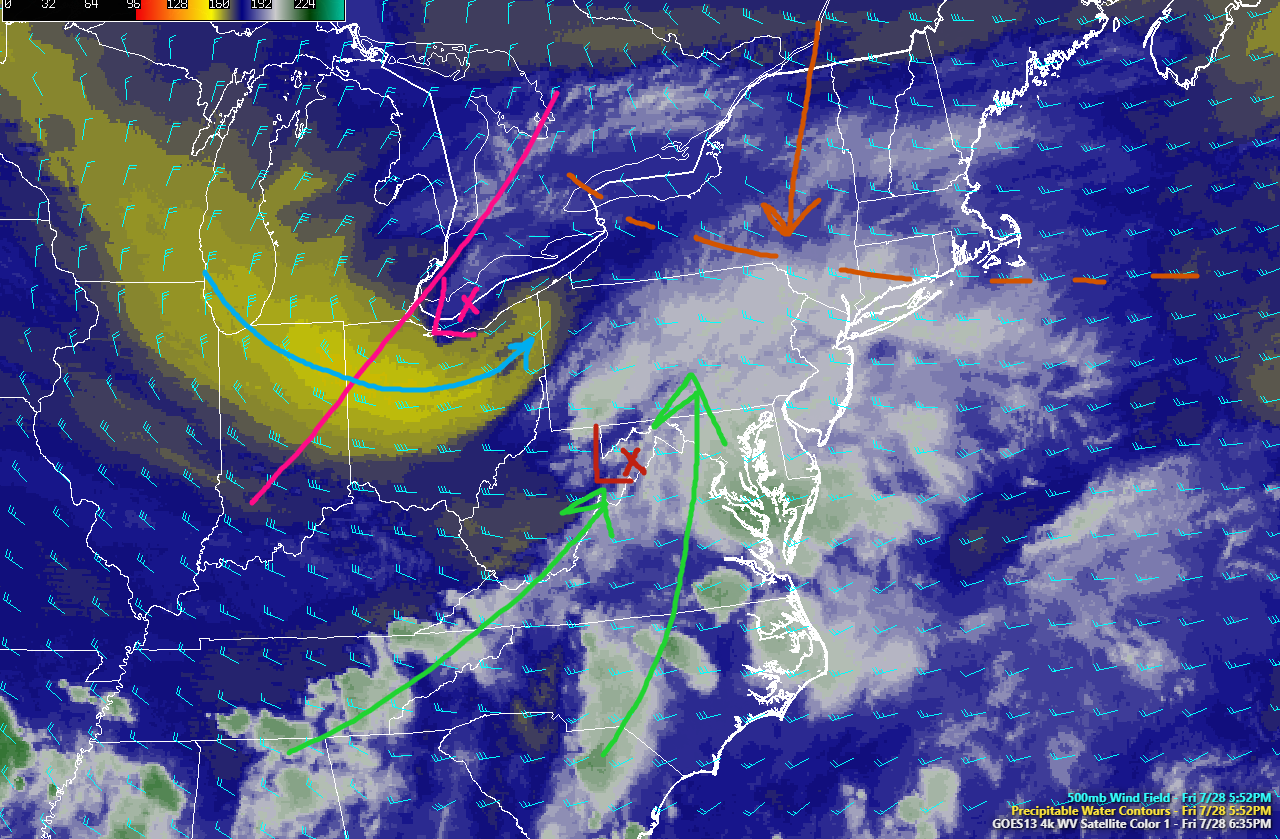
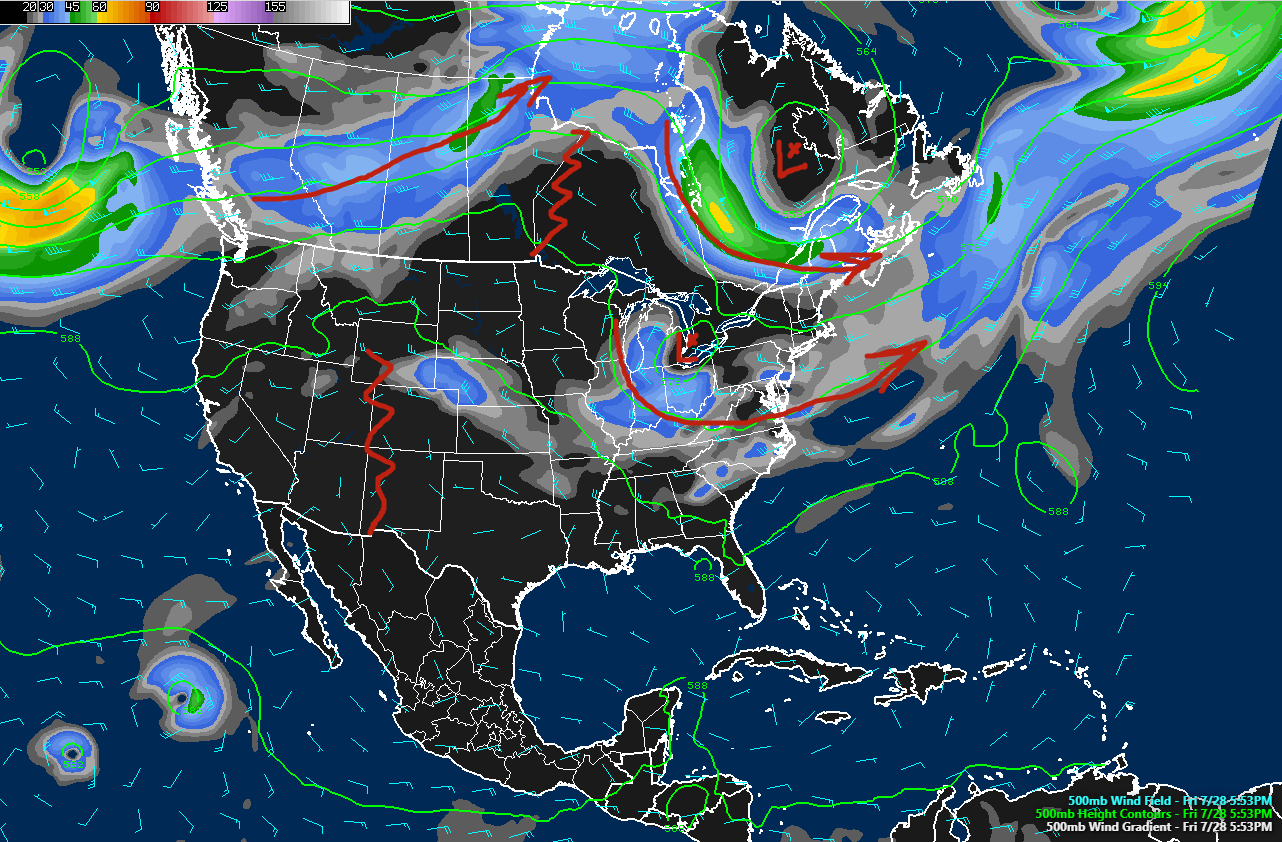
For starters, a positively tilted trough approaching the Northeast is never really a great start if you’re looking for a large, lumbering system with abundant precipitation to form off the coast. This is exactly what we have approaching the area this evening, as noted on the latest 500mb analysis as well as water vapor imagery from the non-operational GOES-16 satellite. The next factor preventing this region from seeing a long-duration system is the very fast flow out to the east of the main storm system. This is something that we usually have to deal with when forecasting winter storms, but it also applicable to summer storms as well. This speedy flow can be attributed to a large upper level low in the eastern regions of Canada. As energy in the base of the large upper level system over Canada begins to rotate and shift southeast, it begins to flatten heights to the east out, and this is the exact opposite of what we would need to slow this system down.

Ideally, we would want the Canadian system to be centered more to the west, mitigating the effects of lower heights ahead of the storm, which would allow the system to slow down a bit and have more northward progression. So putting these negative factors all together, we can expect the shortwave over the Ohio Valley to continue to move east quite slowly, and continue to cause the development heavy rainfall over portions of the Mid Atlantic. Instead of amplifying and strengthening to our south and east tomorrow, the mid level system will remain to our west and will likely wind up getting sheared out-which should cause the overall system to decay.

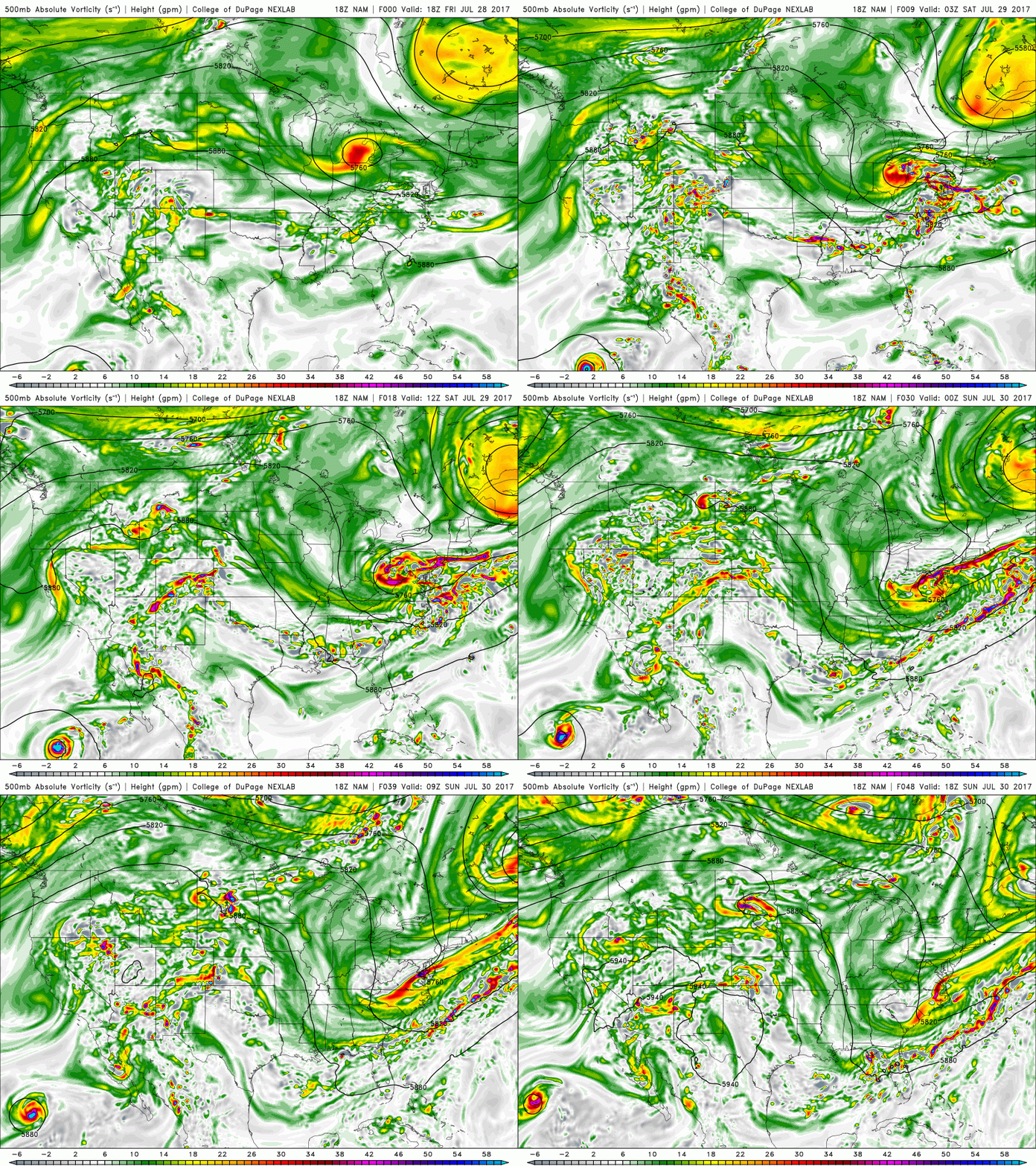
This afternoons NAM, showing the mid level evolution of the storm system over the next two days. Note the lack of phasing and eventual sheared-out look

This afternoons NAM, showing the mid level evolution of the storm system over the next two days. Note the lack of phasing and eventual sheared-out look!

So what are the impacts? 

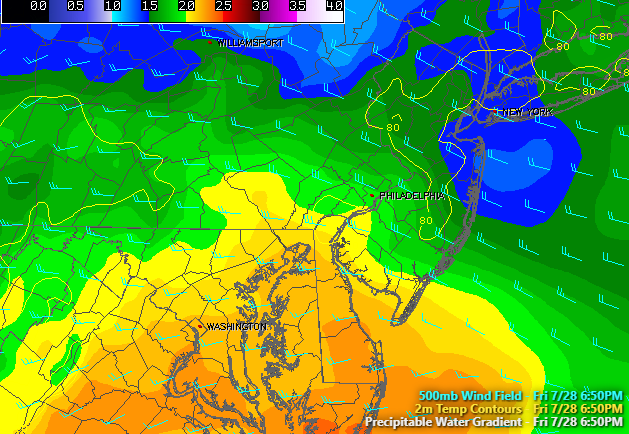
Despite its obvious flaws, this is definitely an anomalous system for this time of year and it will bring some heavy impacts, but those do not look to be directly aimed at the NYC metro area. As precipitation continues to break out later this evening, they will be in an extremely moist environment characterized by PWATS over two inches in some spots. Additionally, soundings over the Mid-Atlantic region indicate that a deep “skinny” CAPE profile also exists with values around 1500-2300j/kg^2, which will add to the torrential downpour situation as the night goes on. The last major player that is on the table, is an extremely impressive upper level jet nosing in from the the Ohio Valley. As the wind maximum from this upper level jet streak begins to move further east, it will begin to greatly expand the amount of upper level divergence, which will be directly over the heaviest areas of convection (thunderstorms). This strong upper level divergence will support whats known as low level convergent boundaries-which could spark heavy storms with prolific and near-record rainfall rates over portions of the Mid Atlantic.

It is quite obvious that the numerous favorable factors are coming together in just the right manner so that flooding concerns will be extremely high for the MA region. In fact, the Weather Prediction Center has issued a rare High Risk for flooding over portions of the Mid Atlantic! In general, rainfall totals should be around the 2-5″ range, with some localized amounts of 7-10″ possible in the heaviest of rain bands. This will almost certainly create very serious flooding, so please stay tuned to your local NWS!

Further north for the NYC metro area, things will be a bit more tame as we appear to be on the northern fringes of this system. This does not mean that we are exempt from seeing any heavy rains at all, as we will still have a very moist air mass to work with, and the same excellent upper level divergence to promote some convergent boundaries-which may spark some showers and storms. However, we will have to deal with some sinking air over the NYC area, which should prevent any widespread heavy rain from developing. Some isolated pockets of 1-2″ may be possible with the heaviest showers here, but general totals should be around an inch or less.

By tomorrow afternoon, the disturbance should begin to decay and get sheared out, which should gradually put an end to the heavy precipitation across the entire region.

(Again, if you are located in an area prone to flash flooding, please be aware of any warnings issued-ESPECIALLY during the overnight hours) 

Loop of the development and progression of the heavy rain over the Mid Atlantic over the next day and a half

Loop of the development and progression of the heavy rain over the Mid Atlantic over the next day and a half

We will be back Monday with a look at next week and beyond!

For more information and posts like this one, make sure you sign up for Premium Forecasts — where multiple detailed articles, videos, and interactives are posted each day. Also, come interact with our staff and many other weather enthusiasts at 33andrain.com!

Have a great weekend!

Steve Copertino