Sunday AM Update: Wintry pattern looms

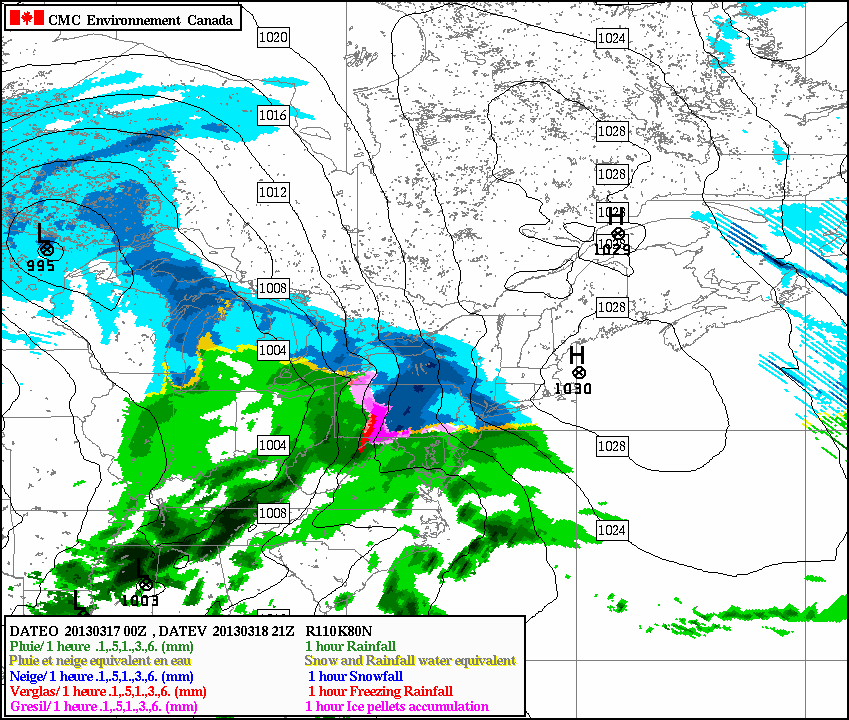
The RGEM model shows moderate snow in the NYC area at 5 p.m. Monday

The RGEM model shows moderate snow in the NYC area at 5 p.m. Monday

The NAO blocking has arrived, and much of the area saw periods of snow during the day on Saturday, enough to remind us that winter is still holding its grip on us, despite the calendar turning towards Mid March. We are also following the potential for two storm systems; one for Monday evening through Tuesday morning, and another one as we approach the March 24 period. Monday evening through Tuesday morning looks more rainy and messy than snowy, though further northwest of the city might be able to hold onto enough cold for minor snowfall accumulations along with some ice. However, March 24 is a period that needs to be watched for more serious snowfall potential, albeit it is quite far away, so caution should still be urged.

A stronger storm system will be developing to our west, as energy enters the United States from the Pacific Ocean. Considering we have a decently cold airmass in place right now, the precipitation that moves into our area could start off as snow, as warm, moist air overruns the cold air in place. If enough solid precipitation can break out to the east of the storm system, then we might see precipitation before the warm air advection would settle in. The RGEM model illustrates this well, as it shows a several hour period of snow for the NYC area, and then turning over to sleet.

Read more

High latitude blocking may set up a cold finish to winter

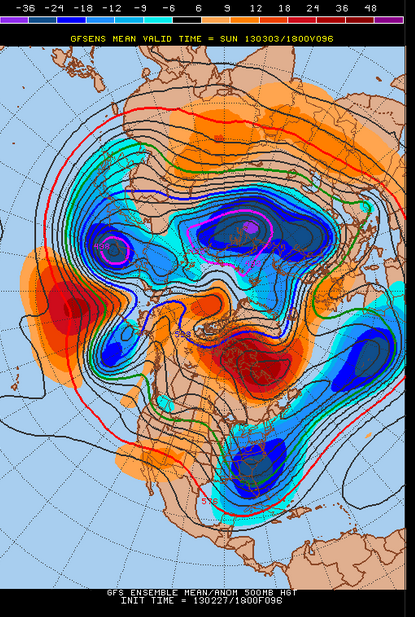
GFS Ensembles showing 500mb height anomalies well below normal across the Northeast US by next week in response to blocking developing in Greenland and Northern Canada.

GFS Ensembles showing 500mb height anomalies well below normal across the Northeast US by next week in response to blocking developing in Greenland and Northern Canada.

It may be a bit premature to say that Spring will be off to a cold start. Medium and long range forecast guidance, however, would say that is a fair forecast. Forecast guidance has been pointing to the development of a very strong high latitude blocking episode within the next week, which could include a NAO and EPO ridge. The combination of the two could force a piece of the Polar Vortex (and very cold arctic air) into South-Central and South-East Canada, meaning our chances of below normal temperatures would increase … especially the farther north you go.

It seems, at least to the meteorologist, that there is a bit of an underlying passiveness towards March snowfall events in the New York City Area. I guess this comes somewhat naturally due to the past several years, which have offered very little hope for March snowfall (running well below normal in our area over the last 5-10 March’s). In fact, last year around this time much of the area saw temperatures soar into the 70’s for highs. Lets face it, March has been a nonexistent winter month in our area with the exception of a storm in 2009 which produced significant snowfall in parts of the area.

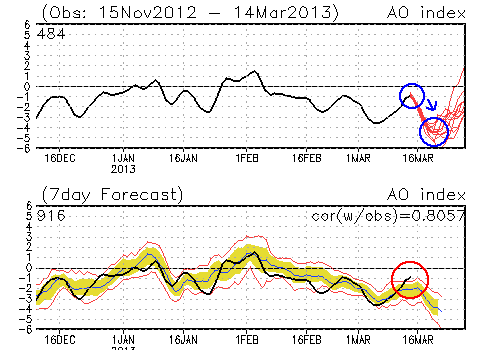
GFS Ensemble forecast Arctic Oscillation readings.Notice the rapid dropoff over the next week.

GFS Ensemble forecast Arctic Oscillation readings.Notice the rapid dropoff over the next week.

With all of that said, most of you are probably asking yourself: Why would it suddenly get cold and potentially snow this March? What makes it so much easier this time? The answer is that it won’t be that much easier. It still will be more difficult to get snow this time of year given the longer days, stronger sun, and warmer ground. But it is important to remember that forecast guidance has been strongly pointing towards the potential for a significant blocking episode — not just a run of the mill Greenland block or positive height anomaly. We can begin to see this response just glancing at the Arctic Oscillation forecasts, with remarkable ensemble agreement on the AO readings falling off the proverbial cliff. Almost every ensemble member brings the Arctic Oscillation below -4 and some of them to -5 — this is not your basic – AO development. It’s worth noting, too, how much lower these readings are compared to even the lowest readings of the past few months. A word of caution though, we should carefully watch the AO over the next several days as it has outrun the 7 day ensembles forecast in a positive direction recently (bottom chart).

Read more

Meteorological Spring Approaches, But Spring Weather Does Not

As many of you know, Meteorological Spring begins on March 1, which is this Friday. However, in both the short term and long term, the weather will not be cooperating. After this current storm system that has given us our clouds and rain over the past few days moves away, colder weather will be ushered in for Friday and beyond. Temperatures will generally represent average highs and lows for early February, rather than early March.

The 18z GFS ensemble mean, valid for the afternoon of March 3rd, shows a very strong negative NAO block, which favors the development of a strong storm system.

The 18z GFS ensemble mean, valid for the afternoon of March 3rd, shows a very strong negative NAO block, which favors the development of a strong storm system.

What’s responsible for this? For the first time this winter, we are going to see sustained NAO blocking. The 18z GFS ensemble mean forecast for 96 hours out, which is valid for the afternoon of March 3, shows a huge closed off positive anomaly of geopotential heights south of Greenland. This is classified as a strong negative NAO event, and these events often lead to very strong storm systems affecting our area, such as Hurricane Sandy. These negative NAO blocks help to force a trough on the east coast, providing sustained, cold air, along with storm systems that can slow down, strengthen, and take tracks just off of our coastline.

So, do we have any storm systems to look out for? Initially, some models were indicating a threat for the March 3 time period, but the problem for that time period is that the trough axis is too far east and too positively tilted. There was a positive PNA ridge on the west coast, but a disturbance moves onto the west coast, which flattens that ridge, represented by that little blue area in Washington State. It also pushes the flattened ridge eastward, pushing our trough eastward. The NAO block will prevent the trough from scooting out to sea, but it cannot keep the trough axis far enough west for a storm system to bring us precipitation. Additionally, and arguably the bigger problem is the upper level low pressure system that is elongated to the southeast of our NAO block. That keeps the flow out in the Atlantic pretty flat, preventing any storm from being able to turn up the coast. Thus, this time period is not favorable for a storm.

However, will this change? Potentially. When?

Read more

Indian summer this week, but will it continue?

GFS Ensembles showing above normal mid-level height anomalies throughout parts of the Central US during the last week of October. Courtesy Stormvista.

Most of the area has seen the first frost/freeze of the season with the exception of the immediate coast and urban areas (NYC, JFK, LGA, EWR). Any period of warmth / above normal temperatures that occurs after the first freeze is referred to as an “Indian Summer.” We’re certainly see that today – widespread warmth with temperatures surging into the 60s after morning lows in the 30s/40s for many. High temps near 70F in land portions of New Jersey cannot be ruled out today, and tomorrow should feature 70s across the entire metro area out ahead of the next cold front.

Beyond this week, folks are beginning to get antsy for the winter, and some are excited about the prospect of more blocking this winter compared to last winter’s complete lack of any block (Blocking – the tendency for positive height anomalies to form in the northern latitudes which can result in troughiness / cold weather in the middle latitudes).  While it’s true that we have plenty of blocking right now, that doesn’t necessary mean that we’ll see it persist into winter. We’ll have to see how the pattern evolves over the next several weeks.

Moving forward, many forecast models are suggesting a generally mild regime for the Eastern US. Why is that the case given the negative NAO and AO currently in place? Doesn’t a negative NAO mean troughiness / cold in the East? Generally in the winter months that is true, yes, but the correlation between NAO values and height anomalies in the Eastern US is not as strong as other indices, like the PNA, right now.

Keep reading for all of the details, technical discussion, and forecast…

Read more