In Autumn, all eyes are on the North Pacific

With Autumn officially underway and the leaves starting to turn, many are beginning to wonder about the upcoming winter, and if the Autumn pattern will foreshadow it. Unfortunately, it is not as easy as “cold October yields cold winter” or “warm October yields warm Winter”. If that were the case, we’d have long range forecasting figured out by now, and there would be no need for winter outlooks. The best we have for now are correlations, analogs, physical pattern drivers, and pattern persistence. When added together, the summation of these various factors provide a higher probability of success in medium to long range forecasting, but these methods are far from perfect. The evolution of different atmospheric oscillations during the autumn season can give us a substantial clue as to the ensuing winter’s dominant index modalities.

In this particular case, let’s examine the autumn north pacific pattern of years since 1990, giving us a sample size of 22+ years. The North Pacific pattern is often represented as the East Pacific Oscillation (EPO). Like the North Atlantic Oscillation the EPO has certain, generally predictable outcomes when it oscillates from positive to negative phases. The positive phase of the EPO is usually associated with lower than normal heights across the northeastern Pacific, much of Alaska, and northwestern Canada. Conversely, the negative phase of the EPO generally produces higher than normal heights over the region just described. The positive (+EPO) tends to flood the United States with maritime pacific air due to the low pressure around Alaska, while the negative (-EPO) acts as a block to maritime pacific air due to high pressure over the NE Pacific/Alaska. The -EPO often sets up a cross polar flow with high pressure centered over Alaska and the flow oriented across the north pole from Siberia into Canada. The -EPO pattern has yielded some of most impressive, severe arctic outbreaks on record.
Read more

Coastal storm departs, beautiful weather returns

Our products are a bit late this morning (forgive us, we spent the night at Derek Jeter’s last game at Yankee Stadium) — but they won’t come without any good news! The coastal storm system which marred yesterdays weather, bringing widespread rain and clouds, is shifting well to the northeast of the area this morning. Taking over in its wake are northerly winds, drier air, and a beautiful autumn airmass. Temperatures today will climb into the mid to upper 70’s still, but will feel perfectly comfortable as humidity values drop and moisture moves seaward, associated with the coastal storm.

The best news of all, however, is the fact that this weather looks to continue into early next week. In fact, airmass modification will allow temperatures to climb into the upper 70’s to low 80’s on both Saturday and Sunday with a tremendous amount of sunshine. Dry offshore winds will keep away any marine influence, as well, so the weather really will be exceedingly pleasant. The mid level ridging will keep this pattern in place through the early part of next week.

Read more

Heavy rain, blustery winds throughout today

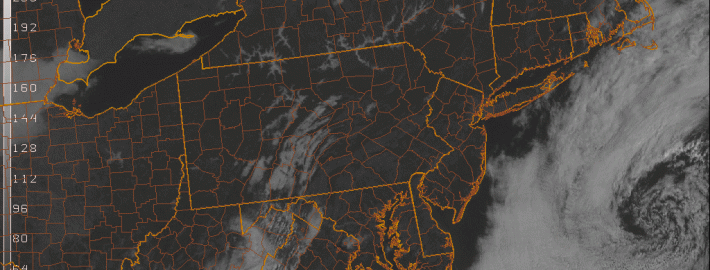
If for some reason you haven’t left your bed this morning or looked outside yet, well, first of all we’re jealous. But more importantly — it’s raining out there, pretty consistently. The culprit is a low pressure system sitting right near the Mid-Atlantic coast, one which we detailed a few days ago. Moderate to heavy rain, occurring as a result of mid level forcing and lift, will continue to push northward throughout the day today. The heaviest rain in New Jersey and New York City will occur during the late morning hours as the strongest support for precipitation pushes through.

A strong onshore flow, developing as a result of a high pressure to the north and the strengthening low pressure to our south, will continue to create blustery and gusty conditions as well as high surf. So the most raw conditions from this system will almost certainly occur near the area beaches. Still, moderate to heavy rain and wind can be expected throughout a vast majority of the area today — and temperatures will remain cool and damp.

Read more

A deeper look into the upcoming storm

Although confidence has increased in a coastal storm developing and giving the area plenty of rain and wind from late tonight through Thursday, there are still a lot of details that need to be ironed out. This is because the storm system is not truly a Nor’Easter, it will remain primarily disorganized, and the weather pattern aloft does not necessarily favor a strong storm system. Instead, we have a system that is forming during the climatological peak of the hurricane season, and it will initially be sitting in an area allowing for some tropical development. No, this will not be a tropical storm, but this will be a weak storm system with some tropical characteristics, rather than a true Nor’Easter. That will create a big headache for the computer models, since they tend to be better at forecasting Nor’Easters.

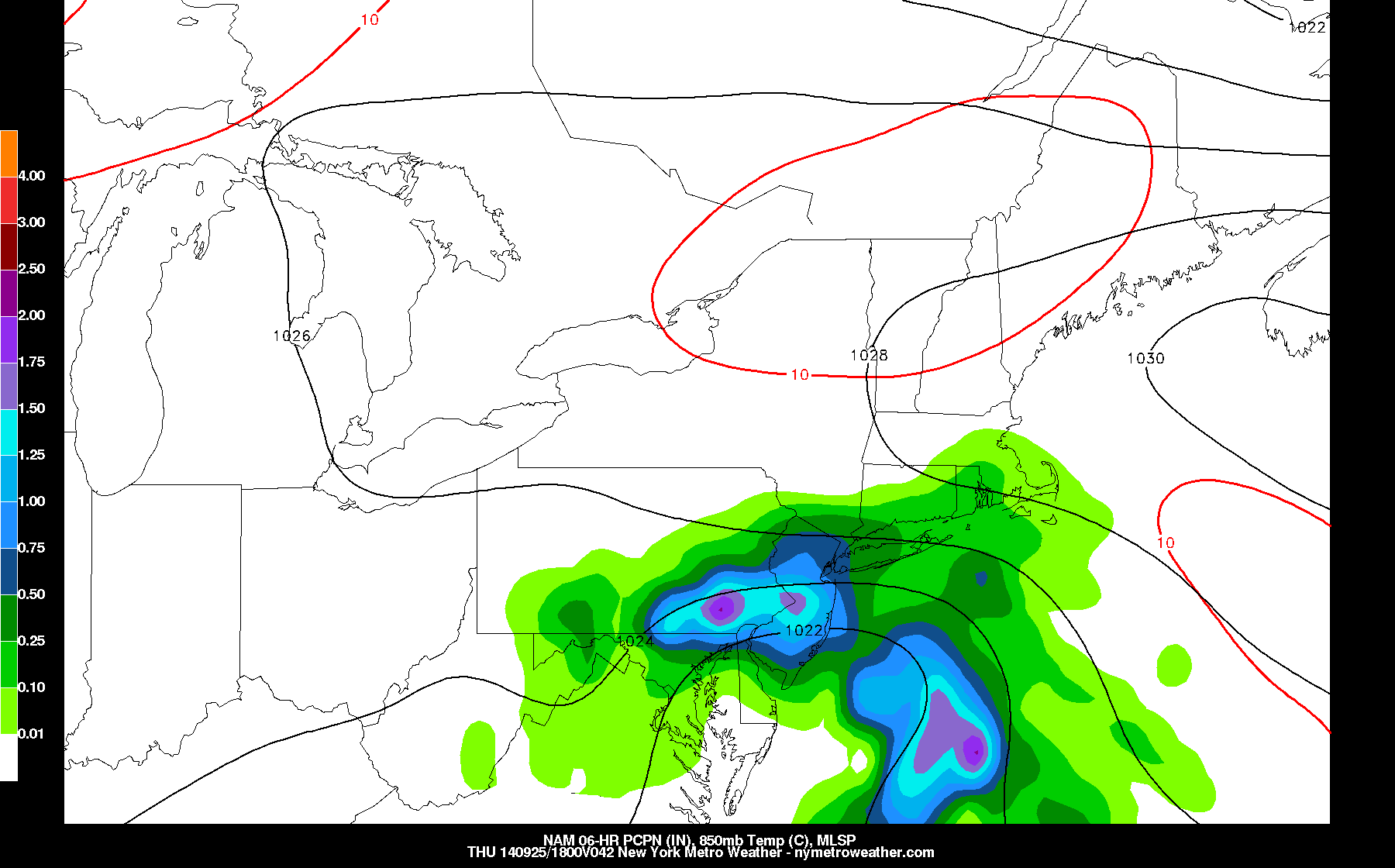
Last night's NAM Model showed plenty of rain for most of the region, but the storm system itself is very weak.

Last night’s NAM Model showed plenty of rain for most of the region, but the storm system itself is very weak.

Note how in the image above, there are surface pressures of 1030mb + sliding offshore of New England, but the storm system approaching is not very impressive. The “Low” Pressure is barely below 1022mb — these pressures in some weather patterns would be a high pressure! Areas of high and low pressure on a weather map are denominated relatively, not absolutely — meaning the lowest pressure in a certain area is the “low”, where counterclockwise motion forms and inclement weather is generally associated, and the highest pressure in a certain area is the opposite. But the fact that our “Low” is so high in pressure is a good indicator that the storm system itself is just not that impressive.

Read more