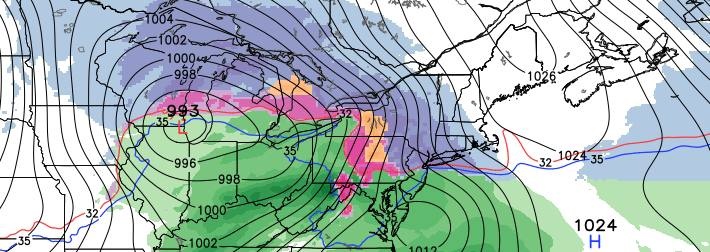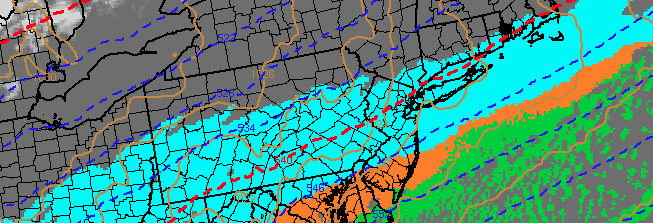
Substantial snowfall possible Thursday

On the heels of a strong southwest flow event which left the area under more snow and sleet this Tuesday into Wednesday morning, a low pressure system is forecast to develop late Wednesday into Thursday and deliver another round of snow. This time, it looks more significant in terms of snowfall accumulations. As a cold front sinks south of the area Wednesday, mid level energy will shift from the Central United States eastward, forcing the development of a low pressure system from the Southeast States into the Mid Atlantic.

A thermal gradient, or baroclinic zone, will be positioned from the Ohio Valley through the Mid Atlantic and Northeast, serving as a highway for the development of precipitation. As the mid level jet dynamics are enhanced Thursday, snow will become more widespread throughout the Mid Atlantic and Northeast United States. On the northern periphery of the forcing for moderate to heavy precipitation, a band of moderate to heavy snow is likely to develop.

Programming Note: We will have a Storm Total Snowfall forecast for release around 11:00pm tonight.
Read more

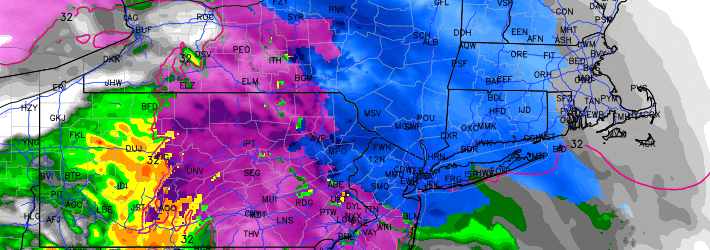
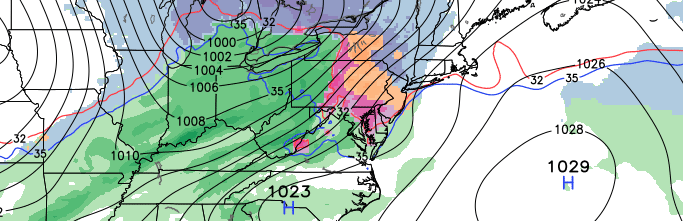
Rough PM commute likely with snow, sleet expected

A storm system developing over the Central United States will shift northward today, bringing enhanced lift for precipitation and forcing the development of snow from southwest to northeast throughout the area. As this lift shifts northeastward, snow will become steadier and heavier later this afternoon throughout the area. This snow will be falling as a result of increased lift for precipitation, owing to an increased southerly flow in the mid levels of the atmosphere as a result of warm air advection.

This warm air in the mid levels will continue to shift northeastward from the Mid Atlantic into the Northeast States, shifting precipitation from snow to sleet across much of Northern NJ and NYC by later tonight. In the low levels, however, cold air will remain stout — creating the potential for not only sleet, but ice accretion as well if the depth of the mid level warm layer becomes wide enough to support freezing rain. This will create treacherous conditions on roadways tonight across Northern NJ and the suburbs of NYC in SE NY and Connecticut.

Read more

Two more wintry events possible this week

An active mid and upper level atmospheric pattern continues to bring storm threats from the Central to Eastern United States this week. After a moderate snowfall event on Sunday Night into Monday, eyes will turn to two more potential winter weather events, both of very different nature, during the middle part of this upcoming work week. Both have the potential to bring snow, sleet, and ice accumulations to much of the forecast area.

The first threat will come Tuesday Night into early Wednesday Morning. A classic “southwest flow event”, as meteorologists often refer to it, will transpire throughout the Northeast United States. A low pressure system will be well to our north and west — over Canada — drawing in southerly winds and warmer air, but low level cold air over the Northeast will hold on long enough to allow for a period of snow.

Read more

Multi-wave winter weather event possible next week

A multi-wave winter weather event is increasingly likely to unfold during the early to middle part of next week across a large majority of the Northern 1/3 of the United States, initially in the Great Lakes and then northeastward into New England. The exact area where this winter weather potential sets up obviously remains highly uncertain. Forecast models have been extremely inconsistent in handling mid and upper level features which will eventually have major impacts on the sensible weather experienced by many. But in this case, there are clues in the meteorological pattern that point to the answers to some of our questions. Instead of looking specifically at forecast models and their trends, we can begin to look for answers to our questions in the hemispheric pattern. 

The winter weather threat traces its roots back to the total degradation of the West Coast ridge and positive PNA on along the West Coast of the United States into British Columbia. Inherently, this is a bad sign for snow lovers on the East Coast Any time we degrade a PNA ridge there is a positive mid and upper level height field response to the east of that over the Southeastern United States. In fact, the collapse of a PNA ridge can bring a response all the way into the Western Atlantic. As the amplified pattern out west collapses, the mid level jet collapses east into the Untied States and allows for the flow to enhance further to the east. So not only does the Southeast Ridge suddenly gain amplitude, but the pattern becomes more progressive over the Great Lakes and Southeast Canada — working against snow chances in the East. 

Read more