Cold pattern looms for the first half of January

As we approach the end of 2013, we close the books on a very wintry month of December for both the NYC metro area and the United States as a whole. From record lows across the Rockies, Plains, and Mid-west, frequent snow/ice events for the Northeast, a recent major ice storm for Northern New England, to record high temperatures yesterday over the region, this month has produced some wild swings in weather. Extreme temperature shifts were liable to occur this winter due to the presence of a negative EPO, blocking ridge in the North Pacific constantly combating an unfavorable positive NAO signal in the north Atlantic. The result has been a robust SE ridge, though the arctic air has been pressing quite fiercely on the NW fringes of this SE ridge. For our region, our location along the baroclinic zone / thermal gradient has yielded some minor to moderate snows for winter 2013-14 thus far, giving us above normal snowfall for December 2013. Some of the analogs previously examined for the winter outlook, like 2008, have been working well in terms of the overall 500mb pattern, although this month actually finished snowier than December 2008 for most. This is not a surprise since analog years won’t be able to tell us where the heaviest snow will fall, but they are helpful for clues for the mid level pattern that produces said wintry events.

Going forward, the pattern turns colder over the coming days, with an outside chance of a white Christmas for a low percentage of our area. A quick moving but fairly potent mid level wave will be propagating through the area tomorrow, and this could ignite some stronger snow showers in association with the zone of upward motion/convergence at 700-800mb. For most, it’ll bring about some “mood” flakes as a nice reminded that winter is still alive and kicking.

Dry weather prevails through late week, then things begin to get more interesting as we approach the New Year and beyond. The negative EPO, North Pacific ridge that provided us with the cold/snowy mid December briefly broke down over the past week (and we can see the result with very warm, rainy conditions) will be returning over the coming week. This NPAC mid level ridge has been a very stable feature over the past couple months and continues to be crucial in combatting the poor north atlantic / +NAO signal. However, the Arctic pattern could be changing over the next couple weeks, and this could make for a somewhat different evolution for January. Thus far, we’ve seen a strongly positive AO (low height field in the Arctic) which correlates to a stout SE ridge near the East Coast. That signal in conjunction with the +NAO has prevented the core of the cold anomalies from reaching the East Coast so far this winter.

Read more

NYC Forecast: Slow warming trend this week

Cold weather has become a staple in the area forecast over the past several days, with the only warmup coming during a significant storm system — which produced the first rainfall of over 1″ since September in New York City. Otherwise, though, it has been a cold and dry pattern which has dominated the past several weeks. Some changes are in order during this week, but the start will be characterized by a slight warmup. Monday will be the first of a few “warmer” feeling days, with highs in the 40’s to near 50 in many spots as well as plenty of sun.

During the week, the airmass will slowly modify as a high pressure continues to control the pattern. High temperatures will reach into the upper 40’s and lower 50’s by the middle to second half of the work week. With the warmup, will come a chance of precipitation and the likelihood of clouds, which will move into the area as a warm front moves nears on Thursday.

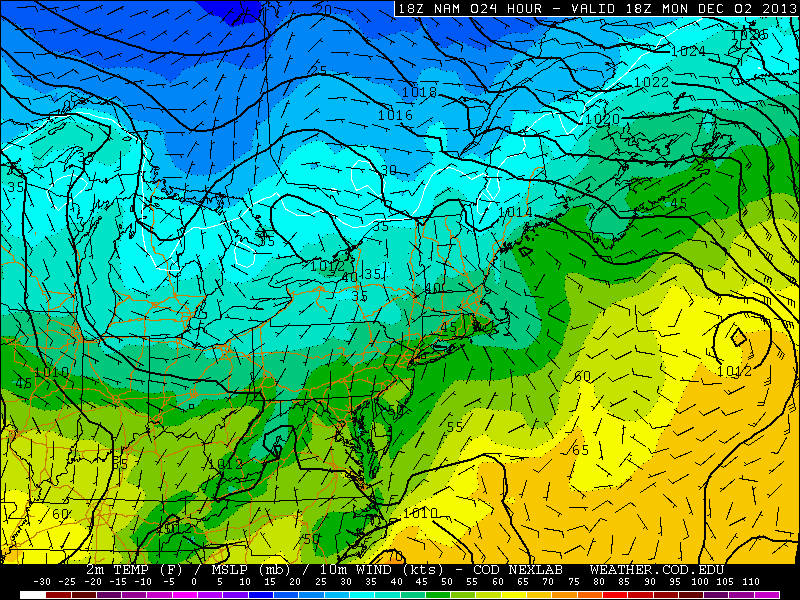
NAM model, forecasting high temperatures in the upper 40's to lower 50's on Monday.

NAM model, forecasting high temperatures in the upper 40’s to lower 50’s on Monday.

Read more

Pattern overview: Some ups and downs, but overall warm

After a chilly few days, temperatures are rebounding, and this should continue to be the case. Thanks to a -PNA pattern, which favors a trough in the western half of the country and downstream ridging in the eastern half of the country, as well as no -NAO nor -AO to keep that ridging at bay, our temperatures have moderated nicely. Temperatures will rise into the mid and even some upper 60s on Wednesday and Thursday out ahead of that trough, before a cold front comes through on Thursday night with a few showers and chilly weather for Friday and Saturday, but nothing too unseasonably cold.

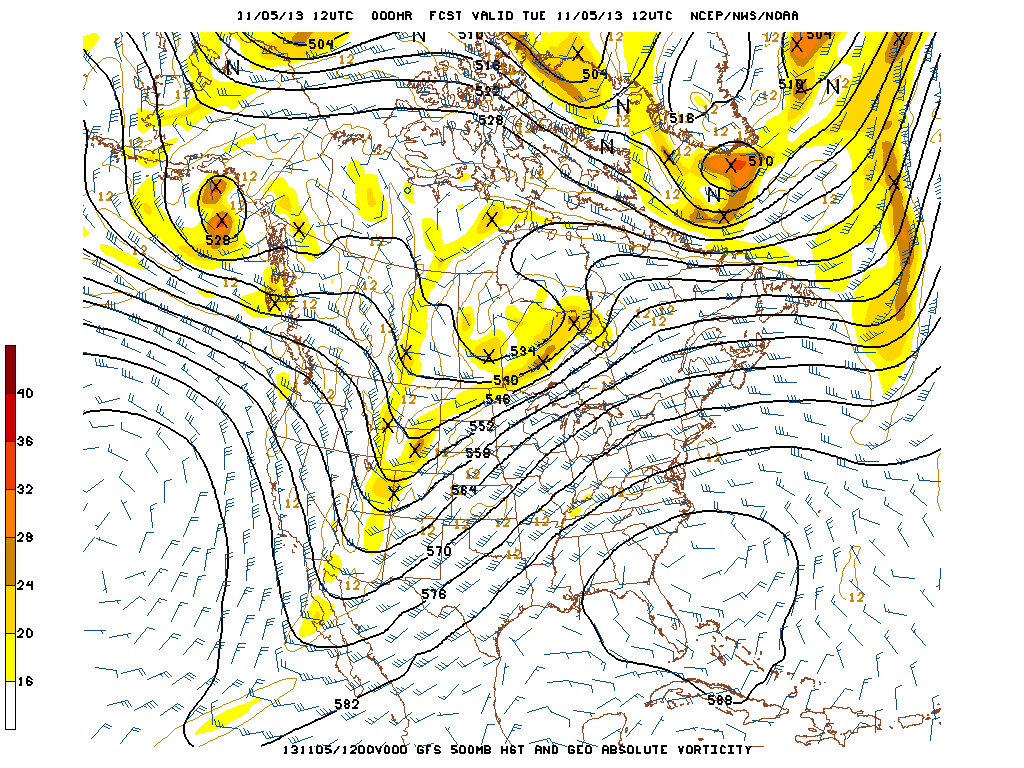
The initialized GFS from this morning shows a positive NAO, positive AO, and negative PNA pattern -- all favoring a ridge in the east.

The initialized GFS from this morning shows a positive NAO, positive AO, and negative PNA pattern — all favoring a ridge in the east.

As one can see, the initialized GFS image from this morning shows very low heights in Greenland, leading to a positive NAO, low heights close to the Arctic, leading to a positive AO, and a trough in the west, leading to a negative PNA. This all favors a ridge in the east, which is clearly shown. And although there is a ridge in the Pacific, its amplitude gets cut-off by low heights in Alaska, which is a +EPO pattern. This means that all the cold air gets bottled up in the Arctic, and cannot get sent down to the United States. Instead, any troughs tend to contain more Pacific-oriented air, so even the trough in the west is not all that impressive. Since there is not a whole lot of cold air associated with the trough, the temperature gradient is weak, and any storm that forms along it will not be all that impressive. Also, the strongest height gradient is currently in the midwest, so any storm would tend to take that track and mostly miss our area.

Read more

Importance of the North Pacific Pattern in Autumn

As we progress deeper into the autumn season, many are beginning to wonder if the upcoming cold pattern is a precursor to the type of winter that we will see. Unfortunately, it is not as easy as cold October yields cold winter or warm October yields warm winter. If that were the case, we’d have long range forecasting figured out by now and there would be no need for winter outlooks, as the winter would be set in stone by the end of October. The best we have are correlations, analogs, physical pattern drivers, and pattern persistence. When added together, the summation of these various factors provide a higher probability of success in medium to long range forecasting, but these methods are far from perfect. With that being said, the evolution of different atmospheric oscillations during the autumn season can give us a substantial clue as to the ensuing winter’s dominant index modalities.

In this particular case, let’s examine the autumn north pacific pattern of years since 1990, giving us a sample size of 22 years (we would have to wait through this winter to see if 2013′s correlation holds up). The north pacific pattern is often represented as the East Pacific Oscillation (EPO). Like the North Atlantic Oscillation, the EPO has certain, generally predictable outcomes when it oscillates from positive to negative phases. The positive phase of the EPO is usually associated with lower than normal heights across the northeastern Pacific, much of Alaska, and northwestern Canada. Conversely, the negative phase of the EPO generally produces higher than normal heights over the region just described. The positive (+EPO) tends to flood the United States with maritime pacific air due to the low pressure around Alaska, while the negative (-EPO) acts as a block to maritime pacific air due to high pressure over the NE Pacific/Alaska. The -EPO often sets up a cross polar flow with high pressure centered over Alaska and the flow oriented across the north pole from Siberia into Canada. The -EPO pattern has yielded some of most impressive, severe arctic outbreaks on record. The upcoming 10-15 days, for example, will be colder than normal in the East primarily due to the forcing from the negative EPO signal in the northeast Pacific. There’s not much blocking in the north Atlantic or arctic regions, so the main impetus for this cold through November 5th is the -EPO.

Read more