Public Analysis: Record-breaking Warmth Gives Way To Seasonable Weather

Today has been yet another absolutely beautiful day with scattered clouds and light winds making for an excellent and unusual end to another February workweek. After a cold front and possible associated line of showers and thunderstorms move through tomorrow, a return to more seasonable temperatures is likely.

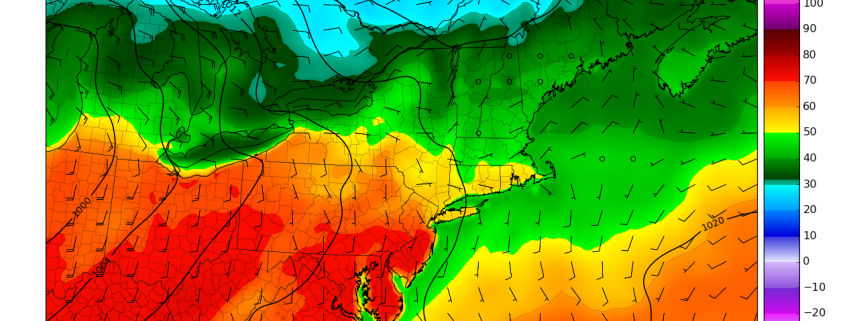
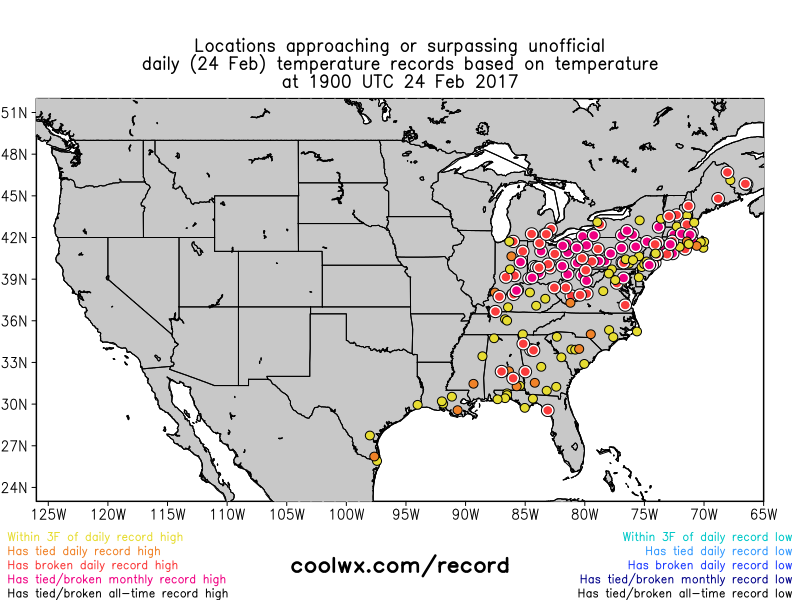
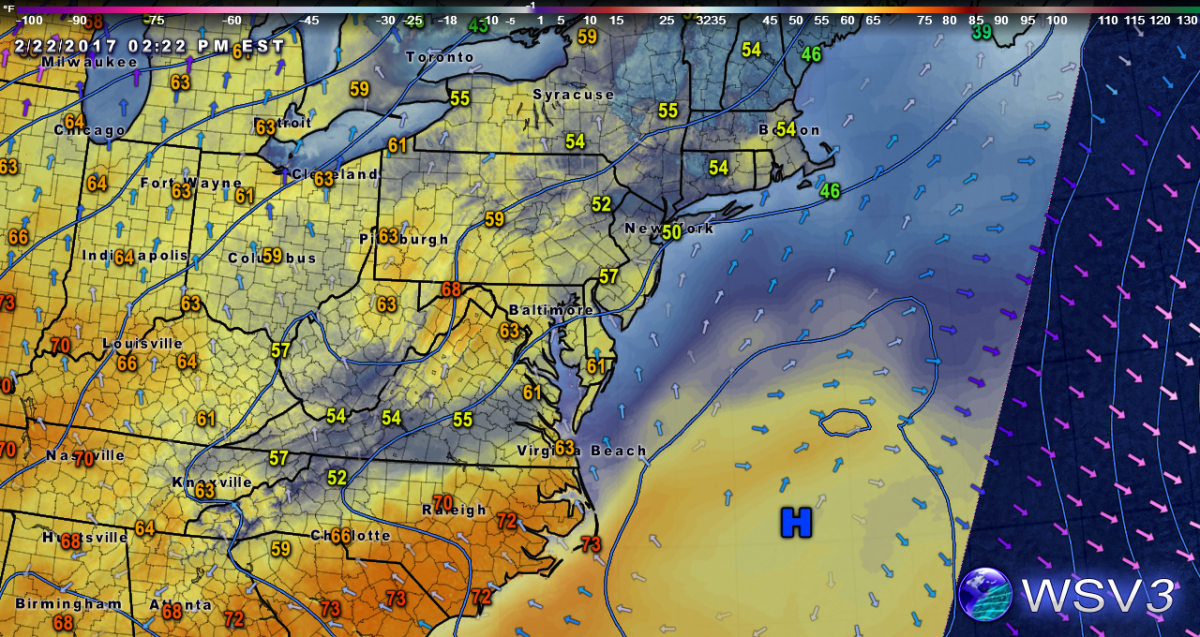
Temperatures this afternoon have soared into the low to mid 70’s across much of the area. with coastal locations along Long Island and Connecticut seeing temperatures a bit lower in the mid 60’s. As was mentioned as early as Monday, these temperatures are 25-35 degrees above normal for this time of year, and as a result, numerous monthly high temperature records are falling across the entire Northeast. All of this warmth has been caused by a high pressure system over the western Atlantic that continues to provide winds out of the southwest that will continue through this afternoon. As we progress through the afternoon and into the evening, the persistent ridging and attendant high pressure system will begin to give way to a stronger mid-level disturbance currently located over the central Plains this afternoon. (This system is also responsible for the marginal severe threat in the Ohio Valley this afternoon and evening-see our Severe Analysis for more on this event)
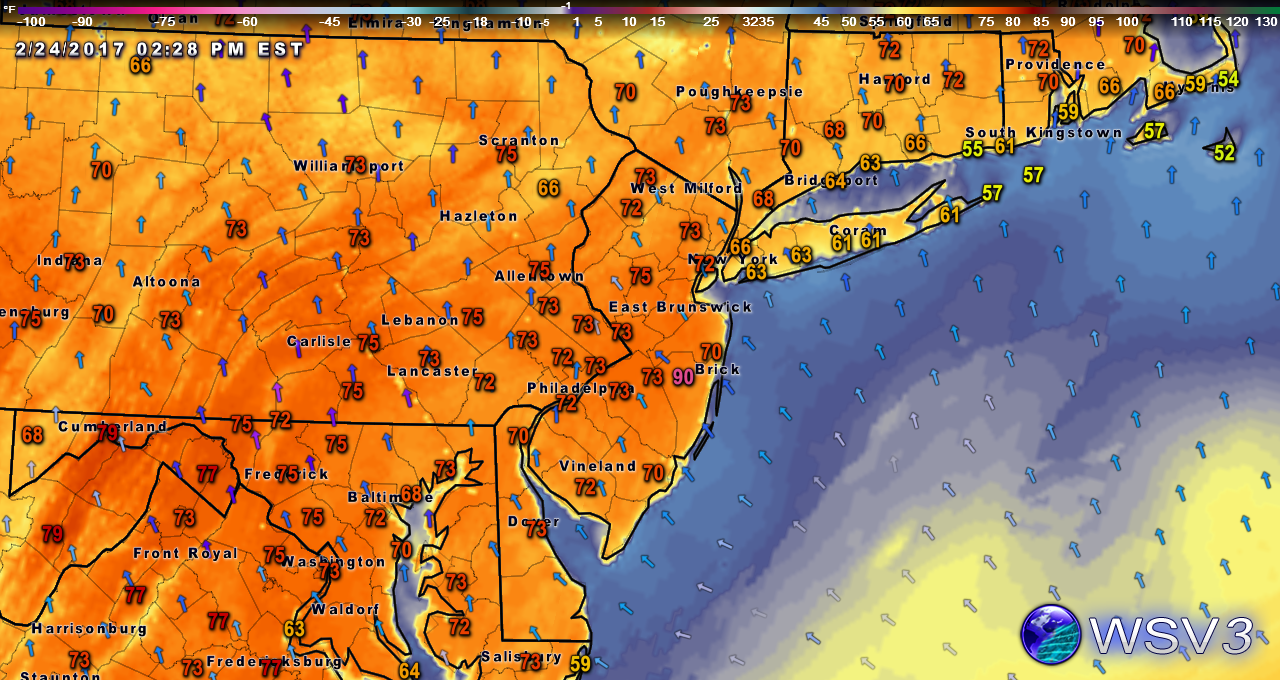
A look at the record-breaking temperatures across the metro area this afternoon

A look at the record-breaking temperatures across the metro area this afternoon

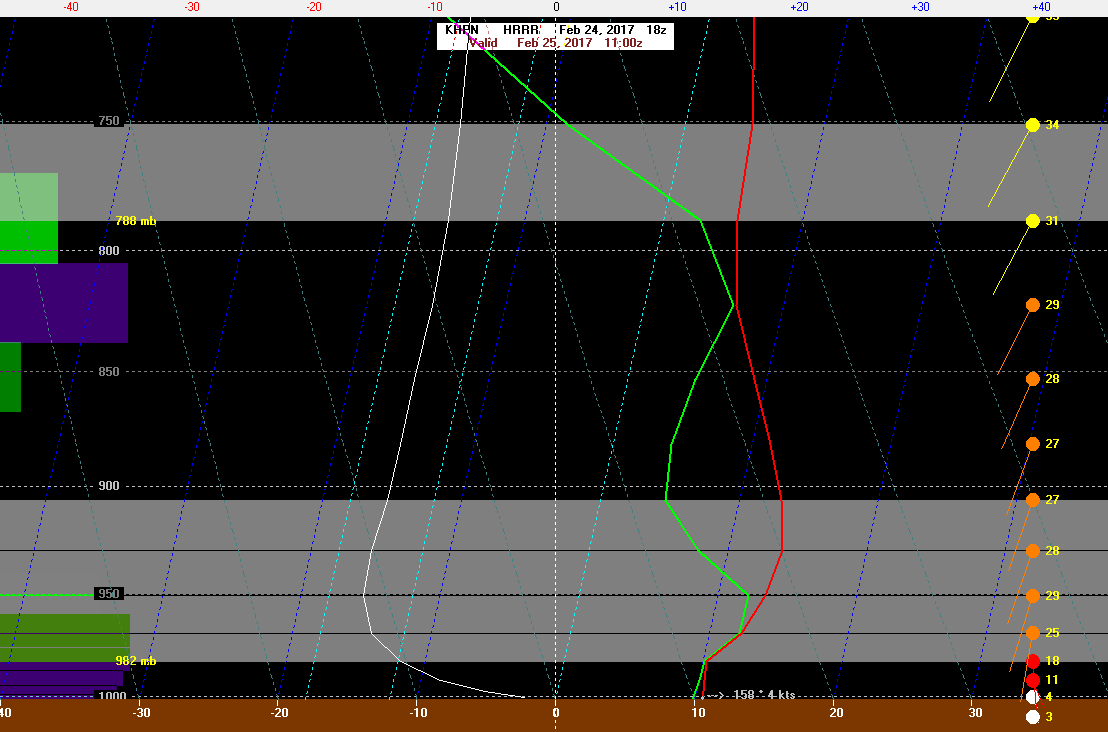
As the influence from this system increases later this evening, the amount of moisture available in the atmosphere will also increase. This low level moisture will become trapped underneath a temperature inversion, which will act as a “lid”, and enhance the possibility for some dense fog for coastal regions this evening and lasting into early tomorrow. This moisture should linger into the morning hours, with low level clouds and even some patchy drizzle taking place in the areas that have more available moisture to work with. As we move into Saturday afternoon, temperatures should not be as warm as today as winds from the southeast start to work into the metro and limit highs to the upper 60’s for inland locations and 50’s for the coast. Some locations that are stuck underneath prolonged low level clouds tomorrow afternoon will also struggle to really warm up too much tomorrow afternoon.

HRRR model showing limited surface visibility tomorrow morning (Valid 7am)

HRRR model showing limited surface visibility tomorrow morning due to low clouds and fog (Valid 7am)

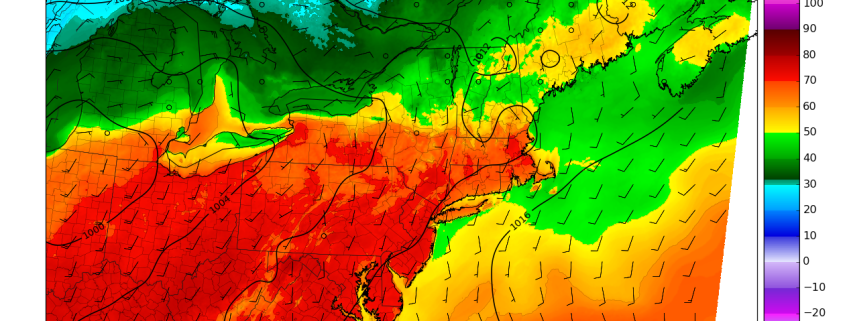
The main story tomorrow will be a cold front advancing eastward from the Ohio Valley and into Pennsylvania by tomorrow afternoon. Due to some limited instability as well as some lift provided by the upper level jet overspreading the area, a line of showers and thunderstorms will likely develop over Pennsylvania early tomorrow afternoon and quickly race eastward. As this line of thunderstorms reaches eastern Pennsylvania, southern New York, and New Jersey, what limited instability and dynamics that this line had to begin with will gradually fade. As a result, by the time the line of showers and thunderstorms reaches our area they should begin to weaken quite a bit. Heavy downpours, some brief gusty winds, and even some thunder are all possible, especially across inland zones.
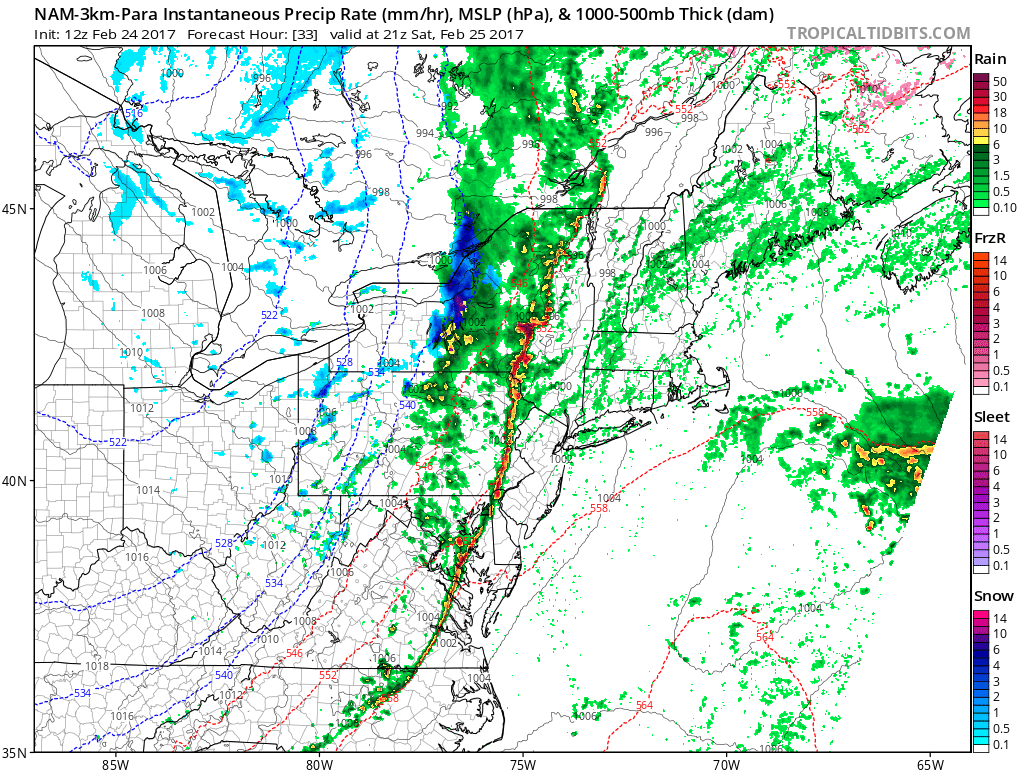
3km NAM showing line of thunderstorms and associated showers along the cold front (Valid 3pm Saturday)

3km NAM showing line of thunderstorms and associated showers along the cold front (Valid 3pm Saturday)

After the front moves through late tomorrow afternoon/evening, some lingering showers will be possible as temperatures begin to return to seasonable levels, and then even back down to below-normal temperatures by early Sunday morning. Although this below-normal period of temperatures appears to be short-lived, it should be quite the contrast from what we have seen over the past week or so. Once we get into the upcoming work week, temperatures should hover around normal to slightly above-normal with the chance for a few weak disturbances passing near our area to provide some precipitation for the area starting on Monday. This unsettled weather will continue for the rest of the week, but as we move on in time, long range guidance is beginning to indicate that the very fast flow that has prevented a few significant winter storms this season will begin to relax. This could possibly lead to at least some cooler weather and possibly a full return to winter by March. Make sure to stay tuned for updates on tomorrow’s possible heavy rain threat as well as the evolving long range pattern! For more information and posts like this one, make sure you sign up for Zone Forecasts — where multiple detailed articles, videos, and interactives are posted each day.

Have a great weekend!
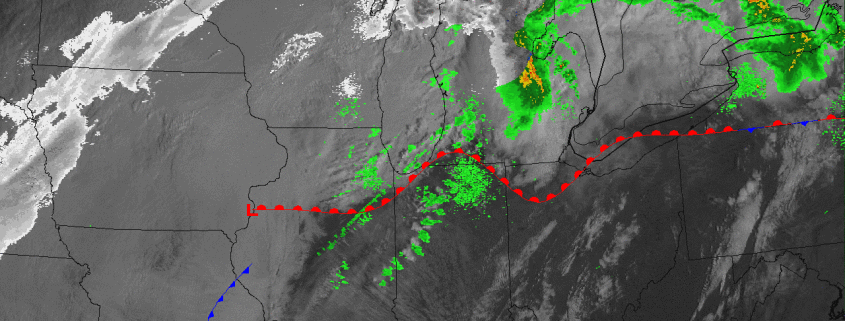
Enhanced Risk for Severe Weather in the Ohio Valley on Friday

3:30pm Update: So far, everything is on track with respect to downplaying the event relative to SPCs and other outlooks’ expectations. As expected, there is still a lingering strong capping inversion in the warm sector, so there is not enough lift to generate strong thunderstorms to take advantage of the instability. Additionally, the low-level jet (LLJ) still continues to lag significantly behind the daytime heating, so the low-level winds are not strong enough for additional lift, superceullar organization, nor for transporting severe wind gusts down to the surface. There are only a few isolated wind reports so far, which is far below the threshold for an “enhanced” risk.

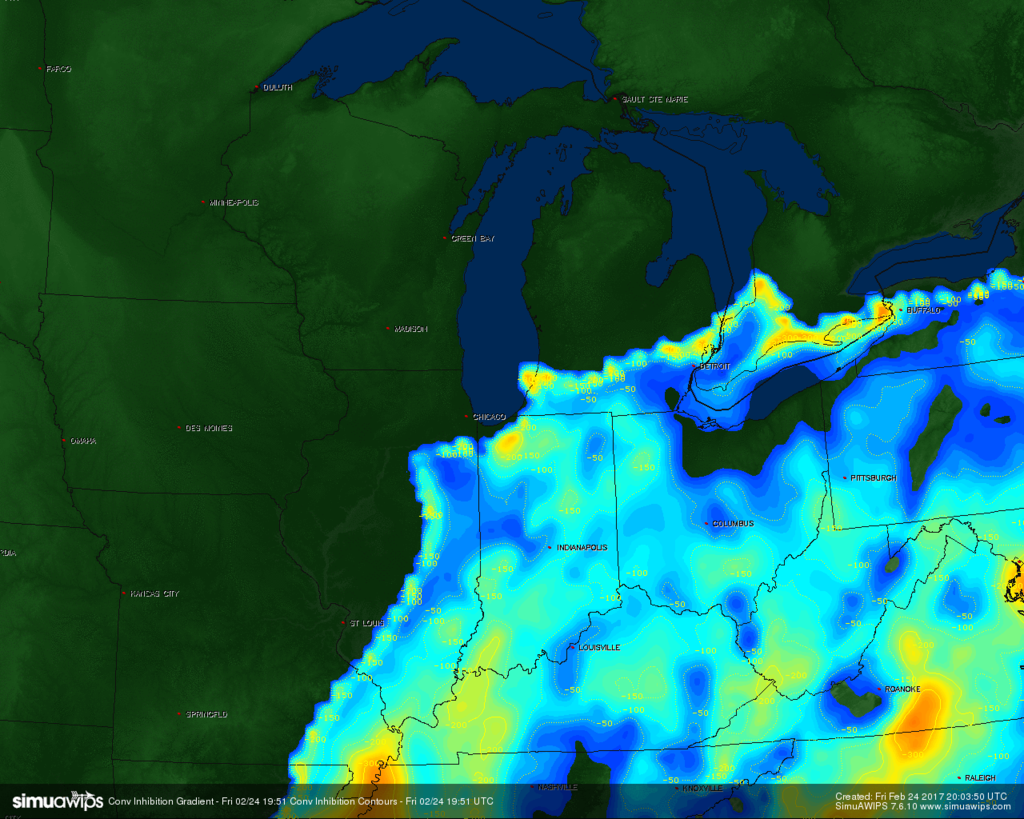
Current SIMUAWIPS analysis shows plenty of convective inhibition (CINH), preventing storms from taking full advantage of daytime heating.

Current SIMUAWIPS analysis shows plenty of convective inhibition (CINH), preventing storms from taking full advantage of daytime heating.

We still do think that later this evening, when the storm system strengthens a bit and frontal forcing increases, we’ll get a decent low-level jet increase late this afternoon and through this evening, which may produce a strong to marginally severe line of storms along the cold front from eastern Indiana into Ohio. We still think Ohio may be more likely to see strong to severe winds since they are in the best location for an increase in the low-level jet. Some initially isolated discrete cells out ahead of the line may be able to produce some hail in Indiana and perhaps parts of Ohio, but the linear wind profiles indicate a transition to a line with moist mid-levels, so we do not expect many severe hail reports.

Additionally, the low-level jet is way too linear and weak right now to generate the necessary updraft helicity for tornadoes — which is why we never bought into a true tornado threat. There still may be some isolated tornado reports later this evening if some discrete cells can form ahead of the line of thunderstorms when the low-level jet does increase in strength. Fortunately, any tornado threat will be isolated and any tornado that does form should be weak.

Previous Content: During this early-spring…I mean late-winter day, the ingredients are beginning to come together for an impressive severe weather episode on Friday in the Ohio Valley. A strengthening storm system which will provide blizzard conditions for parts of the Northern Plains will have its warm sector line up perfectly with Gulf of Mexico moisture transport and instability. Furthermore, this strong storm system will be dragging a strong cold front to its east, helping to increase low-level moisture return via strong low-level winds from the Gulf of Mexico, provide plenty of lift via the frontal forcing, and also provide very cold mid-level temperatures. This is because behind the cold front, mid-level temperatures are very cold since there is actual winter-cold behind the front, but mid-level winds often blow so fast that they advect the mid-level cold air to places on the warm side/ahead of the cold front, helping to juxtapose a warm, moist airmass with cold air aloft and a lifting mechanism — perfect ingredients for thunderstorm formation. This cold air aloft and thus very strong thermodynamic and dynamic lifting with these types of systems this time of year often make up for not having a true summer-like low-level airmass and can provide lift equal to that of spring and summer-like outbreaks.

From here, the devil lies within the details as far as taking this severe weather episode from minor to major. At this point, we think this event will be somewhere in between. While the above details portend a significant outbreak, there are more nuances to this event, such as jet-streak behavior, as an alignment of strong jet streaks can turn lift from merely sufficient for thunderstorms, to majorly supportive. And what we see currently is a not ideal alignment of jet streaks in the low-levels and the upper-levels with when the storms actually initiate.

Read more

Public Analysis: Unusual Febuary Warmth, Unsettled Saturday

Another very warm end to the work week is on tap with temperatures leveling off on Saturday as a cold front moves through the region and provides a chance for some much needed precipitation for the area.

After some overcast and lingering sprinkles this morning that moved over the Lower Hudson Valley and Long Island, the associated  overcast and showers have eased up enough to allow for temperatures to reach into the 50’s across much of the area this afternoon. With just middle to high level cloud cover persisting the rest of the afternoon, the Metro area should continue to see temperatures rise into the 50’s, with even some 60 degree readings possible in the southern half of New Jersey. As a very weak mid level disturbance dissipates while it quickly moves off to the east this evening, high pressure centered over the Atlantic will remain in control of our weather as we head into the evening and will help to provide a very light southerly flow. This southerly flow may introduce some moisture at the lower levels of the atmosphere very close to the surface that could produce areas of fog. The fog may reduce visibilities quite a bit in some locations, so use caution if driving. Otherwise, temperatures this evening will drop down into the 30’s for inland sections, and into the low to mid 40’s for the coastal areas which is just about average for this time of year.

Read more

Threat Analysis: Northern Plains/Lakes winter storm this week

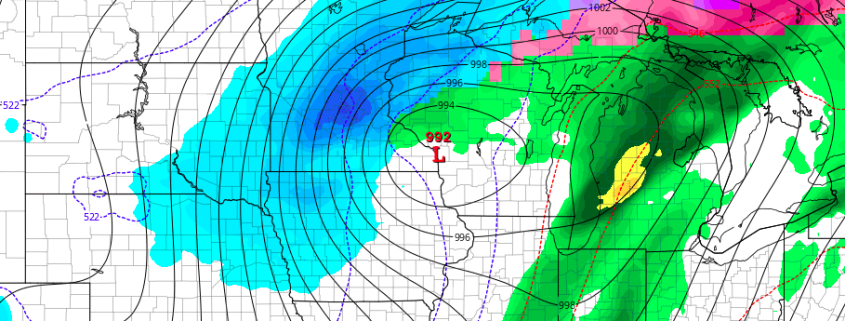
A potent disturbance is forecast to eject eastwards from the Pacific Ocean this week, reaching the Western United States and eventually moving northeastwards towards the Rockies during the middle of the week ahead. Meanwhile, northern stream energy (associated with the colder, northern jet stream) will be sliding across the Southern parts of Central Canada, just north of the international border. This reinforcing cold air, combined with the disturbance ejecting from the rockies, will lead to the potential for a winter storm in the Northern Plains and Great Lakes late this week.

A low pressure system will eject from the Central Rockies into the Plains states from midweek onward — essentially from Thursday into Friday. This low pressure area is expected to strengthen as it moves through parts of the Central Plains (Nebraska and Kansas) north-eastwards towards Iowa. Forecast models have struggled to pin down exactly where the low pressure center will track, which has led to considerable forecast uncertainty.

Read more