Winter Storm Likely Wednesday for Portions of the Northeast

Good evening! 

Today has been a rather cold and blustery day across the entire Northeast as a cold front quickly blasted across from west to east early this morning. This cold front ushered in a fresh blast of cold air from Canada, causing temperatures to drop a few degrees this morning before peak daytime heating. As the cold front moved offshore, dry air filtered into the region which allowed for mostly sunny conditions to persist throughout the rest of the day. Despite the clear skies, the cold mid level temperatures only allowed for temperatures to rise into the lower to middle 30’s for the immediate NYC metro area. Highs were a bit lower to the north and west with temperatures staying in the middle to upper 20’s-which is only slightly below normal for this time of the year. The main story today was actually the winds that arrived immediately after the frontal passage, which gusted at around 30-35 mph at times. These winds really helped to make conditions feel quite a bit colder than they actually were, with wind chills in the middle to lower teens. Additionally, any residual standing water left over from melting snow quickly froze this morning, leading to some very slippery conditions across the entire Mid Atlantic and Northeast.

Conditions will remain quite clear, with winds gradually abating by around midnight. A weak area of high pressure will work over the Mid Atlantic this evening and provide rather favorable conditions for radiational cooling to take place tonight. Highs should drop down into the middle to lower 20’s for most of the NYC metro area, with locations to the north and west getting down into the middle teens for lows.
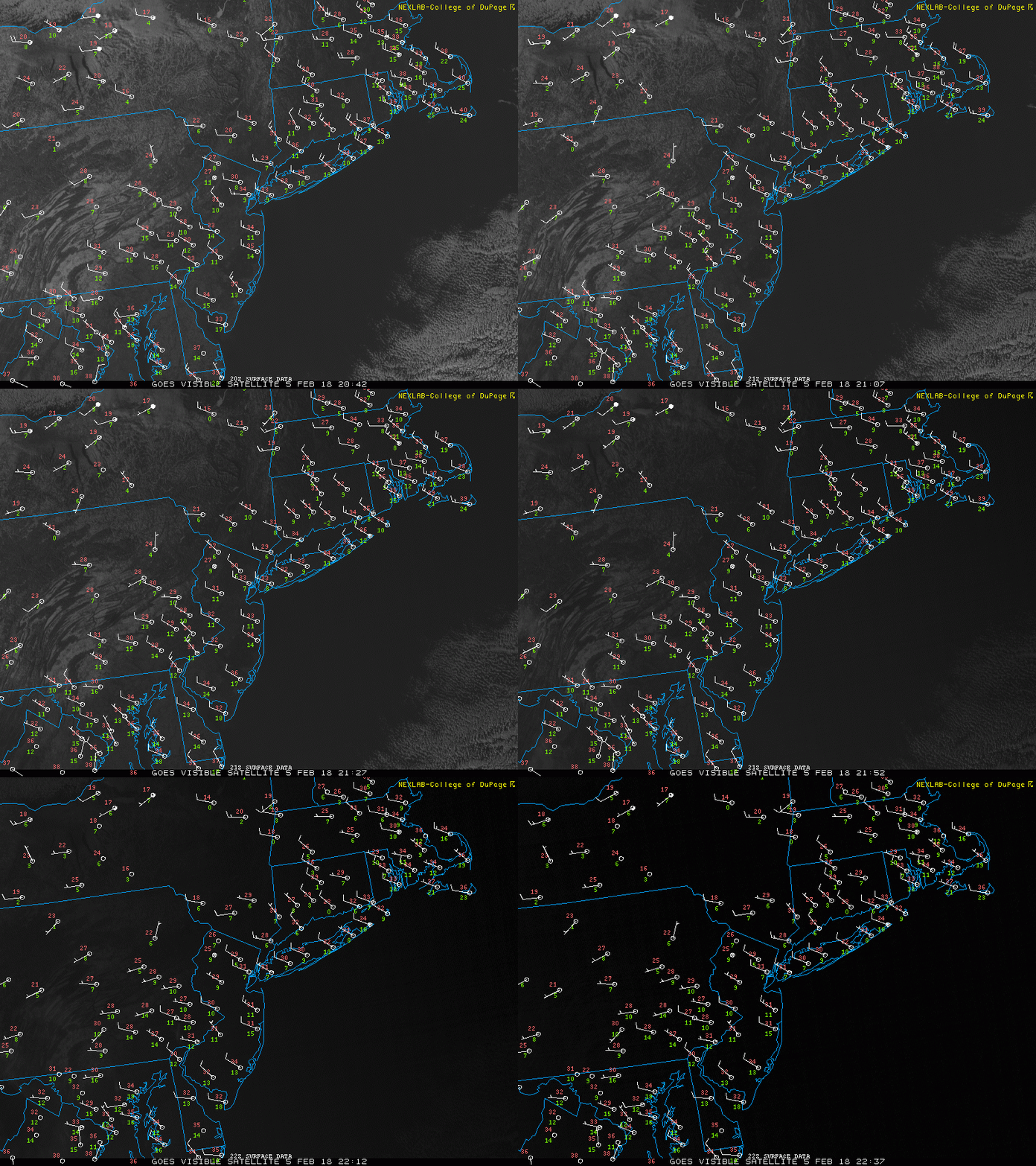
This afternoons high resolution satellite imagery and surface observations over the Northeast

This afternoons high resolution satellite imagery and surface observations over the Northeast

Calm Tuesday, Winter Storm Likely Wednesday 

Tuesday: A weak area of mid level energy will be racing across the Ohio Valley and into portions of the Northeast tomorrow morning, which will have to be closely monitored for possibly being able to produce some areas of light snow in the morning. This area of energy, being so weak, will not have a reliable source of moisture and will also be running into dry air. This will cause the threat of snow to be greatest over western locations of the Northeast. Any snow that does fall will very light in nature and should only lead to accumulations of around a trace to an inch. This area of energy will likely move off the coast by the middle afternoon hours, gradually giving way to clearing skies from west to east.  Despite the threat for some isolated snow, the rest of the day should be mainly calm and cool, with highs staying in the low to middle 30’s across the immediate NYC metro area. These calm and conditions will last through the evening hours, with lows ranging in the middle to upper 20’s.

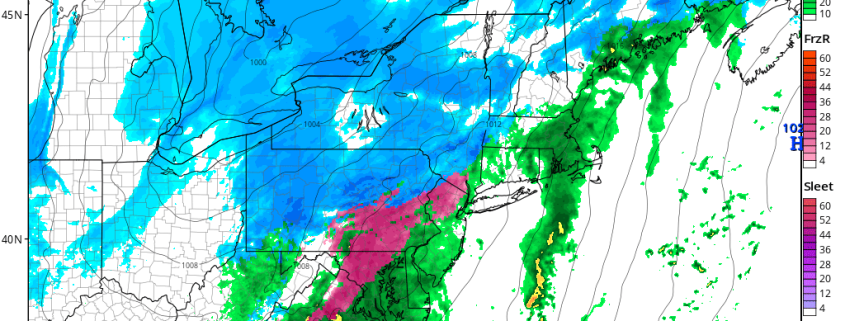
By Wednesday morning, two areas of energy will begin to interact over the central Plains states, leading to a very weak surface low developing over the Tennessean valley. As this low develops Wednesday morning, it will drag up a moderate amount of moisture with it that will likely cover the majority of the eastern US. The area of high pressure that is currently dominating our weather will be retreating to the east by this time, leaving some residual cold air behind over the Northeast. Precipitation will likely expand further to the north and east during the morning commute on Wednesday as an impressive upper level jet streak strengthens overhead. Since the surface high will be displaced to the east, the cold air will only be able to stick around for so long as warmer air begins to rise up from the south. This will likely lead to a quick-hitting period of moderate to heavy snow propagating from south to north , that will gradually change to rain over time as warmer air moves north. The further north and west you get from New York City, the better chance you have at more wintry precipitation. At this time, points south and east stand to get maybe a coating to an inch before the changeover to rain, but locations over NW New Jersey and SE New York have the best chance to see at least a couple of inches before a mix and eventual change to rain sets in.

It is important to note that the hi-res models have been waffling quite a bit over the past day or so, and this is mainly due to the handling of the extent of the low level cold air. If the cold air sticks around longer, there will be a greater threat of snow lasting longer in addition to more substantial frozen precipitation accumulations. These types of events usually do tend to be colder than forecast, which is why we feel that those traveling Wednesday morning keep an eye on the weather and stay tuned for further updates, as travel may be at least moderately impacted across the region.

Precipitation will gradually end from southwest to northeast as the low quickly heads off to sea during the evening hours on Wednesday.
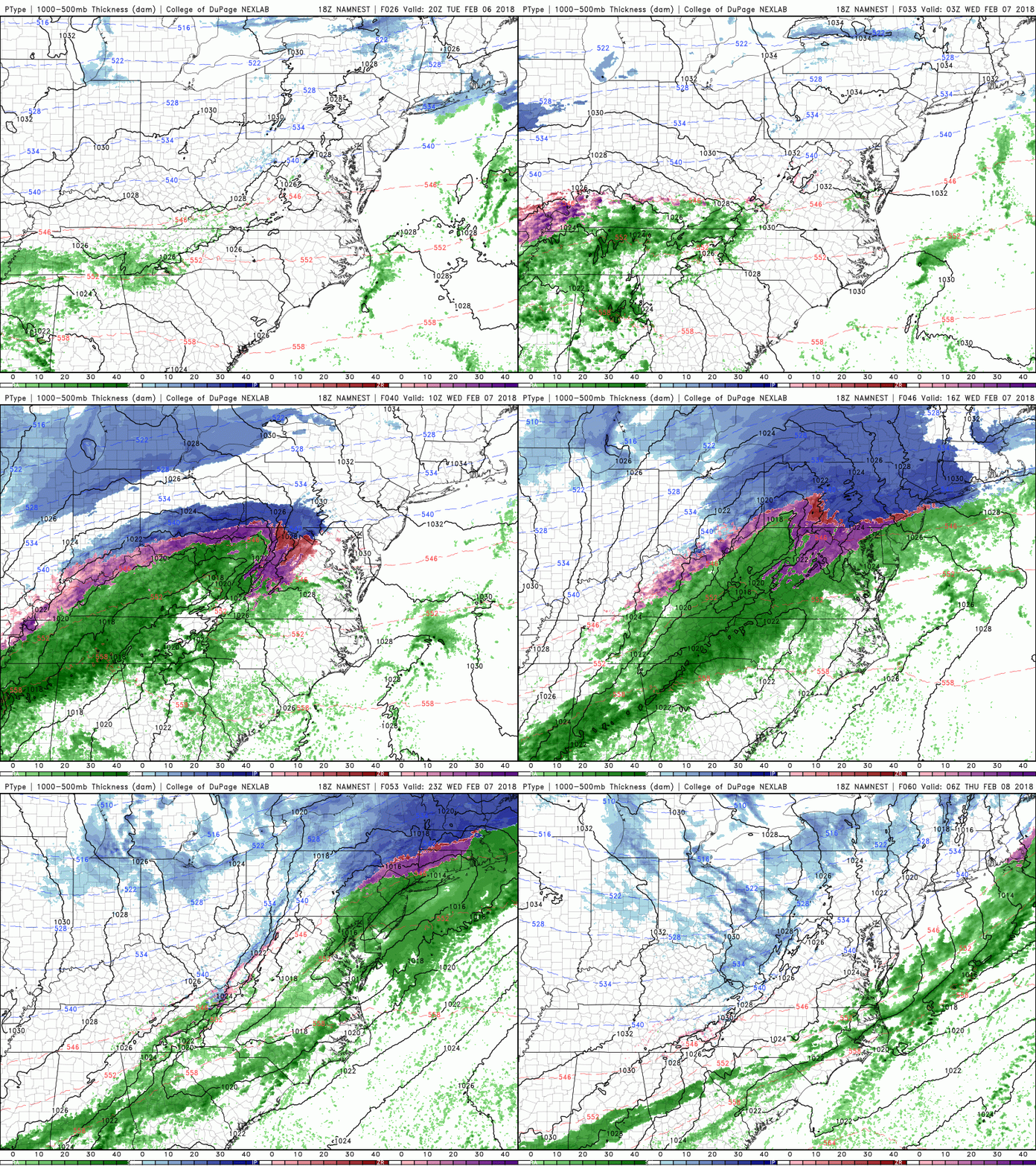
This evenings NAM model showing the evolution of the winter storm over the Northeast on Wednesday

This evenings NAM model showing the evolution of the winter storm over the Northeast on Wednesday

Another Storm Possible Next Weekend

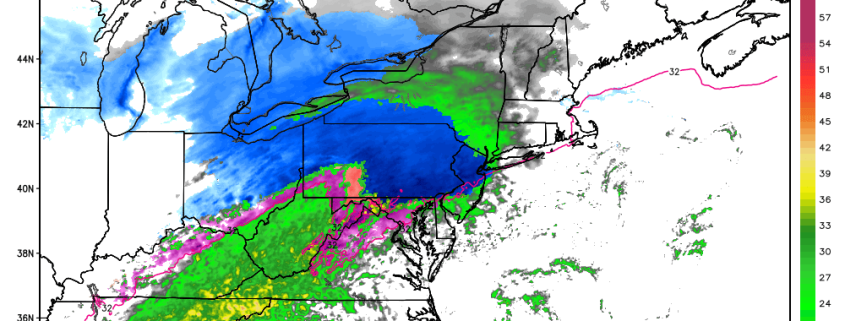
The computer models continue to depict another area of low pressure developing over the Tennessee valley Saturday and into Sunday as yet another area of high pressure exits to our east. This system will likely be quite large and disorganized in nature as the upper level pattern remains quite unfavorable for a strong surface cyclone. Additionally, there does not look to be a reliable source of cold air over the east, therefore any chance at significant snowfall through the weekend remains low at this time. There is still a lot of time for this to change over the next couple of days so make sure to check back for updates as they become available!
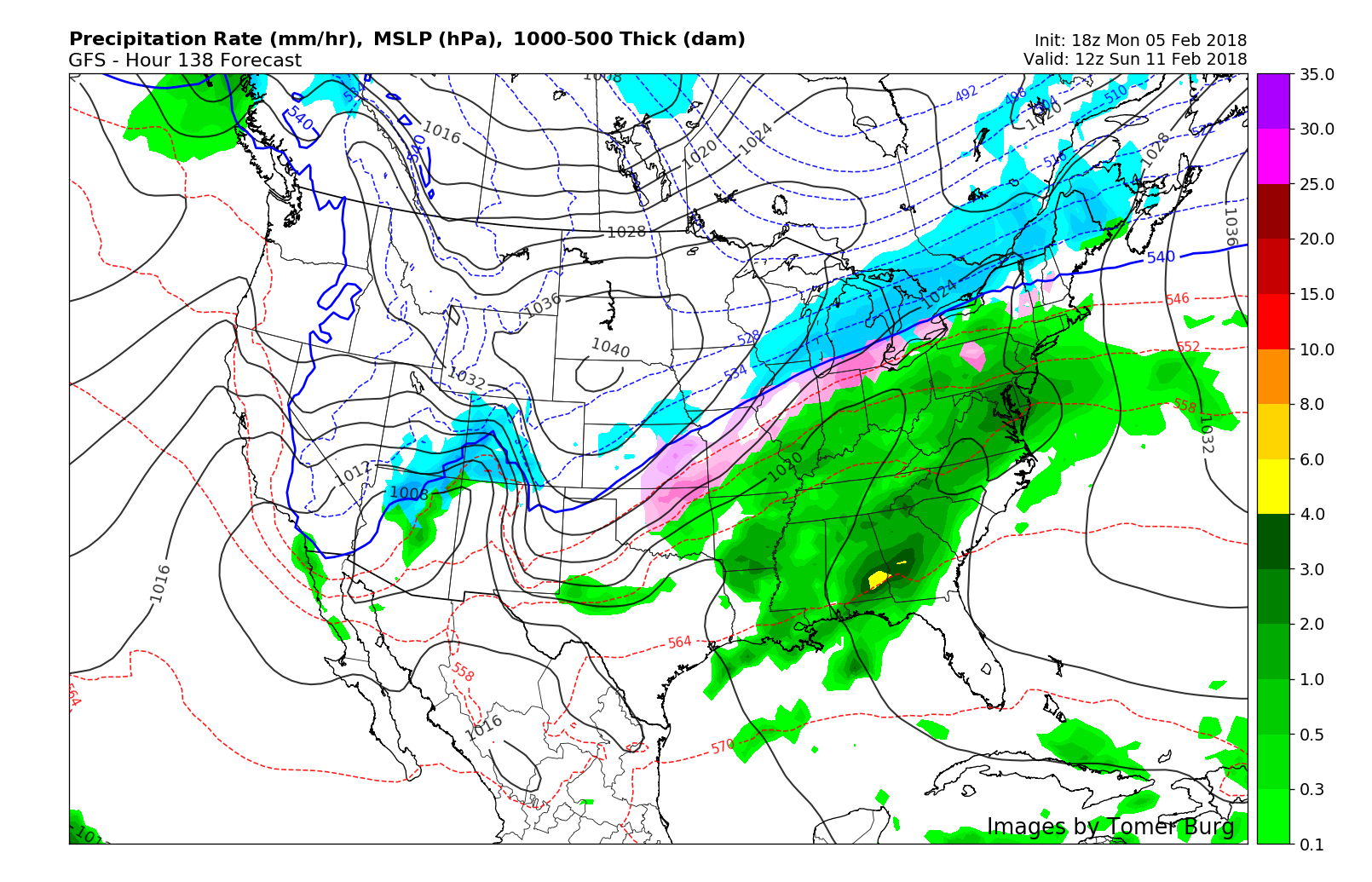
This afternoons GFS model showing the potential for another system to impact the east this weekend

This afternoons GFS model showing the potential for another system to impact the east this weekend

Have a great night!


Steve Copertino 
Monday Briefing: Winter Storm in the Northeast Wednesday

Happy Monday! High pressure from the west, builds into the Northeast today, behind our departing storm system on Sunday. Mostly sunny skies and breezy conditions are expected.  Cold air advection with northwest winds behind a cold front early this morning will keep temperatures nearly steady in the mid-upper 30s most of the day. A tighter pressure gradient could cause winds to gust up 30 to 35 mph at times.

Skies will remain clear and winds diminish early tonight. Then some mid-high clouds will be increasing, as a weak upper-level disturbance approaches from the west. Overnight low temperatures will range from the upper teens to middle 20s in many areas. However, some of the Interior Valleys and Pine Barrens may drop into the lower to middle teens, with some radiational cooling occurring, before more clouds arrive.

Read more

Sudden stratospheric warming increasingly likely, what does it mean?

In about 10 days time, all reliable forecast model and ensemble guidance suggests the development of an impressive Sudden Stratospheric Warming event (SSW) across the higher latitudes of North America, the Arctic, and the North Pole. The stratospheric polar vortex is set to split in two, as anomalous warming occurs in the stratospheric levels of the aforementioned regions. This will send the vortex, which has recently strengthened and tightened up over the Arctic regions, spiraling southward toward North America.

These events are not rare – but have not been a common occurrence over the past several years. The last SSW which occurred in the fashion which is being depicted by modeling to occur in several days was in 2009 – and even then, the atmospheric base state was quite different to what we see now. Truthfully, it has been some time since we have seen a SSW, especially during February. So what exactly does it mean for the weather across North America as we move forward in the back 1/3 of winter?

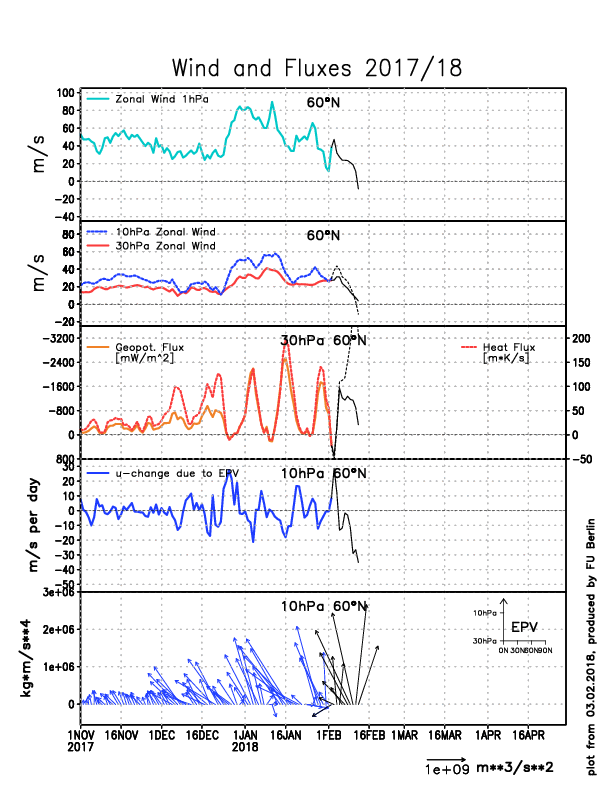
The latest European Model analysis shows a strong increase in heat flux (third panel) in a very poleward manner (bottom panel), which ultimately helps to significantly weaken the Stratopsheric Polar Vortex, evidenced a large drop in zonal winds (fourth panel).

The latest European Model analysis shows a strong increase in heat flux (third panel) in a very poleward manner (bottom panel), which ultimately helps to significantly weaken the Stratopsheric Polar Vortex, evidenced a large drop in zonal winds (fourth panel). (FU Berlin)

The answer, as you may have already imagined, is quite complicated. There are many factors that act to determine exactly how a SSW behaves, including its origin, its evolution, and its eventual location, displacement, and form. It helps, then, to understand the base state of the atmosphere prior to the SSW occurring, and to understand the processes that are at work during the SSW itself. Then, we can understand the impacts that may occur down the road to our sensible weather patterns.

The stratospheric vortex has, for the most part, been perturbed during this year, particularly across the Pacific Ocean. Multiple anomalous, poleward-building ridges in the Pacific Ocean have sent waves into the stratosphere that have disrupted and elongated the stratospheric vortex throughout the winter. This has weakened the vortex itself, but has not completely split it at any point. In fact, of late, the vortex itself has tightened up and is expected to retract a bit over the next few days.

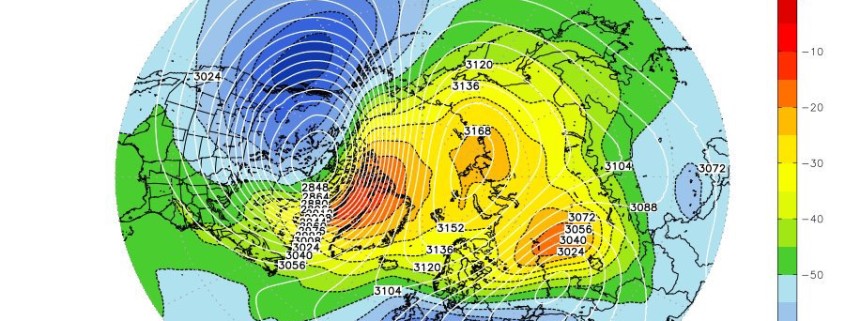
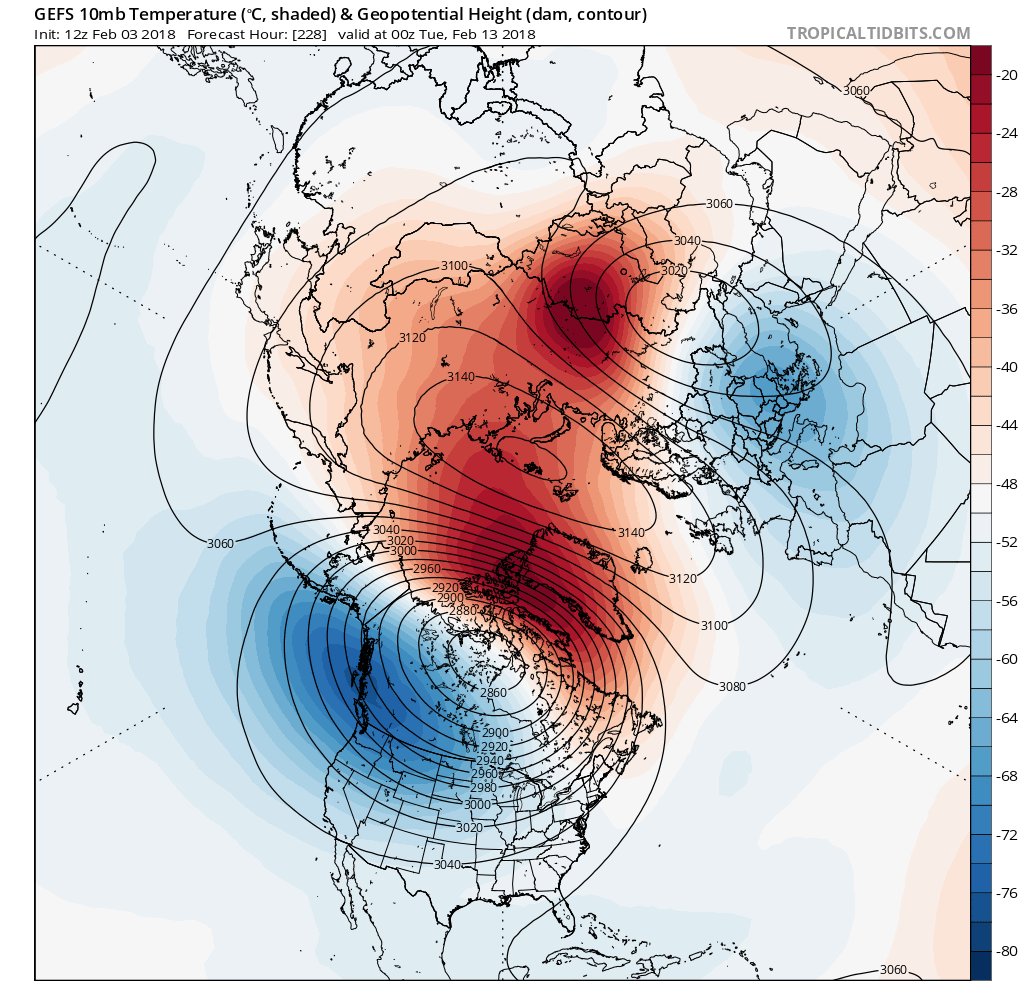
Today's GFS ensemble mean valid on February 12th shows a significant warming in the Stratosphere, allowing the Stratospheric Polar Vortex to split into two pieces (Tropical Tidbits).

Today’s GFS ensemble mean valid on February 12th shows a significant warming in the Stratosphere, allowing the Stratospheric Polar Vortex to split into two pieces (Tropical Tidbits).

Forecast models suggest that a burst of anomalously warm air will push into the stratosphere during the middle of the month of February. This may occur concurrently with the very impressive, near record-breaking MJO pulse in Phase 7. Research has suggested (Wheeler/Hendon et al, 2004) that MJO bursts into Phase 7 with impressive amplitude can be predecessors to SSW events. Warmer anomalies in the lower polar stratosphere have been shown to suddenly and rapidly develop – mainly as a result of constructive interference between mid latitude circulations and a anomalous convection in the tropical Pacific Ocean.

The latest observations and short/medium term model guidance show impressive “coupling” of the troposphere and stratosphere. This is important — in simple terms, it means that the troposphere (where our weather occurs) and the stratosphere are working in-sync. This significantly increases the possibility that the SSW will have an impact on the weather across the Northern Hemisphere – and rather quickly.

Evidence of these impacts occurring relatively quickly can already be found in some of the latest forecast models from around February 15th, and beyond. There may be an MJO –> Stratosphere –> MJO feedback, which could give new life to what was once forecast to be a weakening MJO pulse.

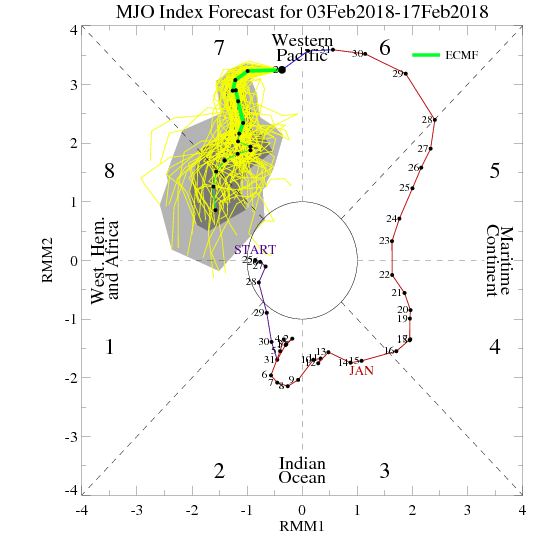
The new ECMWF MJO forecast shows it becoming strong again as it heads into phase 8. This tends to lead to increased high-latitude blocking.

The new ECMWF MJO forecast shows it becoming strong again as it heads into phase 8. This tends to lead to increased high-latitude blocking. (CPC)

Previous forecasts had the record-breaking phase 7 MJO pulse dying before it reached phase 8, and now newer forecasts show it progressing into phase 8 in a very healthy matter. This is because of the alterations the models are making with the stratospheric forecasts, showing that the tropical forcing in the troposphere, and the stratospheric warming are very much in sync.

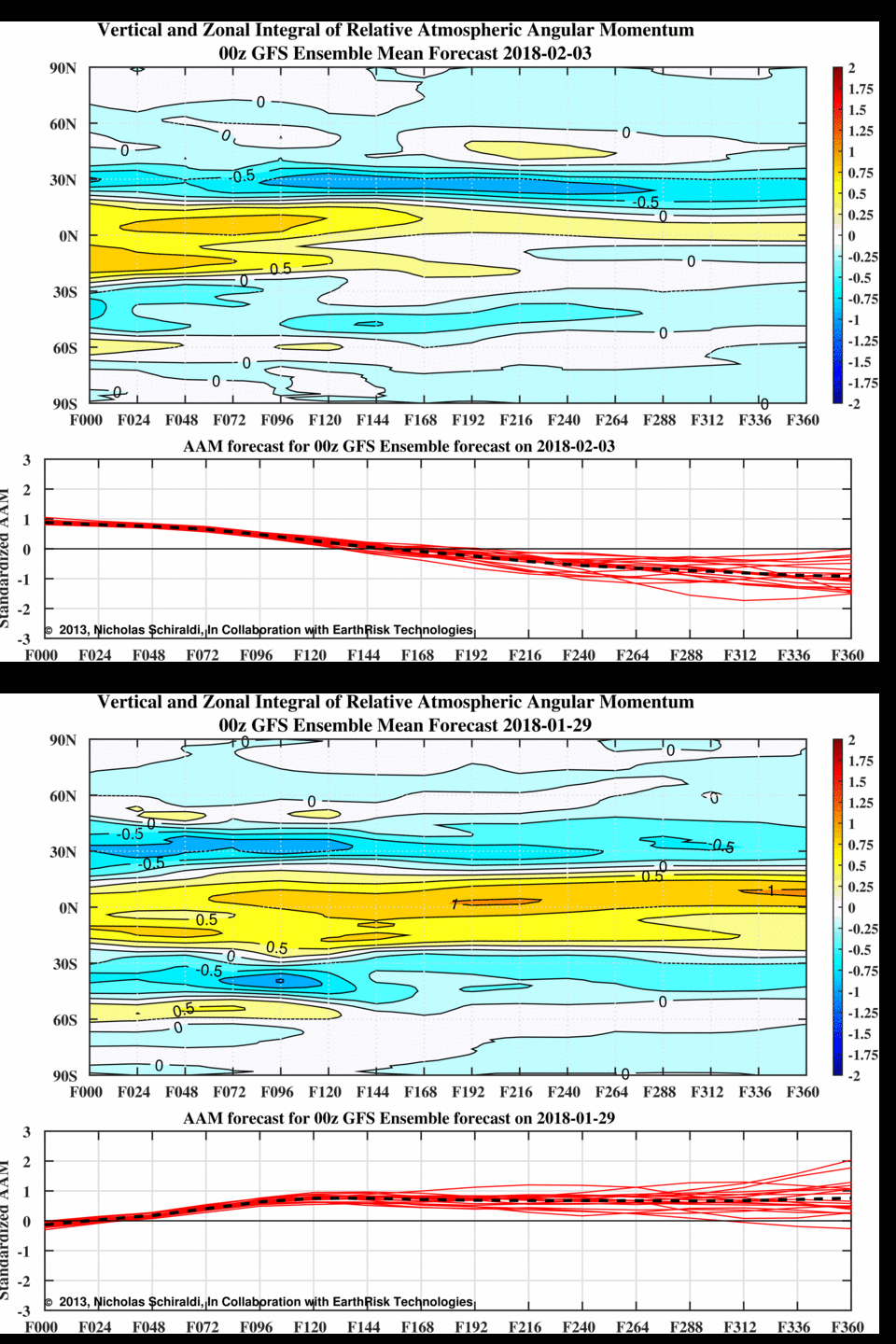
We see further evidence of this by the fact that the latest forecasts are showing a significant decrease in Atmospheric Angular Momentum (AAM) in the Arctic. Mean atmospheric flow trends to run from west to east, and pretty fast in the Arctic — especially within the polar vortex, so a +AAM is faster than average west to east flow.

An animated gif, comparing the AAM forecast from 5 days ago, to the most recent forecast. Notice the increased -AAM anomalies at 0 degrees latitude (the Arctic).

An animated gif, comparing the AAM forecast from 5 days ago, to the most recent forecast. Notice the increased -AAM anomalies near 0 degrees latitude (the Arctic).

The forecast from five days ago showed a strong +AAM, and in the cross section, we can see that it was very much located within the high-latitudes from 30N to 0N. But notice on the most recent forecast, how those warm colors almost completely evaporate, in favor of the cold, blue colors in those same locations. This means we are now seeing a -AAM take place in the high-latitudes, and towards the Arctic. This is a direct byproduct of the SSW event, which decreases the mean west to east zonal winds within the Polar Vortex. The fact that this is translating to the AAM budget is very significant going forward, in that it further proves the Troposphere and Stratosphere coupling.

The forecast decrease in AAM means we have less mean west to east flow in the high-latitudes, which significantly helps to weaken the polar vortex, and helps lead to more stagnation in the mean flow in general — since the “momentum” (thus the ‘M’ in AAM) is being slowed down. This inherent stagnation to the pattern in the Arctic leads to more high-latitude ridging and blocking to develop.

Thus, it is fair to say that this SSW episode, combined with a coupling within the Troposphere, should help lead to increased high-latitude blocking fairly quickly, as we approach February 20th. This could mean an increase in opportunity for cold and a significant snowfall in the February 20th through March 10th period.


This post was written by John Homenuk and Doug Simonian

Friday Briefing: Arctic Cold Then Northeast Winter Storm Threats Sunday & Wednesday

Happy Friday! Rain overnight ended as some snow across over the region, early this morning. Interior locations, including parts of Northwest NJ, the Poconos and Catskills saw few inches of snow. Little or no snowfall accumulations occurred elsewhere, as the best dynamics and moisture moved quickly offshore, with the cold front. As a result, snow was mostly light and ended after hour or two, with temperatures still above freezing.

However, there is threat for a flash freeze, as much colder air rushes in behind the cold front today. Temperatures will be mostly in the middle or upper 20s for the rest of the day. So any standing water could freeze into some this morning. Some patchy black ice will also form on any wet, untreated roads. So use more caution driving roadways, especially during this morning.

Read more