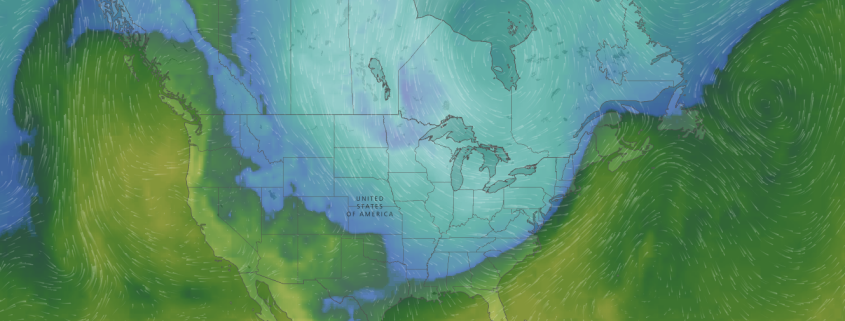
Dry and Seasonable Pattern Holding On, Substantial Changes Looking More Likely Next Week!

Good Evening! 

Today was the warmest in a series of mild days across the entire Northeast. Dry air in the mid levels of the atmosphere was quite abundant this afternoon, and this dry air helped to mix the warmer mid level temperatures down to the surface with stout northwesterly/westerly flow. Mostly sunny skies and light winds helped much of the region see highs rise into the well-above normal values this afternoon, with many stations across the Northeast breaking the 60 degree mark. In fact, some stations across portions of Long Island and southern New Jersey saw readings in the middle 60’s, which is a good 10-15 degrees above normal for this time of year! As the day progressed, we had a weak cold front with extremely limited moisture push through the Northeast. This front was weak enough that surface temperature did not/have not immediately responded as the main cold air pool is located well behind the surface front. High pressure is gradually building into the Northeast this evening, with the onset of cooler temperatures finally reaching northern portions of New York and New England where temperatures have since fell off into the low to middle 30’s.

The rest of this evening should be quiet, with winds shifting to more northerly/northwesterly. As this happens, conditions will be rather good for efficient radiational cooling to take place across much of the Northeast. This should allow for lows to drop into the middle to lower 30’s across much of the area, with middle to upper 20’s possible further north and west.
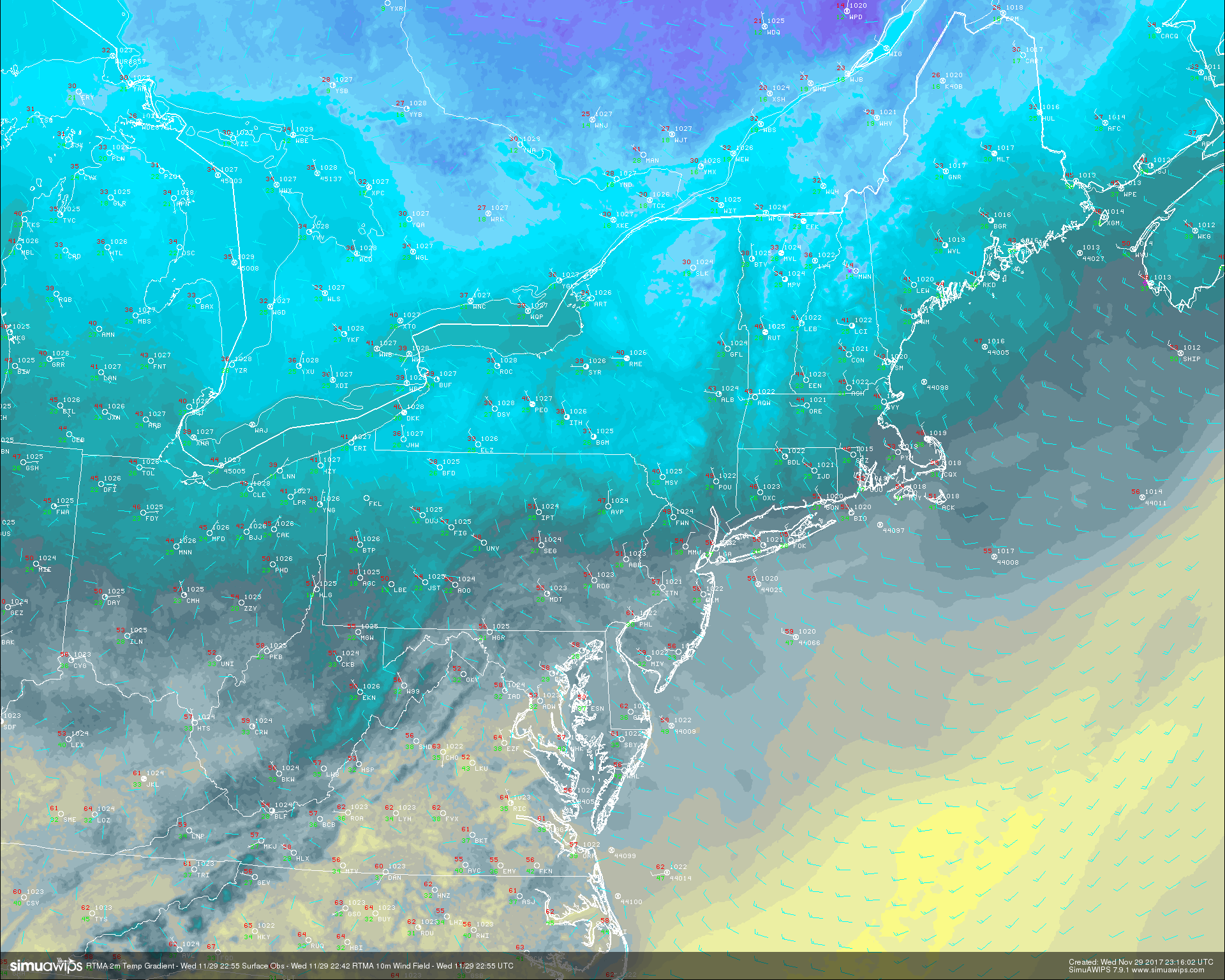
This evenings Real Time Mesoanalysis showing surface temperatures and surface observations across the Northeast. Temperatures are gradually becoming cooler from north to south across the region as a cooler airmass works in (Courtesy of Simuawips)

This evenings Real Time Mesoanalysis showing surface temperatures and surface observations across the Northeast. Temperatures are gradually becoming cooler from north to south across the region as a cooler airmass works in (Courtesy of Simuawips)

Thursday and the Weekend

Thursday should start off a good deal cooler than Wednesday did, but as the area of high pressure currently located over Canada quickly moves offshore, we should see offshore flow overspread much of the Northeast, leading to increased temperatures and available moisture. As this high quickly rockets east, a shortwave trough will also be quickly heading east, embedded in the fast west to east zonal flow over the country. This disturbance should be located over the Great Lakes region by tomorrow afternoon, with a cold front extending southward. Unlike the past few fronts, this one may be able to tap into some moisture lingering over the Gulf of Mexico, which should allow the front to be a bit more active with showers likely along the front. As we head into tomorrow afternoon, southwesterly flow should be rather stout at the surface as well as the mid levels, ushering warmer mid level temperatures as well. With the increased low level moisture from the offshore flow, there may be more clouds than sun across portions of the Northeast, but we still expect temperatures to still reach into the upper 40’s to lower 50’s. This should be right around normal for this time of year, but some locations to the south of the NYC area may see readings into the middle 50’s.

By tomorrow evening, the cold front should begin to move through the Northeast with light to occasionally moderate rain likely. The rain along this front should be limited due to the overall dry mid to upper level conditions and quick movement of the upper level system. With clear conditions behind the front expect temperatures to generally fall into the lower to middle 30’s across much of the area, with colder readings to the north and west.
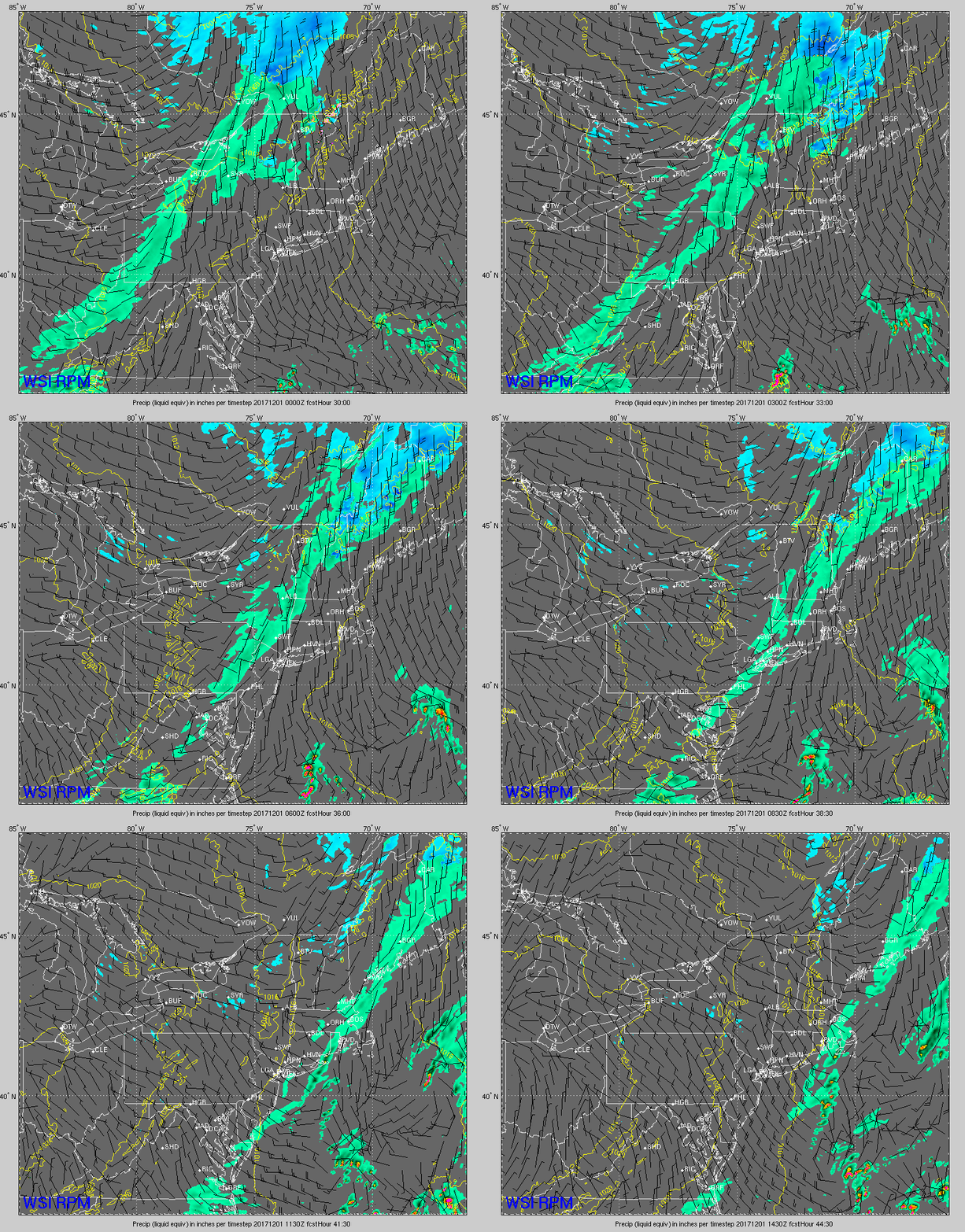
This evenings RPM model showing the progression of the weak cold front moving over the Northeast tomorrow evening. Only light rain accumulations are expected (Courtesy of WSI)

This evenings RPM model showing the progression of the weak cold front moving over the Northeast tomorrow evening. Only light rain accumulations are expected (Courtesy of WSI)

Another high pressure will build into the Northeast by Friday morning, bringing in renewed northwesterly flow and slightly cooler temperatures in the mid levels. The vast majority of the day should be dry, but a couple of spotty showers may be possible around Long Island and Connecticut as some residual energy behind the aforementioned cold front moves over the area. Highs will likely stay around normal for this time of year, with readings in the middle to upper 40’s-with a couple of locations reaching 50 possible. Friday night looks to be a calm and clear evening with radiational cooling likely, so we expect lows to drop down into the upper 20’s and lower 30’s across the immediate NYC metro area. Areas farther north and west could see lows drop into the middle 20’s if conditions allow strong enough cooling to take place.

Saturday and Sunday look rather quiet and seasonable, with highs likely staying in the upper 40’s to lower 50’s range. The only real chance of precipitation may come on Sunday night when a sloppy mid level piece of energy moves quickly eastward from Canada. This system looks to be rather moisture-starved, so it does not appear to be of major concern at this time.
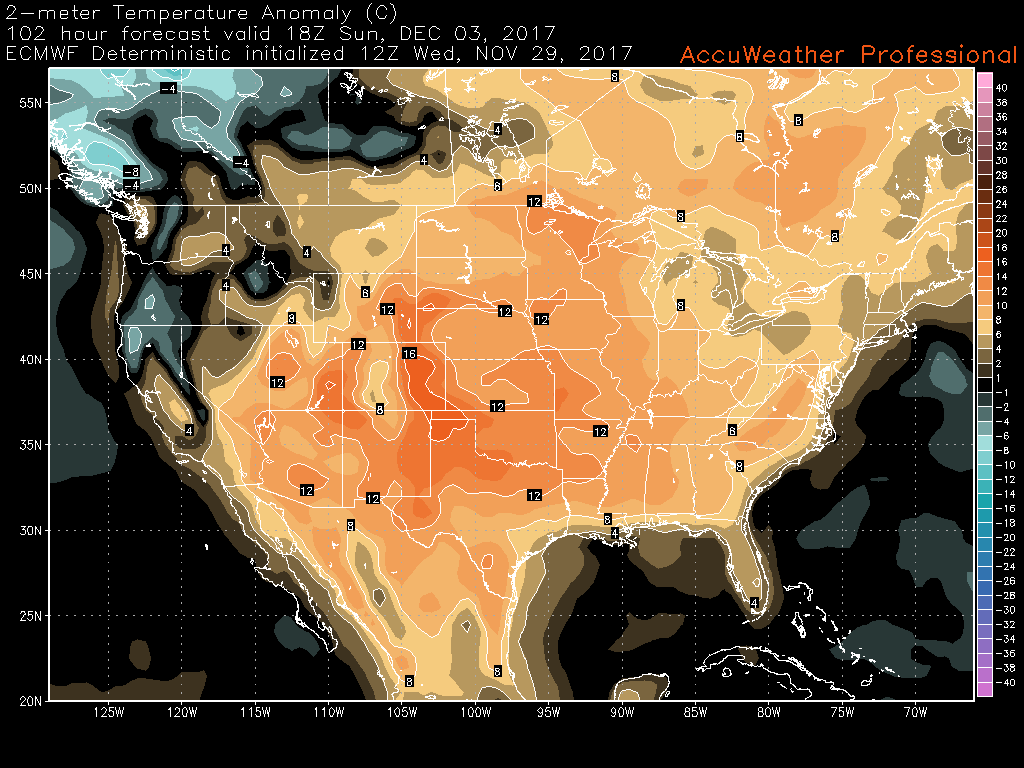
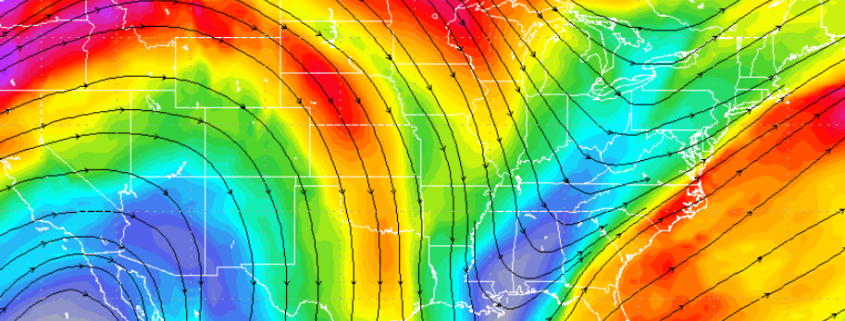
This afternoons ECMWF model showing above normal temperatures persisting across much of the country this weekend as a mid level ridge builds in.

This afternoons ECMWF model showing above normal temperatures persisting across much of the country this weekend as a mid level ridge builds in.

Substantial Changes Likely Next Week! 

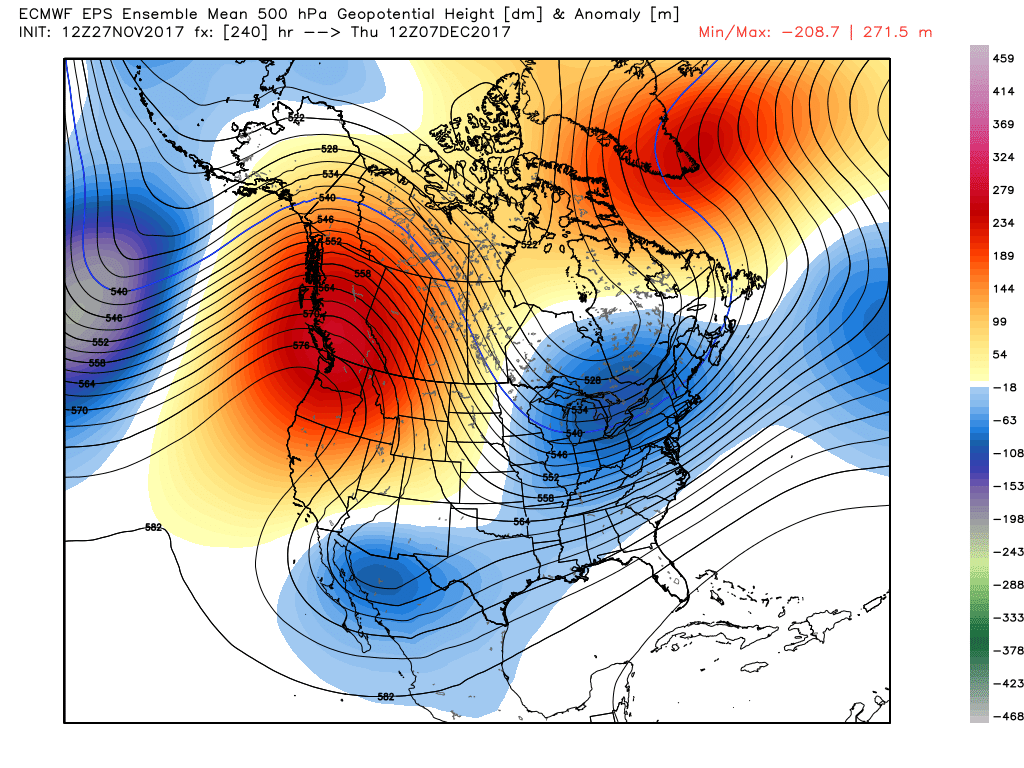
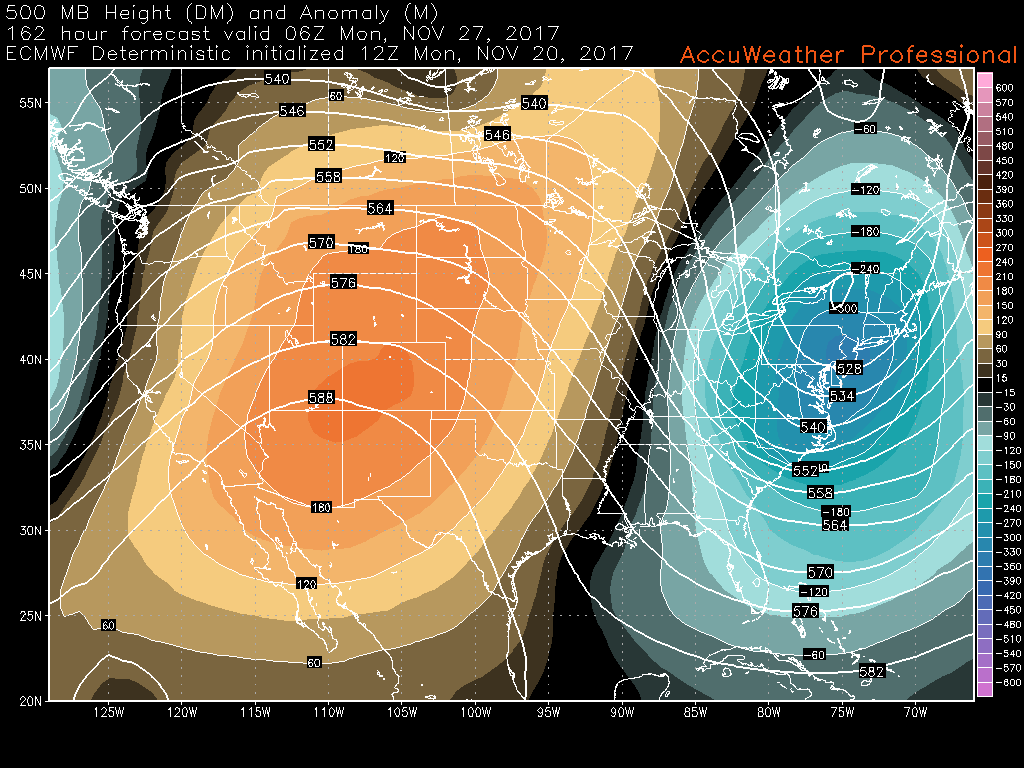
We have been watching the pattern for the upcoming week very closely for the past seven days or so, and it seems like with every successive model run, things continue to look more and more interesting for a major pattern change to take place in this time period. By the middle of next week, we should begin to see the development of a major ridge over the west coast of the United States, which should extend deep into Canada. This ridge is whats referred to as a “PNA ridge”, and when coupled with the right ingredients, can lead to a very cold and potentially stormy pattern across the United States. As this ridge gets stronger as time goes on next week, it will begin to send Arctic air from the far northern regions of Canada and even Russia into a building trough which will likely be located over the central part of the country.
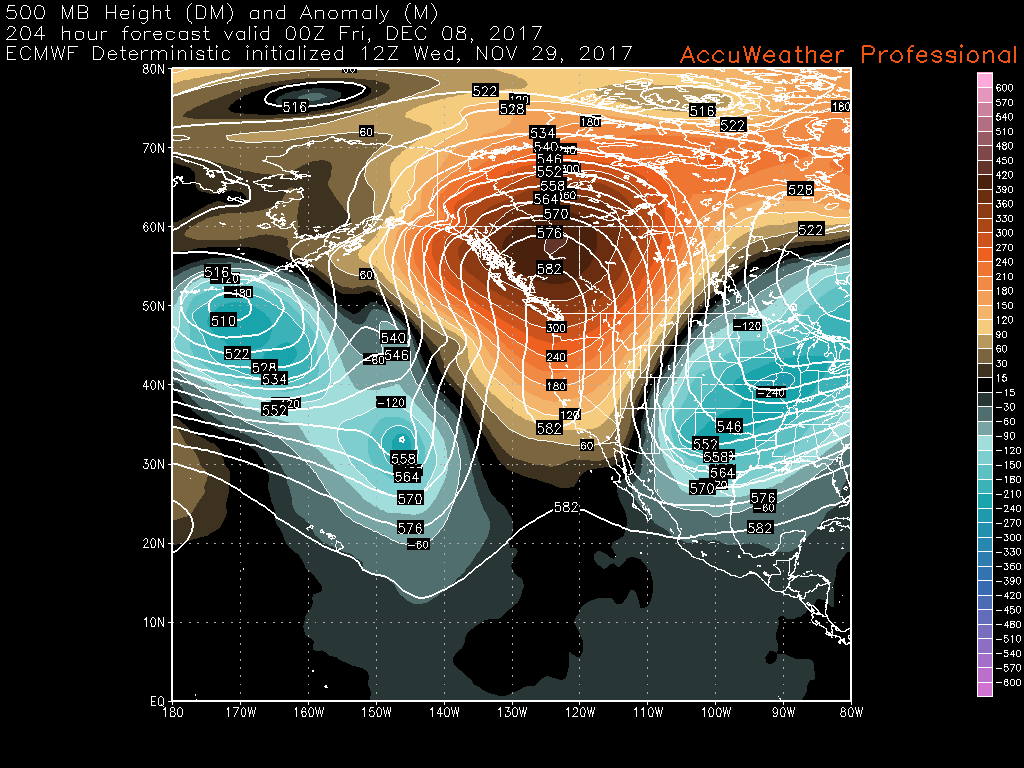
This afternoons ECMWF model showing a very impressive area of mid level ridging going up over the west coast and deep into Canada. This pattern is highly supportive of colder weather in the east.

This afternoons ECMWF model showing a very impressive area of mid level ridging going up over the west coast and deep into Canada. This pattern is highly supportive of colder weather in the east.

Another key ingredient of this pattern change will be increased high pressure/ridging over Greenland (a negative NAO), which will help to slow down the trough in the central/eastern US. This is very important as it will allow the Arctic air to pour in and build as it moves east. Model guidance has been very consistent on these ingredients taking shape, and have even been strengthening them to a degree as we get closer in time which is extremely important for this pattern to actually come to fruition. With the ridging in the west and in the east, the pattern becomes “blocked up”, meaning that systems have a chance to slow down and amplify, which is the exact opposite of the pattern we are currently in! This means that there will be an increasing storm threat for the eastern half of the country starting late next week and into the middle portion of December. At this point in time, it seems that below-normal temperatures are very likely in the 8-14 day period across the central and eastern parts of the country, and possibly extending deep into the month. In summary, it appears that starting next week we will see major changes taking place across the hemisphere that could gradually push us into a classic winter pattern for the month of December! We’ll have more on this pattern as new details arise!
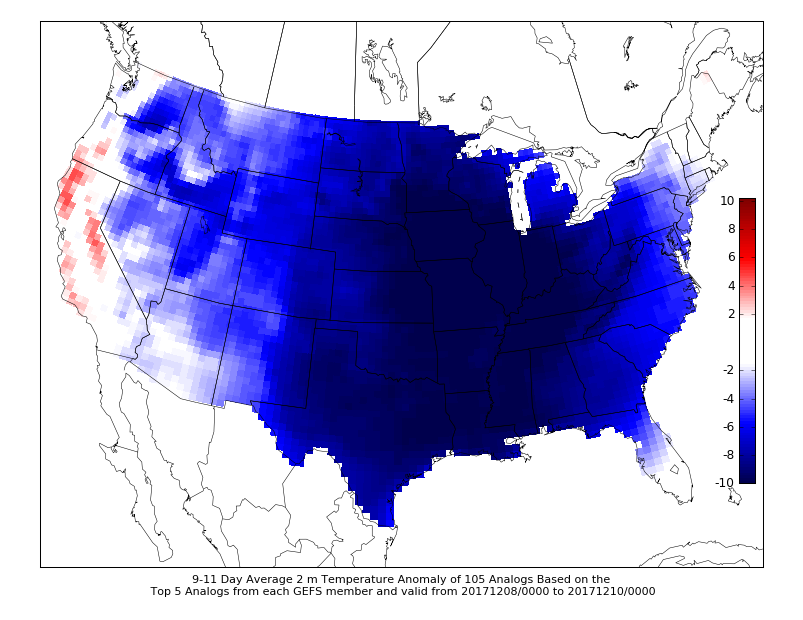
University of Wisconsin CIPS analogs based on the GEFS showing extremely high probabilities for below normal temperatures starting as soon as next week!

University of Wisconsin CIPS analogs based on the GEFS showing extremely high probabilities for below normal temperatures starting as soon as next week!

For more information and posts like this one, make sure you sign up for Premium Forecasts — where multiple detailed articles, videos, and interactives are posted each day. Also, come interact with our staff and many other weather enthusiasts at 33andrain.com!

Have a great night!

Steve Copertino 
Mild and Dry Conditions Settle In, Signs of Change?

Good Evening! 

Today was a nice start to the work week as an area of high pressure moved over the East, which prompted an increase in temperatures and calmer conditions over the entire Northeast. Much of the day was characterized by a mix of sun and clouds as a cool mid level airmass from Canada moved south on the heels of a weak cold front. This cold front is relatively weak and does not have any substantial moisture associated with it, thus any showers or flurries were extremely isolated in nature and did not last long. Otherwise, most of the New York metro area saw highs in the upper 40’s to lower 50’s, with lower to middle 40’s further north and west. These temperatures are just around normal for this time of year, with only a couple stations going slightly above normal.

The rest of the evening should remain quiet and cool as the high pressure remains firmly planted in place over the Tennessee valley. With the recent cold front passage, dewpoints have lowered and winds have also dropped a bit. This will set the stage for some stout radiational cooling to take place across the Northeast despite some warmer air in the mid levels trying to creep in overnight.  Lows should be able to drop into the middle 30’s for the immediate New York City area, with upper 20’s and lower 30’s likely for the suburbs. Locations well to the north and west may see more efficient radiational cooling this evening, and could even drop into the upper teens and lower 20’s.

Real Time Mesoanalysis Temperatures for the Northeast this evening showing an impressive gradient over the area. Notice readings in the middle teens over northern New England , with 50's closer to the coast! (Courtesy of Simuawips.com)

Real Time Mesoanalysis Temperatures for the Northeast this evening showing an impressive gradient over the area. Notice readings in the middle teens over northern New England , with 50’s closer to the coast! (Courtesy of Simuawips.com)

Tuesday Into Thursday 

Tuesday will likely start of with clear skies and cool conditions area-wide, as the area of high pressure located to our south begins to move over and east of the region by the morning commute. The center of the high pressure will likely be situated just off the coast through the morning and into the afternoon hours, and this should introduce more southwesterly winds in the mid levels of the atmosphere. These southwesterly winds should be capable of ushering a warmer airmass over the region, but the degree of this warmth should be muted somewhat by return flow from the Atlantic. This should keep highs in the area mild, but not too warm. Expect temperatures to get into the lower to middle 50’s during the afternoon hours tomorrow, with some locations having a shot at middle to upper 50’s near the coast. Calm conditions should last throughout the day, with warm air advection increasing once again by the time we head into the overnight hours. With the high pressure located offshore and warmer mid level temperatures working their way in, expect lows to be warmer tomorrow night with readings likely in the upper 30’s to lower 40’s, with some locations north and west staying in the 30’s.

Wednesday looks to be a full-on above normal day as the strong southwesterly flow begins to surge northwards during the day. Mid level dry air will be present tomorrow afternoon, and this will help warmer mid level temperatures to reach the surface and cause highs to rise into the middle to upper 50 across much of the New York Metro area, with some locations closer to the coast possibly getting to the 60 degree mark by the afternoon hours. As the day goes on, another weak cold front looks to push through the area. This front should be another moisture starved front, so any showers will be isolated and weak in nature.

By Thursday, we see the pattern across the United States become rather progressive and zonal in nature, meaning that the jet stream will be flat and west to east oriented. This will allow the high pressure behind the cold front to quickly move offshore, providing more return flow from the south once again. This time there should be more Gulf moisture involved with this flow, and this should only increase as another disturbance works its way east across the country. The system should be located in southern Canada by Thursday evening, with a cold front extending down into Pennsylvania. Light to moderate showers will likely extend along this front as it moves through the Northeast, with only minor rain accumulations expected.

The rain should quickly head offshore by the early morning hours of Friday, with improving conditions thereafter.

This afternoons ECMWF ensembles showing the rather flat nature to the pattern over the US, leading to rather calm and mild conditions.

This afternoons ECMWF ensembles showing the rather flat nature to the pattern over the US, leading to rather calm and mild conditions.

Major Long Range Questions

Some of you have likely heard the buzz on social media that this boring weather pattern is likely to change and snap into a colder and potentially stormy one. While any potential pattern changes are a long ways out, we do have to mention that there is a growing consensus among the more reliable long range computer models that pattern across the Globe will shift to one that is much more supportive of at least a brief period of below normal temperatures across much of the country. This period looks to start during the second week of December and could possibly continue into the rest of the month depending on how other larger factors behave. At this time, we think that the models do have a relatively good grasp on the pattern at hand, and other outside factors like the MJO, and Stratosphere support the ideas being put forth by these models. We will continue to monitor this potential change as it moves up in time and will provide updates on any developments when they come up!

This afternoons ECMWF ensembles showing a major change to a much colder pattern with the potential for some winter weather threat to take shape by the middle of the month.

This afternoons ECMWF ensembles showing a major change to a much colder pattern with the potential for some winter weather threat to take shape by the middle of the month.

For more information and posts like this one, make sure you sign up for Premium Forecasts — where multiple detailed articles, videos, and interactives are posted each day. Also, come interact with our staff and many other weather enthusiasts at 33andrain.com!

Have a great night!

Steve Copertino 
Warmer Conditions Arrive Tuesday, How Does Thanksgiving Day Look?

Good Evening! 

Today was another cold and breezy day across much of the Northeast, as the strong low pressure area that affected our region earlier this weekend continues to move off to the east and over the martime regions of Canada. The interaction between this low pressure system and a high pressure system to our south has created a steep pressure gradient which has been the source for these gusty conditions over the past day or so. Strong northwesterly flow in the mid levels of the atmosphere has also contributed to colder air aloft blowing over the Great Lakes, which has produced some lake effect snow showers that have mainly been focused across far northern New York state and Pennsylvania. However, some of these “lake-effect” snow showers moved over portions of the New York metro area, producing some of the first flakes of the year for most locations. While surface temperatures over the area were not at or below freezing, cold mid level temperatures allowed precipitation to remain mostly frozen, with ice pellets also being recorded in northern New Jersey. While these snow showers did catch some people by surprise, they weren’t anything more than “mood flakes”, or just some light flurries that do not stick to any surfaces-allowing travel to proceed as usual.

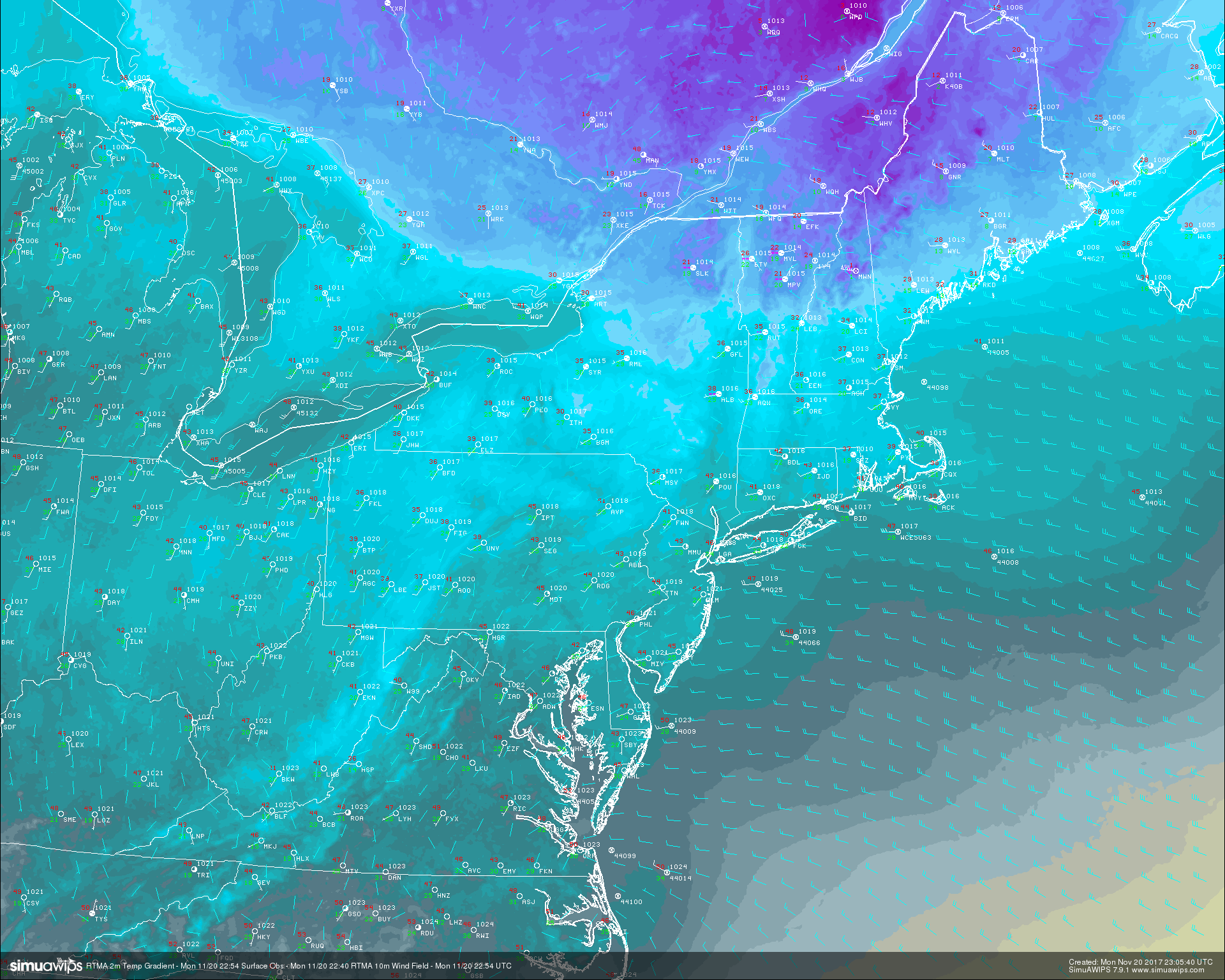
The rest of our Monday was rather chilly, with a mix of clouds and sun keeping our temperatures limited to the lower to middle 40’s across much of the area. Winds have really begun to weaken over the entire northeast as the pressure gradient between the two surface systems really diminishes with time as the systems grow further apart. As we head into tonight, the area of high pressure located over eastern Carolina will remain in control of our weather, bringing lighter winds out of the southwest and clearer skies. Lows tonight will likely have a range to them, with the far northwestern locations likely dropping below freezing and into the upper 20s, while locations near New York City willy likely get down into the lower to middle 30’s.

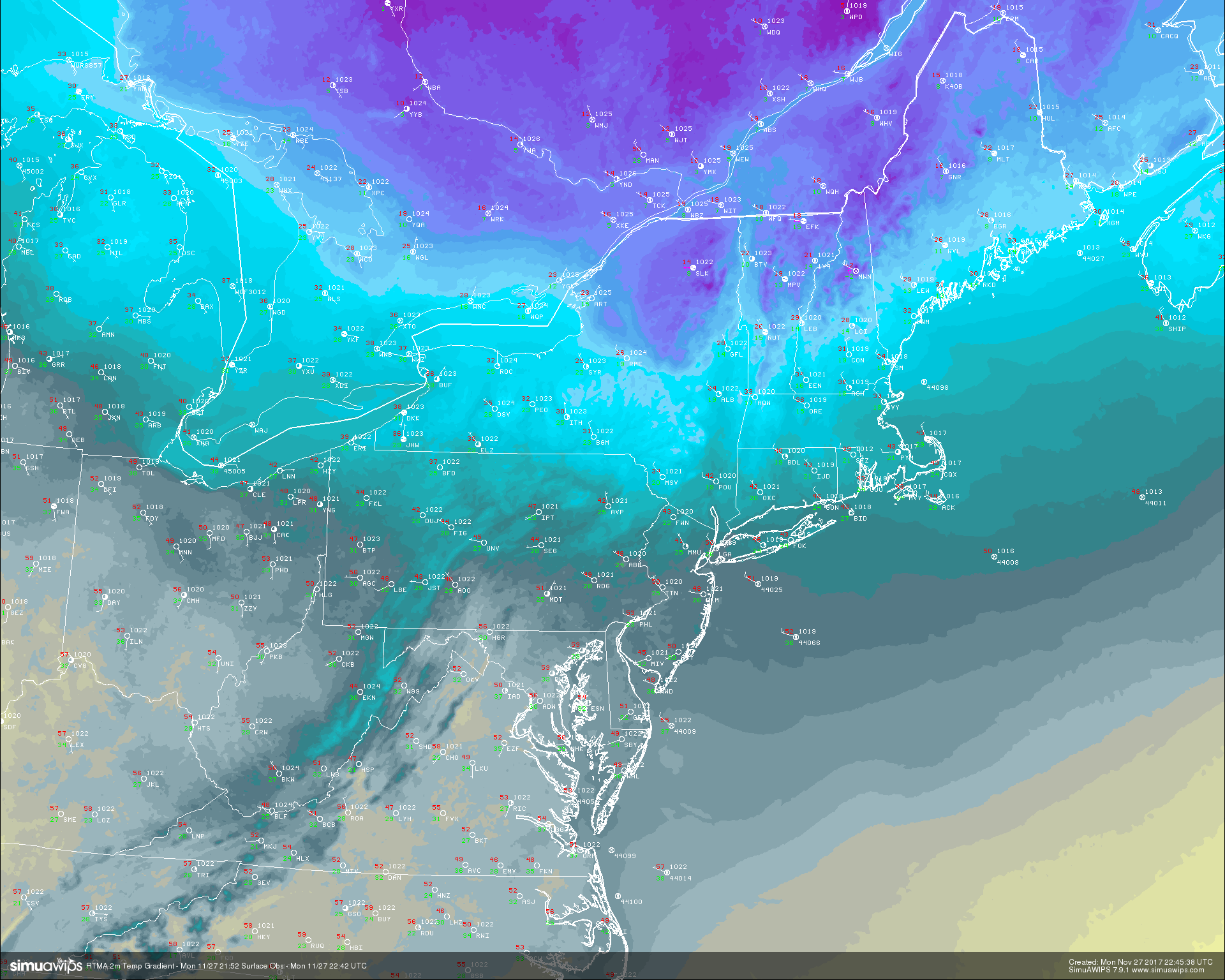
RTMA Analysis of the current temepratures over the Northeast, with surface observations finally showing a change from the gusty NW winds we have been seeing for the past day or so (Credit: Simuawips)

RTMA Analysis of the current temperatures over the Northeast, with surface observations finally showing a change from the gusty NW winds we have been seeing for the past day or so (Credit: Simuawips)

Tuesday morning will likely start off rather cool, but mostly sunny as the area of high pressure that we’ve been following moves offshore and into the western Atlantic by the morning commute. This will mean that as the day goes on, warmer mid level air from the southwest will move into the Northeast, allowing temperatures to moderate quite a bit when compared to today. Additionally, a vigorous area of mid level energy will be diving down from Canada by the afternoon hours of tomorrow, which will be accompanied by a moisture-starved area of low pressure at the surface. As this system heads east with time, it will increase the strength of the southwesterly flow, leading to an increase in winds across much of the Mid Atlantic and Northeast by the late afternoon hours. The relatively clear and conditions and warmer mid level temperatures from the south will allow highs to climb into the lower to middle 50’s tomorrow, with the warmest readings likely just inland from the coast.

As we progress into Tuesday evening, we should see moisture being to develop in the southern states as another messy batch of disorganized mid level energy moves in behind the first system in the Great Lakes. As this takes place, a cold front associated with the system in the Great Lakes region will continue to move east and into the Northeast by the end of the day. This front will remain relatively dry as it moves over the Northeast due to the system to the south and west of it stealing most of the moisture deep in the Gulf of Mexico.

Things may become a little more interesting during the very early morning hours on Wednesday when the upper level jet streak from the Great Lakes system begins to interact with the energy over the south and moisture begins to flow more northerly. The question with this time period is just how much will the precip expand and move west as the new low develops to the south? Today’s model guidance diverges a bit on the extent of the precipitation shield on Wednesday, but as of right now it looks like the immediate coasts of NJ and LI could see some steadier rain, with showers possible further North and West. Since these two systems will remain mostly independent from one another, this is very unlikely to be a big deal, but even slightly more interaction with these systems and a healthier upper level jet streak could promote the development of precipitation further inland, and this will have to be monitored. Otherwise, highs on Wednesday will likely remain in the lower to middle 50’s despite the incoming cold front. The front should clear the area by late Wednesday afternoon, with any residual shower activity quickly leaving the scene as well. Wednesday evening should be a cold one, with lows likely dropping into the middle to upper 20, with warmer readings near the coast.

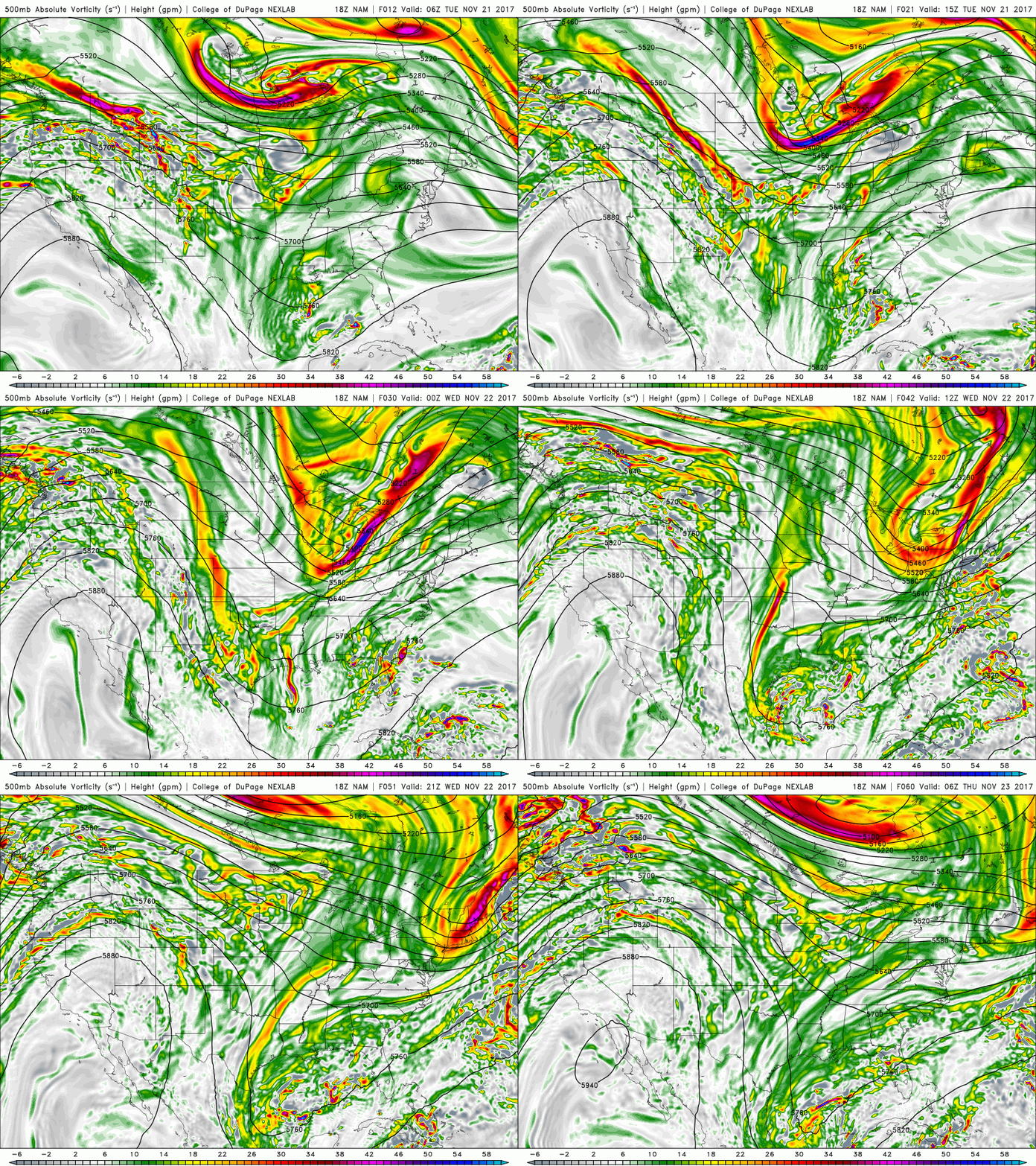
18z NAM 500mb loop showing the initial energy with Wednesdays cold front quickly moving east while more energy drops down into the Gulf of Mexico and becomes "stuck"

18z NAM 500mb loop showing the initial energy with Wednesdays cold front quickly moving east while more energy drops down into the Gulf of Mexico and becomes “stuck”

Thanksgiving Day and Beyond

A colder airmass from Canada will be in place over the Northeast behind Wednesdays cold front, which should cause the day to start off rather cold in the upper 20’s and lower 30’s. Left over dry air in the wake of the cold front should allow mostly sunny conditions to take over on Thanksgiving day. A colder airmass, clear skies, and calm winds should only allow temperatures to rise into the upper 30’s and lower 40’s across much of the New York metro area, with warmer readings located over portions of Long Island. From a historical standpoint, this Thanksgiving should be a rather cold one, as highs will likely come in 10-15 degrees below-normal! Conditions during the remainder of the day should be quite pleasant as a weak area of high pressure moves in from the west. This area of high pressure will cause winds to shift back to a more southeasterly component by the evening, which will signal the arrival of another warmer mid level airmass. Lows during the evening hours should drop into the middle to upper 20’s, with some warmer temperatures likely across locations closer to the coast.

Calm and cool conditions are expected through Saturday afternoon, before another strong area of low pressure over southern Canada drags a cold front through the region early on Sunday. As of right now, this cold front also looks to be moisture-starved, but the big deal with this system will be the temperatures, not the precipitation. With a large area of high pressure over the western Unites States, this cold front will have the potential to dump some impressive cold over the east, which could drop the area down into the lower 30’s and upper 20’s for highs. Though its just under a week out right now, this cold shot does look to be on the quick-hitting side, as the upper level trough associated with the cold air will quickly move out by the middle of next week.

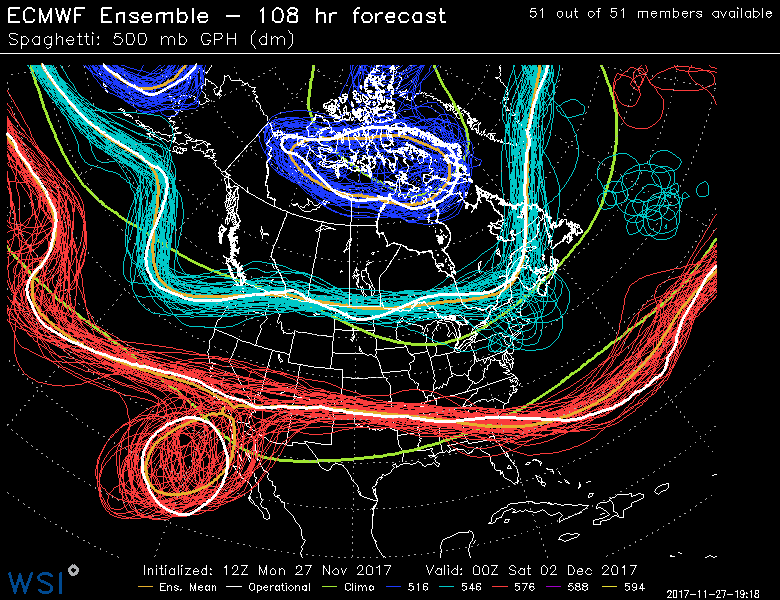
This afternoons ECMWF model showing the potential for a potent, but quick-hitting cold shot by the end of next weekend.

This afternoons ECMWF model showing the potential for a potent, but quick-hitting cold shot by the end of next weekend.

For more information and posts like this one, make sure you sign up for Premium Forecasts — where multiple detailed articles, videos, and interactives are posted each day. Also, come interact with our staff and many other weather enthusiasts at 33andrain.com!

Have a great night!

Steve Copertino 
Winter Forecast 2017-2018

Seasonal forecasting is quite the challenge, but one we always look forward to. It seems every year we learn something new about the atmosphere. It is critical to have a fundamental understanding of how the atmosphere works, and the implications that changes from its base state can have on the weather pattern.

Instead of focusing on individual numerical indexes and their verbatim values, we are going to try to paint a picture of the atmosphere and what it will be doing over the next few months based on these phenomena:

  1. ENSO (El Nino Southern Oscillation) and tropical forcing
  2. High latitude behavior and blocking
  3. Analog years based on global pattern evolution

Read more