Myriad of threats expected from midweek storm
[alert type=”error”]Storm Prediction Center has placed parts of the area in a Moderate Risk for severe weather on Thursday. Details. [/alert]
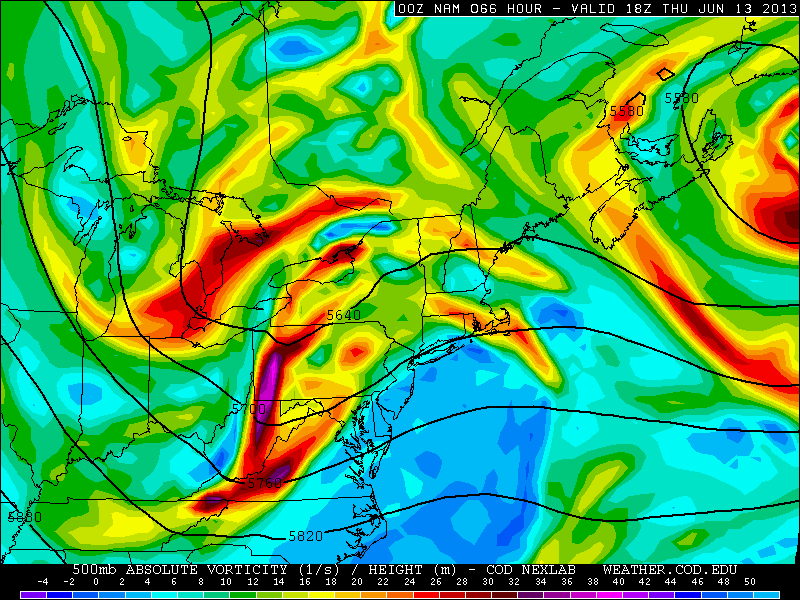
A strong storm system traversing the Ohio Valley will strengthen and shift towards the Northeast US on Thursday, bringing the potential for several types of hazardous weather. Forecast models suggest the system may be anomalously strong for this time of year, with pressures dropping to near 990mb as it moves through the Mid Atlantic states. This is absolutely unprecedented for this time of year, as normally the jet stream is too weak this time of year to support such dynamic systems.
A warm front is forecast to lift northward from the Mid Atlantic states to a position near Central New Jersey on Thursday afternoon. The combination of building instability near and south of the warm front, as well as favorable wind fields and forcing for precipitation will lead to the potential for not only heavy rain and strong winds, but severe weather…including the potential for a few tornadoes.
If you have not already, I highly recommend you check out our previous technical discussion, as it will help to explain some concepts that I will talk about in detail for the rest of this post, and give you a pretext as to what is going on.
The exact position and timing of the surface low, cold front, and warm front will be crucial in determining where the tornado risk is, and where the northern boundary of the severe weather can be expected. Latitudes north of the surface low can expect heavy rain of 2-4″ and little in the way of severe weather, areas with the same latitude as the surface low can expect 1-2″ of rain with a chance of being hit by a squall line producing borderline severe winds, and latitudes south of the surface low can expect severe weather and a few tornadoes. The problem is, the exact position of the surface low is still a bit uncertain, but we’ll do our best to warn everyone of the possibilities.
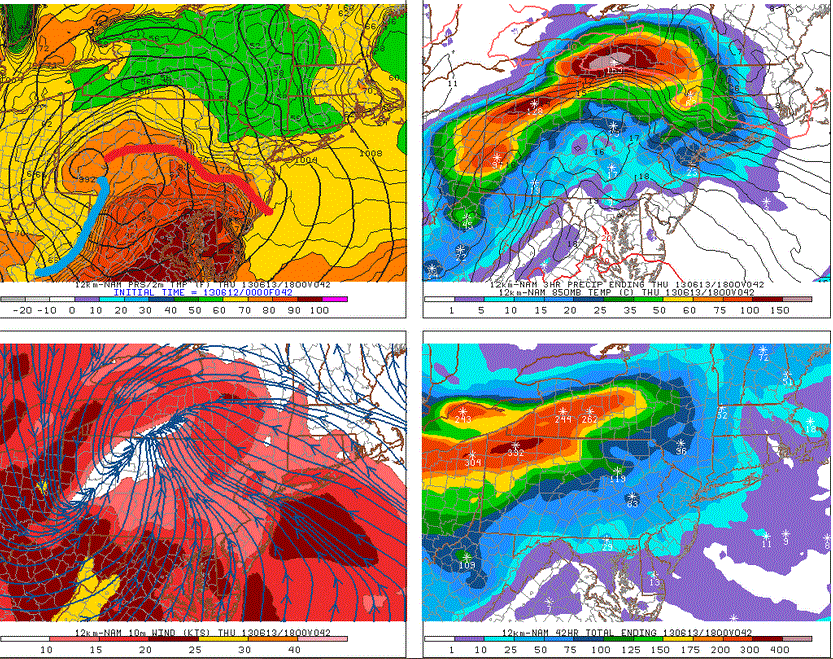
The 00z 6/12 NAM valid for 2 p.m. on Thursday.
Our first two images will illustrate the NAM’s boundaries and its movements throughout the day on Thursday. The NAM, at 2 p.m. on Thursday is forecasting a 990mb surface low in SW PA (top left panel). You can see two distinct temperature gradients — one to the south of the low, and one to the east of the low. I quickly highlighted the approximate warm front position in red and the cold front position in blue, at that time.
As I said in yesterday’s discussion, the cold front often triggers a linear convective mode. But look at how far east the warm front extends away from the front! Areas just south of the warm front and away from the cold front can expect a discrete supercellular convective mode. Thus, at 2 p.m., SE PA, SW NJ, DE, and MD could really be under the gun for a tornado threat, and perhaps severe hail as well.
A very key fact that one must understand for this threat: the slower the cold front advances, the longer the warm front will be the main boundary for thunderstorm initiation in the very favorable tornadic environment, thus discrete supercells. A faster moving cold front means that it would eventually be the dominating player in the favorable tornadic environment, potentially “wasting” the environment and turning the convective mode more linear, since it would more quickly intercept that environment. Linear squall lines can still provide embedded tornadoes, so a squall line does not mean there is no tornado threat, but it would be significantly reduced compared to that of more discrete supercells.
Also note the southeast surface winds that even exist to the south of the warm front in SE PA on the bottom left panel — when you combine that with the potent mid level winds from the WSW associated with this powerful storm, you get strong, deep-layer shear supportive for severe weather and even tornadoes. More will be discussed about the wind profiles later in this post.