Winter storm likely Tuesday into Wednesday

Forecast model guidance has come into good agreement on the eventual track and intensity of a winter storm which is forecast ot impact the area from Tuesday through Wednesday. The system was initially forecast to develop well seaward, but guidance over the last 24 to 48 hours has trended more amplified, slower and stronger with the storm system. The result is a moderate impact winter storm which is expected to begin during the afternoon on Tuesday and continue into Wednesday morning. A mid level disturbance dropping south from the Northern Plains will eventually amplify in the Mississippi Valley before moving off the East Coast, helping to develop a surface low and a nor’easter overnight into Wednesday morning.

It is the exact track and intensity of this low pressure which forecast models have struggled with. But newer guidance agrees that the placement and development of the system will support widespread snowfall through the area. Heavier bands of snow and wind are likely from the I-95 corridor south and east, with highest snowfall totals expected near the area coasts of New Jersey and Long Island. These bands, however, remain unpredictable and can often wind up impacting other areas despite what forecast guidance suggests. Below, we have included our 411 on the storm system including expected totals, timing, and information as well as a snowfall forecast map. Later tonight, we will issue a new set of products including hazards briefings and other information.
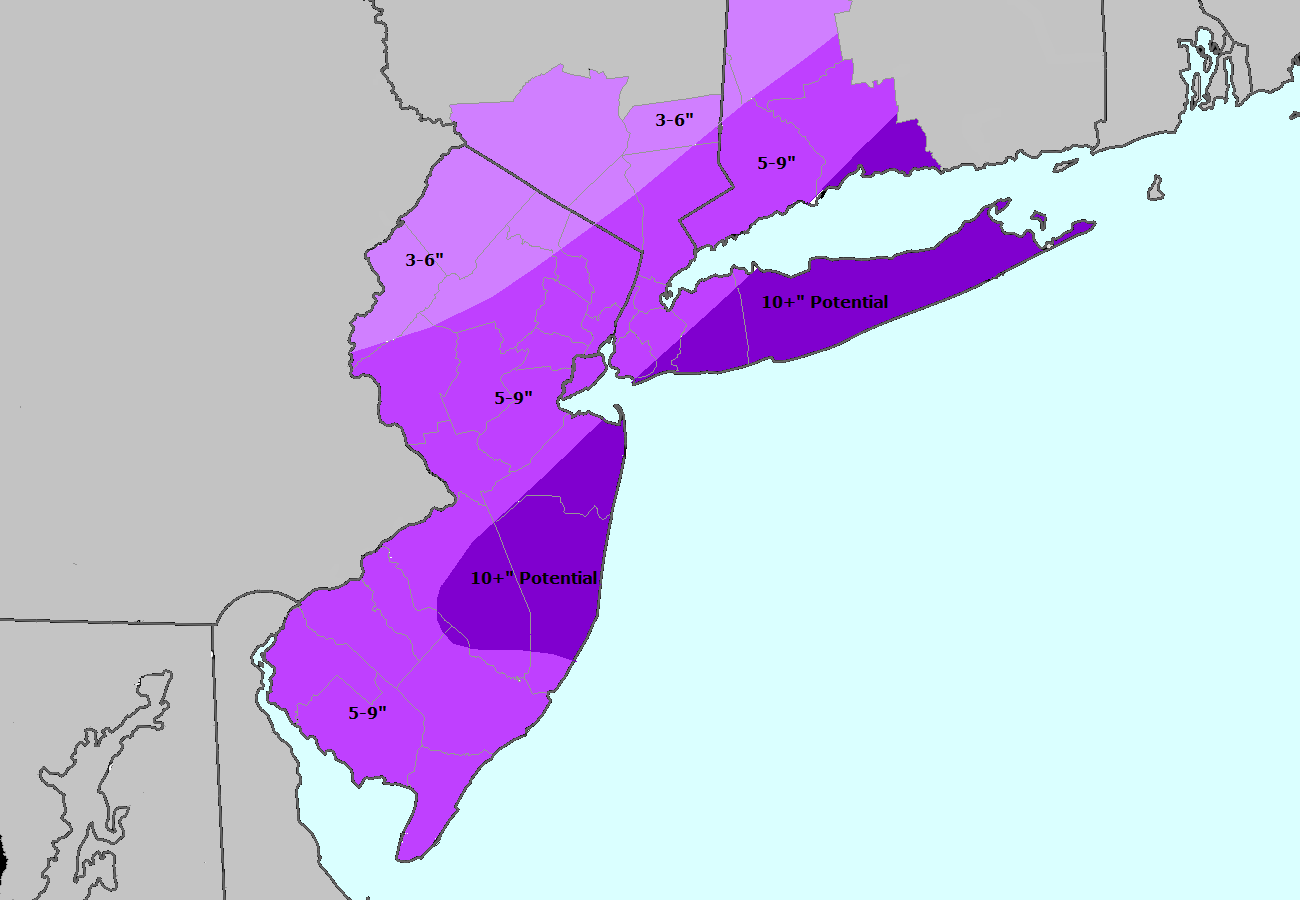
Storm Total Snowfall Forecast from Jan 20 2014

Storm Total Snowfall Forecast from Jan 20 2014

Read more

Light snow event becoming more likely for Tuesday and Tuesday night

In a pattern with a growing PNA ridge and a polar vortex sitting in SE Canada, many shortwaves travel down the downstream side of the ridge as they get squeezed between the ridge and the vortex and forced southward into the United States. Often times, computer models are not good at picking up the strength of these disturbances until we get closer to the event. This time around, that seems to be the case, as many computer models are slowly showing a strengthening system.

Let’s take a look at the GFS model:

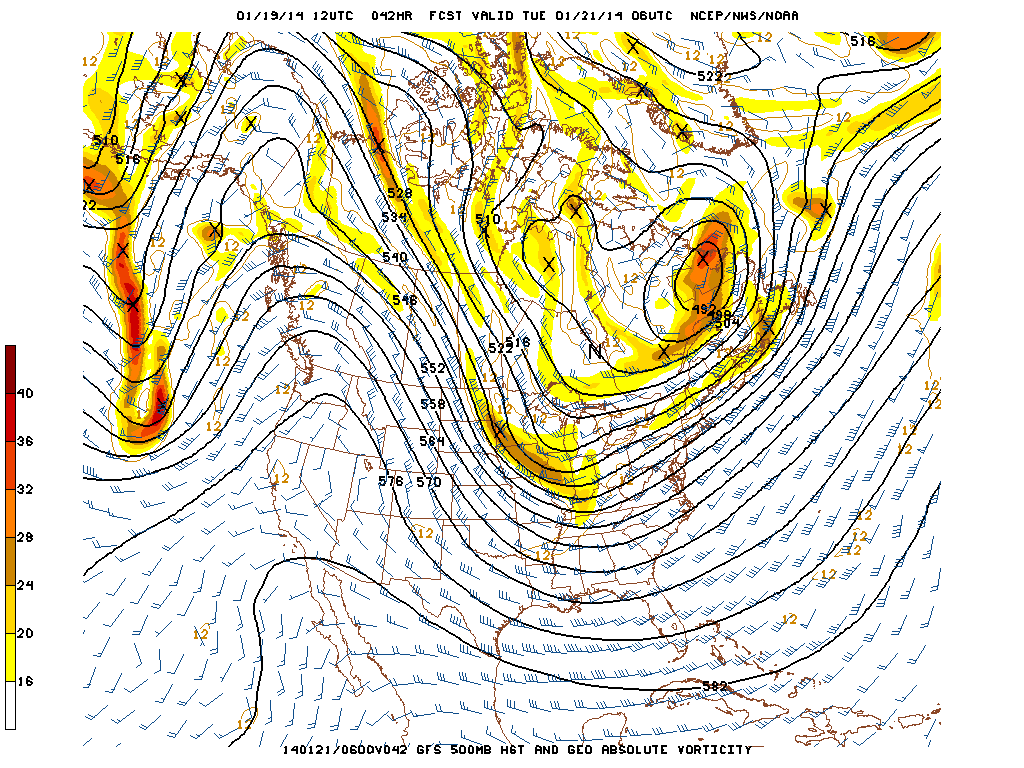
Today's 12z GFS model shows some favorable, and some unfavorable factors for snow along the East Coast come Tuesday. (NCEP)

Today’s 12z GFS model shows some favorable, and some unfavorable factors for snow along the East Coast come Tuesday. (NCEP)

Above is today’s 12z GFS 500mb and vorticity forecast, valid for Monday night. We see a strong PNA ridge to the west, providing some amplitude to the pattern and supporting a trough in the East. It also helps to displace a big chunk of the Polar Vortex in SE Canada, further providing cold and supplying the trough in the East. As a result, a shortwave disturbance can be seen in the Plains and Midwest, as it is getting squeezed between the ridge and vortex, and is forced to amplify somewhat. This all sounds good for a snow event so far, but there are still several caveats.

Read more

Dense fog takes over NYC, in photos

The story of the morning, undoubtedly, was the development of dense fog which initially began in only patchy areas of the suburbs early this morning. But by sunrise the fog had lowered and thickened, in addition to spreading throughout the area — including into lower manhattan. The sunrise and aforementioned development of dense, low fog created a terrific (and somewhat rare) picture opportunity as the tops of building and bridges stuck out of the low cloud deck.

Often misunderstood, fog forms as water vapor condenses into tiny water droplets in the lower levels of the atmosphere. Fog is not water vapor itself (Water vapor cannot be seen), nor is it “smog”, a variation of the word which is used to describe lowered visibilities that occur as a result of pollution. But this morning was a more classic case of low fog, more typical in London or San Francisco. The occurrence was a terrific photo opportunity for some of New York City’s best photographers (and webcams). We’ve included some of the best shots below.

The National Weather Service continues a Dense Fog Advisory through noon today, and also urges caution for those who are traveling. Visibilities near zero are possible in some areas, and the fog is expected to cause delays not only on the roads but also at the area airports. The fog is expected to lift by this afternoon, with a chance of scattered showers and high temperatures generally in the mid to upper 40’s.

NYC in fog this morning. Image via Earthcam, twitter.

NYC in fog this morning. Image via Earthcam, twitter.

Read more

Chances for cold and snow are significantly increasing to close the month

As we are currently in the midst of a January thaw, many people are looking ahead to find out when this thaw will end and when snow chances will begin. Some rumors had been spreading about a snowfall event on Wednesday/Thursday, and again around Saturday, but both of these threats appear unlikely to produce much in the way of snow. It is not until next week and beyond when we expect the pattern to become more favorable for snow.

Taking look at the threat, or lack-there-of, for Wednesday into Thursday, the main problems stem from a progressive pattern and one that is still in flux.

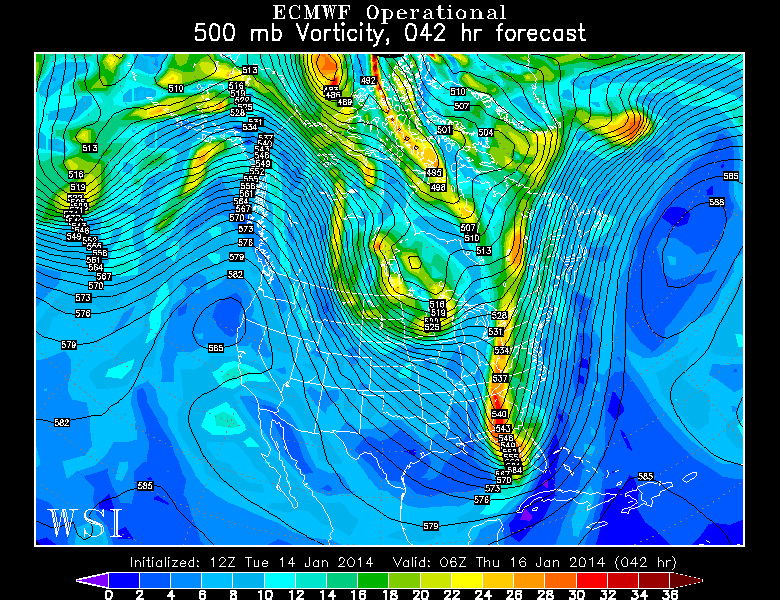
Today's 12z European model shows an unfavorable look for a snowstorm on Wednesday night with a very progressive pattern. Image credit goes to the WSI Model Lab.

Today’s 12z European model shows an unfavorable look for a snowstorm on Wednesday night with a very progressive pattern. Image credit goes to the WSI Model Lab.

The above image is the 500mb pattern and vorticity that is forecast by the European model for Wednesday night. There is a large area of vorticity in the southeast states, but notice how it is very elongated and not consolidated. Also notice how there is another disturbance right on its heels in the Northern Plains and Midwest. This leads to shortwave ridging in the Ohio and Tennessee Valley, which penetrates the trough and forces it to be very narrow and progressive. Also working against the potential for a bigger system is the lack Atlantic blocking to help the pattern to buckle. Instead, the entire country has a NW to SE axis to the heights, instead of a more meridional north to south flow. Thus, there is no room for the trough to grow and amplify. So this disturbance slides out to sea, and does not impact the area. There may not be any precipitation at all in the Wednesday night into Thursday time period.

The same general theme holds true for the threat on Saturday.

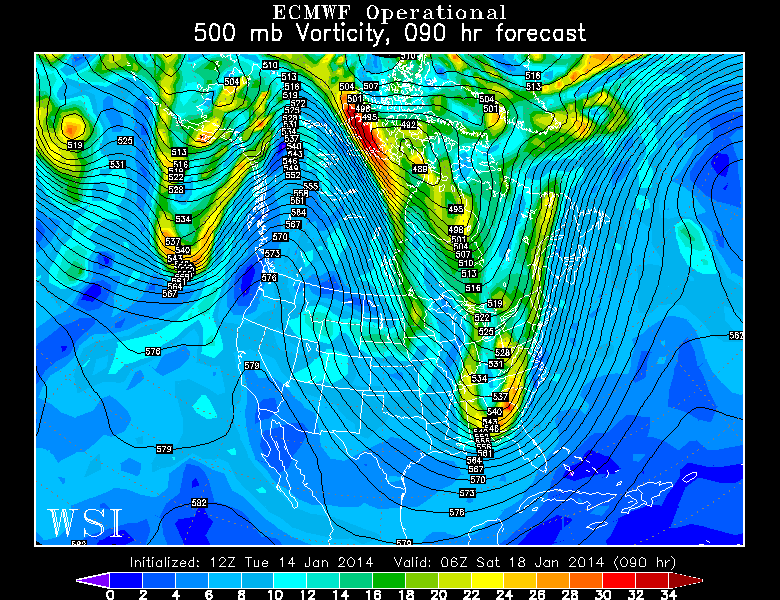
Today's 12z European Model valid for Friday night shows a slightly improved pattern for snowfall, but still not one that ultimately supports a snow event. Image credit goes to the WSI Model Lab.

Today’s 12z European Model valid for Friday night shows a slightly improved pattern for snowfall, but still not one that ultimately supports a snow event. Image credit goes to the WSI Model Lab.

Moving forward to Friday night, we can notice a few important features. First of all, there is still a strong PNA ridge out west, which promotes a tough in the East, and could theoretically favor snowstorm chances. That being said, the Atlantic and Arctic blocking are still nowhere to be found, so the trough cannot buckle. It’s still a progressive pattern — one with a NW to SE height orientation throughout most of the country, which leaves no room for major trough amplification. We have a trough in the East, but once again, the vorticity is relatively disjointed and the trough is being pushed eastward. There is another disturbance right on its heels again in Minnesota, which forces weak shortwave ridging in Illinois, further preventing major amplification of any trough. By the time the trough is finally able to amplify and consolidate, it is already out to sea, with maybe a few passing snow showers. Eastern New England could potentially receive a couple of inches of snow, however.

Read more