The relentless ridge and its effect on 99L

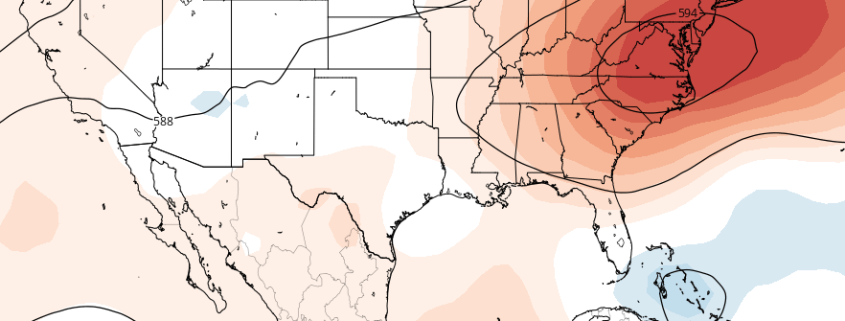
When meteorologists looked at the medium range forecasts on the first of August, one thing was clear, it appeared: Troughiness would become more likely east of the Mississippi River by the tail end of the month. Brought on by a change in tropical forcing and an overall adjustment in the hemispheric wave pattern, this seemed like a moderate to high confidence forecast. Those ideas were wrong.

Instead, poor modeling and a changed pattern evolution has led to an entirely different outcome: The mid level ridging, which has become a staple of the East Coast weather pattern since early July, will return. Forecast model guidance has altered the hemispheric pattern evolution to support a -PNA (Pacific North American oscillation), or troughiness on the West Coast of the United States. This will only feed the development of a strong ridge from the Southeast United States into the Mid Atlantic.
Read more

Central US cooldown on the way, marking larger pattern change

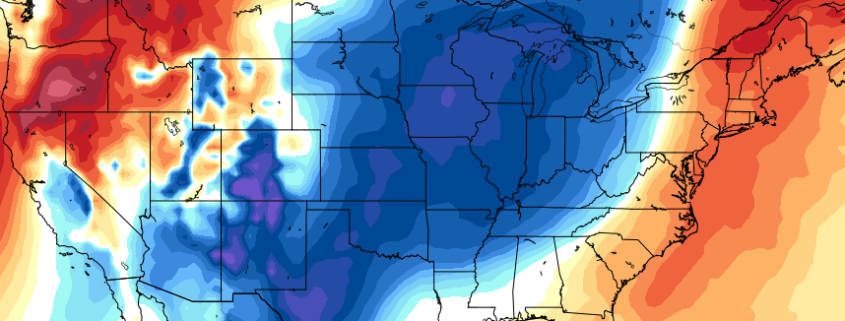
The establishment of a large ridge over the Central and Eastern United States has been well documented. Since July, multiple surges of ridging have kept above normal temperature anomalies rooted from the Plains states through the Mississippi and Ohio River Valleys to the Eastern Seaboard. With varying degrees of intensity and length, these above normal anomalies have slowly taken a hit, lessening in intensity from west to east. This will take on a larger meaning this weekend, as a large trough drives into the Plains and Mississippi River Valley, bringing a widespread area of below normal temperatures into the Central US amid a changing pattern.

While temperatures won’t necessarily be “cold” by sensible weather standards, they will be a few degrees below normal in many locations, and several degrees below normal in some. This is statistically significant for this time of year, especially considering overnight temperatures could fall into the 50’s in many locations. When one considers the change in temperature from the past week, the significance becomes apparent — a 30 degree temperature differential in some locations.

Read more

Oppressive combination of heat and humidity this weekend

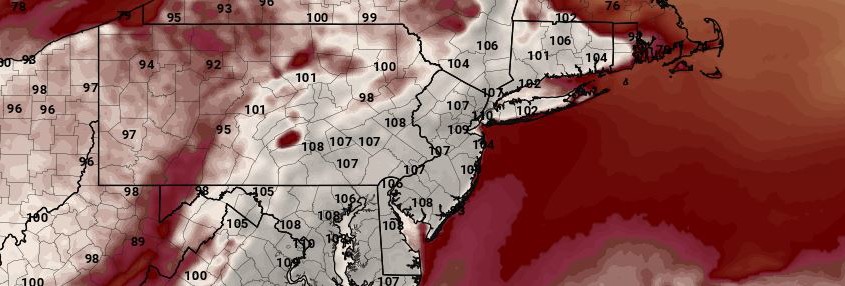
We have all experienced high temperatures before. In fact, most of us sat underneath a large ridge of high pressure earlier this summer which brought us temperatures in the upper 90’s. This weekend, however, temperatures will again surge into the upper 90’s — and combine with dew points in the middle to upper 70’s to bring Heat Index values near 110 F for periods of time each afternoon. This air, not surprisingly, will feel overly oppressive.

The culprit? The positioning of the aforementioned ridge in the mid levels of the atmosphere. Earlier in July, our area experienced a prolonged period of heat. But the ridge axis was centered in the Plains States. A clockwise flow around that ridge axis brought the heat into our area from the Northwest, meaning dew points were lower and the heat was of the “drier” variety. This time, the ridge is centered off the Southeast US Coast, with the clockwise flow around the high pressure bringing the heat into our area from the southwest.

Read more

La Nina Update: Moderate or Strong Event Unlikely This Year

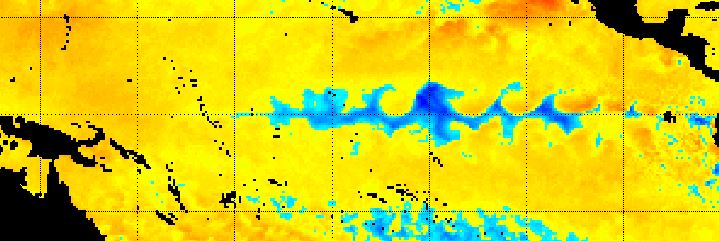
While we had been tracking heat and severe thunderstorms over the first few months of the summer, the atmosphere was still undergoing a major transition away from El Nino and towards a La Nina. This transition has already resulted in sensible weather changes across much of the country, with a huge heat ridge building in the Central US last month — typical of a La Nina. However, to the despair of some long range forecasters, certain aspects of the transition have not gone as smoothly, and more recent forecast models have trended weaker with the eventual strength of the La Nina over the next few months.

During last year’s El Nino conditions, the trade winds in the Equatorial Pacific were strongly weakened, allowing warm water near Australia to pool eastward. Those trade winds have strengthened over the last few months, which pushed that warm water back to the west, and allowed cooler water to upwell towards the surface. However, climatology favors trade winds remaining a persistent feature — in other words, we are supposed to have east-to-west trade winds blowing warm water towards Australia keeping cooler water near Peru. We can only have a La Nina when those trade winds are consistently stronger than average, and that has yet to be the case this year. For more background on what causes El Nino, La Nina, and the demise of an El Nino, refer to our article from late April.

Read more