Slightly Cooler Temperatures This Week, But The Same General Pattern Remains

We have had a stagnant warm and very humid weather pattern over the past couple of weeks, and that general theme is expected to continue. The chance for a scattered afternoon thunderstorm each day also exists, with perhaps a bit more of a widespread threat on Wednesday or Thursday, depending on the timing of an impulse traversing the northern tier of the country. Then, for next week, bigger heat moves back in with perhaps the hottest temperatures of the summer.
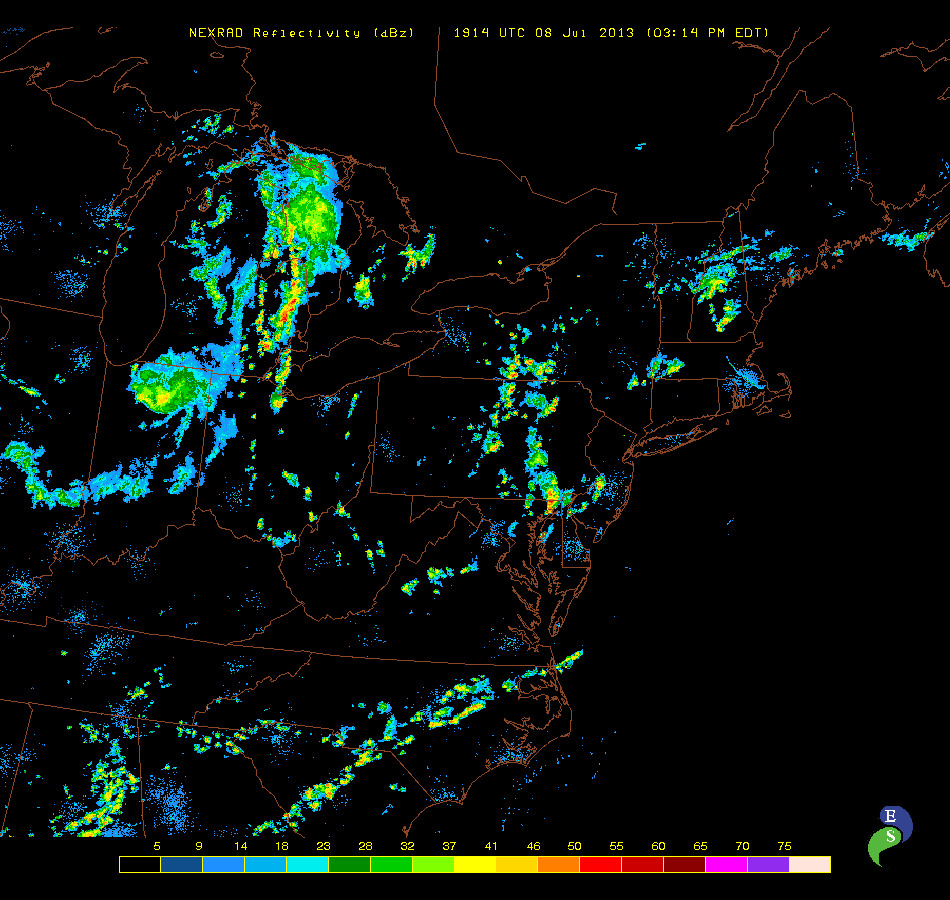
Radar as of 3:15 p.m. EDT shows storms developing to our west due to daytime heating. Some will try to move towards NYC later this afternoon, but they should not be severe and may weaken as they do so.

Radar as of 3:15 p.m. EDT (today) shows storms developing to our west due to daytime heating. Some will try to move towards NYC later this afternoon, but they should not be severe and may weaken as they do so.

Today, we still have a weak shortwave in our area, but it’s a bit weaker than it was yesterday, so our shear is a bit weaker for thunderstorms. Also, the Western Atlantic Ridge has pushed back to the east a bit, which helps to shunt some of the warmest temperatures back to the east. Thus, temperatures today and throughout the week should be several degrees cooler than they were yesterday. Still, though, warm and humid conditions will prevail — with temperatures in the mid to upper 80s throughout the week.

As the shortwave moves east and daytime heating continues, thunderstorm coverage should increase. Since shear and mid-level winds are low, the storms will mainly be pulse severe in nature and slow-moving. Steep low-level lapse rates and high moisture make strong winds and heavy rain the main threats. A widespread severe weather threat is not expected, however.

For Tuesday, the shortwave will move out to sea, with weak height rises behind it, thus limiting any lifting mechanisms for thunderstorms. We do not expect much in the way of thunderstorm activity for the local area tomorrow. A strong shortwave north of the Great Lakes will become embedded within a longwave trough, perhaps leading to an MCS spreading eastward into western PA. Perhaps E PA and W NJ could get indirectly affected by this towards the evening.
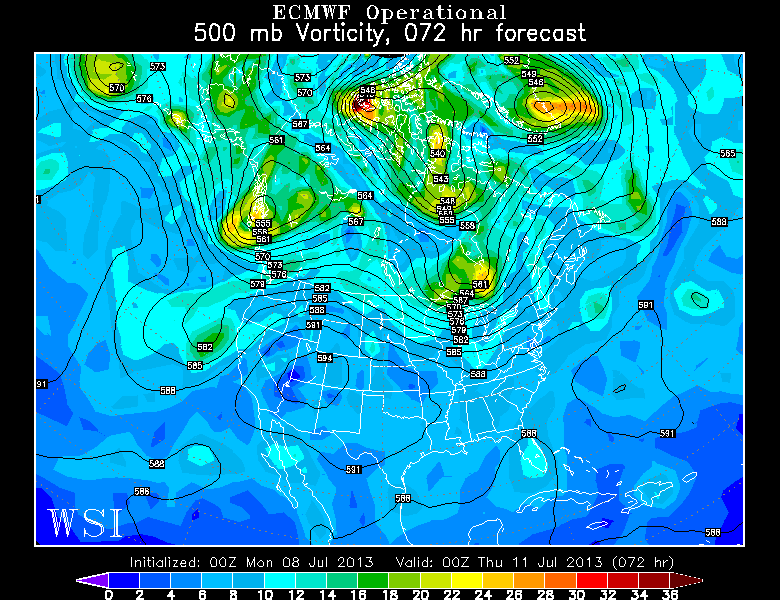
Storm system north of the Great Lakes, combined with the Western Atlantic Ridge will usher in quite warm and humid conditions for Wednesday, with the chance of afternoon thunderstorms. The best threat, as of now, will be north and west of NYC.

The European Operational Model shows a storm system north of the Great Lakes, combining with the Western Atlantic Ridge to usher in quite warm and humid conditions for Wednesday, with the chance of afternoon thunderstorms. The best threat, as of now, will be north and west of NYC. Image courtesy of the WSI Model Lab.

For Wednesday, that strong disturbance will continue to move eastward, creating stronger lifting mechanisms for thunderstorms over a more widespread area in the northeast. However, the disturbance appears to be a bit too far northwest during peak heating for the main thunderstorm threat to be over our area. The storm’s trailing warm front will probably be located in Northern New England, so the strongest mid-level flow and lifting mechanisms will be to our north. SE Upstate NY could be affected, however, and more isolated storms could press towards our area; especially considering that instability should be pretty high. Regardless, the probability of unsettled afternoon weather is a bit higher on Wednesday than the previous days. Out ahead of that disturbance, stronger SW flow will be ushered in from the Gulf, and the Western Atlantic Ridge temporarily pushes back to the west, creating the hottest and most humid day of the week. Temperatures should surge to the low 90s.

For Thursday and the weekend, there is a tad bit of uncertainty. The cold front to the south of the warm front will move eastward, but then get halted a bit due to the ridge to the east. The close proximity of the front will allow for more cloud cover and cooler temperatures than on Wednesday, with temperatures sliding back into the mid to upper 80s. The chance for rain and thunderstorms may be a bit higher on Thursday than on Wednesday, but severe potential seems low for now. The exact position of where the front gets held us will affect how much rain we see — once the front gets east of us, temperatures should cool off even more, humidity would drop a bit, and the rain threat could lower significantly for Friday and the weekend.
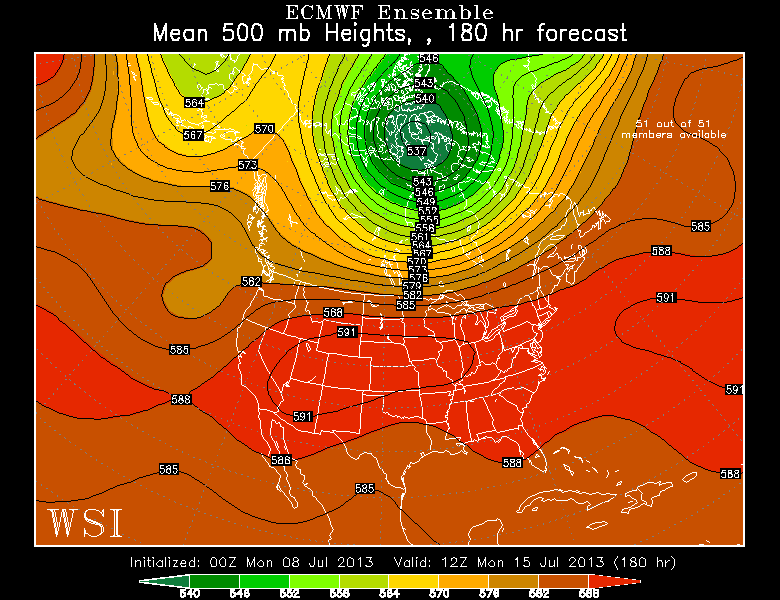
European Ensemble Mean data shows a strong heat dome building into the Midwest, along with the strong Western Atlantic Ridge building back in. This should help to create another heatwave for next week. Image courtesy of the WSI Model Lab.

European Ensemble Mean data shows a strong heat dome building into the Midwest, along with the strong Western Atlantic Ridge building back in. This should help to create another heatwave for next week. Image courtesy of the WSI Model Lab.

For next week, we may have to watch for more widespread heat to work its way back into the area again, similar to last week and this past weekend — only perhaps a tad warmer. Lots of medium range model guidance is showing the Western Atlantic Ridge building back even further west, which would help to usher in more heat and humidity from the Gulf. Additionally, the heat dome that previously gave the southwest record heat will become more expansive and shift eastward towards the Midwest. This will provide strong heat to an area that is often our source region for the biggest heat. If more westerly flow can persist, the expansive heat in the Midwest would push its way eastward, and get downsloped through the Appalachians and into our area. The downsloping, westerly winds from a very hot source region is what often creates our biggest heatwaves.

If the Western Atlantic Ridge can combine with the Midwest heat dome, a week-long heatwave could ensue. If not, then perhaps last week and last weekend would repeat itself. There may actually be too much humidity from the Western Atlantic Ridge for any 100 degree readings, since humid air is harder to heat than drier air. But mid 90s for a few days next week certainly appear to be in the cards.
 

Medium Range Snippet – Potential Severe Weather on May 22nd?

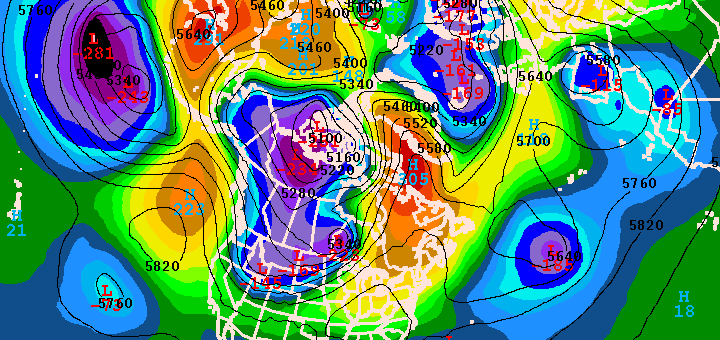
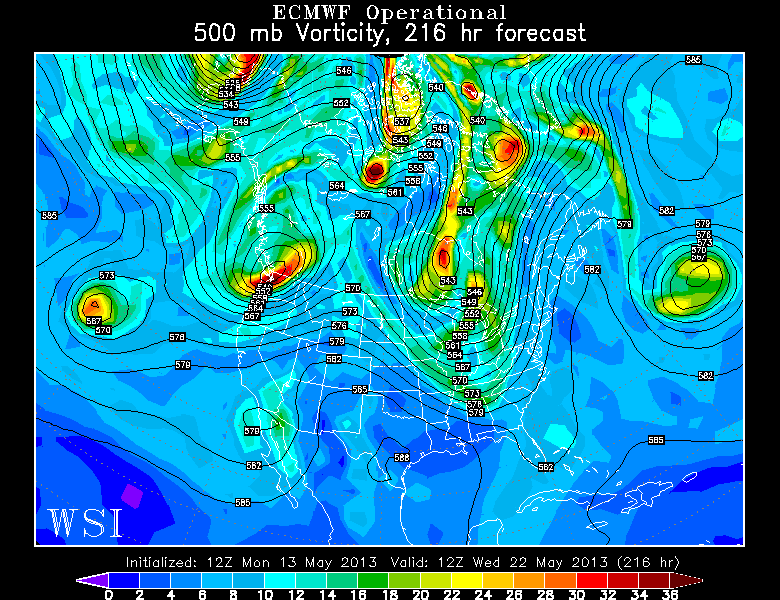
The 12z Euro from May 13 shows a potent trough in the Eastern US, potentially favoring severe weather for the Mid Atlantic and Northeast.

The 12z Euro from May 13 shows a potent trough in the Eastern US, potentially favoring severe weather for the Mid Atlantic and Northeast on May 21 or 22.


I’m sure a lot of you have been wondering where all of the tornadoes been in tornado alley this year. Additionally, some of you are probably wondering when the first widespread severe weather outbreak will occur in the Northeast. I’ll try to give a quick discussion on that in this post.

The problem for tornadoes in tornado alley this year (the Southern Great Plains) is that there has been so much blocking and a slower Pacific Pattern, allowing disturbances to slow down as they traverse the country and become monster cutoff lows. Cutoff lows can often be good for severe weather, but when they are too large and too far east, they cut off the moisture and heat supply from the Gulf of Mexico. This is why there has been record breaking cold in the Plains, and also partially why our weather has been pretty chilly thus far.

However, this is expected to change in the next few days. The MJO (Madden Julian Oscillation) is expected to change into phases 4 and 5, and then move into “the circle of death”, where it will stop having an effect. This leads to a much more active Pacific Jet pattern, a bit more troughing on the west coast, and an attempt to raise the heights on the east coast (from moving into phases 4 and 5). The MJO going into the circle of death prevents the MJO from moving into the phases that do not favor troughing and an active Pacific Jet. This prevents the phase 4 and 5 pattern from changing.

This all will lead to some moisture return and heat from the Gulf of Mexico reaching the Plains and our area as well. The active Pacific Jet will lead to storm systems of decent strength, and combine that with good heat and moisture return from the Gulf, that “clash” can lead to severe storms.

Starting on Friday and through the weekend, storms should start to fire — perhaps significantly so — in the High Plains regions, and the severe storm threats will gradually shift eastward as the trough/storm system moves east. By around the May 21 or May 22 time period, the base of the trough may very well be over the southern Ohio Valley. If the trough is potent enough, it will lead to strong mid and upper level winds in our area, along with low level veering in the boundary layer from the return flow from a developing surface low.

I don’t want to sound a “hype” alarm, as many things can still change. But things are looking pretty good for a decent round of storms for the Plains during the upcoming weekend, and perhaps a decent round of storms for the Mid Atlantic and Northeast on May 21 or May 22. It’s not as easy to get severe weather in our area as it is in the Plains, but this should still be something to keep in mind as we move forward.

Potential for Late Season Freeze

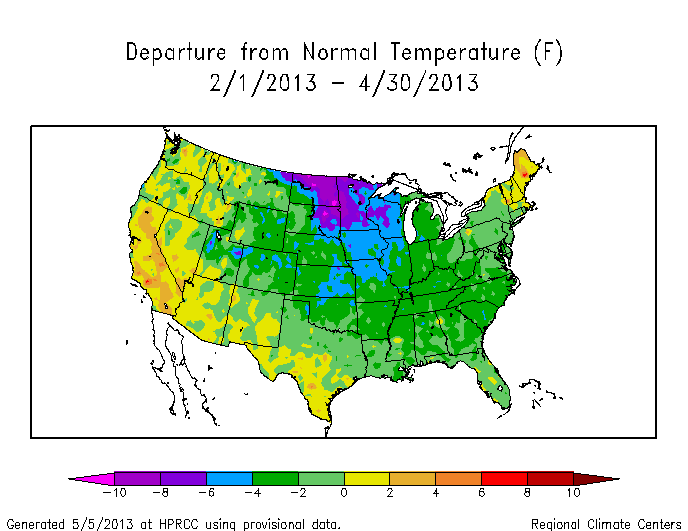
One of the coldest springs in recent history nationwide continues to roll forward with the potential for one more shot of winter across the Mid-west and Northeast. Since February 1st, we have seen a dramatic reversal in temperature anomalies from the blowtorch Dec-Jan period to the very cold Feb-Mar-April of 2013. The only mild areas have been northeastern New England and the SW US – all other locations have been feeling the chill. The epicenter of this cold has been the Mid-west and northern Plains, where many stations experienced over a 20 degree decrease in mean temperature from March 2012 to March 2013:

Last3mTDeptUS

[column size=”one-fourth”]

Chicago  IL:    -27.7º

2012: 64.0º

2013: 36.3º

[/column]
[column size=”one-fourth”]

Des Moines IA: -26.0º

2012: 64.4º

2013: 38.4º

[/column]
[column size=”one-fourth”]

Indianapolis IN: -25.3º

2012: 66.5º

2013: 41.2º

[/column]
[column size=”one-fourth” last=”true”]

La Crosse WI: -27.5º

2012: 59.4º

2013: 31.9º

[/column]


[column size=”one-fourth”]

Marquette MI: -24.3º

2012: 50.6º

2013: 26.3º

[/column]
[column size=”one-fourth”]

Milwaukee WI: -26.3º

2012: 59.1º

2013: 32.8º

[/column]
[column size=”one-fourth”]

Minneapolis MN: -25.2º

2012: 56.3º

2013: 31.1º

[/column]
[column size=”one-fourth” last=”true”]

St. Louis MO: -22.1º

2012: 70.4º

2013: 48.3º

[/column]


The month of May began with similar magnitude of cold in the same areas that have been targeted over recent months. Brutal, recording breaking cold encompassed the Plains, with the historic event of snow flakes flying as far south as Arkansas. The coastal Northeast has been near normal with a northeasterly flow off the Atlantic, but surface high pressure made the airmass a beautiful, dry, sunny one for us. The interior Northeast and OH Valley have been much warmer the past week, though that will change for a time next week.

Read more

Does blocking in May hint at summer weather?

Seasonal forecasting is one of the more tedious and intricate tasks for meteorologists. Not only is it difficult to predict by nature (no pun intended) — but forecast model accuracy skill is greatly reduced at that range. Often, meteorologists find themselves looking back towards past events, and analogs, for help with predicting the months ahead. In our case, interest was piqued when we noted what seemed to be higher than normal frequency of high latitude blocking this year. Hurricane Sandy, the nor’easter which immediately followed, and many events this winter featured patterns that were driven by blocking patterns over Canada, Greenland, and the higher latitudes towards the pole. The blocking pattern was not overly anomalous at least on a per-year basis, but it certainly seemed to be more frequent than the calendar year which preceded it.

As we look forward to May, forecast models are in agreement on the continuation of higher than normal height anomalies at 500mb over Central and Eastern Canada as well as farther north towards Greenland. The continuation of blocking in the higher latitudes, relative to our location, can offer some interesting insights into the summer temperature forecast as we move forward. Is there a common theme amongst the historically warm and historically cool summers in the NYC Area — and can we relate it to Springtime blocking patterns? The answer, may surprisingly to some, is yes.  For the sake of example, take the summer of 2009 and the summer of 2010. Both of these years featured wildly different patterns, with 2009 remaining very cool throughout the summer while 2010 was warm. In 2009, there was very little blocking observed from March through May. 2010, on the other hand, featured periodic blocking in the high latitudes from February through May. Interested yet?

Read more